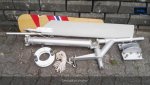
Decent wind vane for classic 35ft sailboat

With my lift up version it would be dead easy to make an emergency rudder to fit the mounting bracket in place of the vane so one might consider that a big plus. The bracket is fairly strong. If I was going offshore I would almost certainly make one.

I too have a lift up Aries............great bit of kit. On my previous boat I had a Sea-Feather: also a great bit of kit but not as massively built as the Aries.

I'm interested in your suggestion regarding the use of the Aries bracket as the mounting for an emergency rudder. (not that I have ever heard of Rivals suffering rudder failure) Do you have any drawings or sketches of how you would create this emergency rudder?
 
Nobody has mentioned the Aries . . . Now Denmark I believe.

Not Denmark anymore. It's now a Dutch guy seeing if he can make a go of it.

But the Danish guy did make one modification that was well worth while under his ownership - his pivot for the servo paddle is well engineered and he claims it fits all English made and subsequent models.

When buying old secondhand self steering gear, do bear in mind that many have been subject to continuous development. The Monitors all have a serial number on them and Scanmar will tell you it's age and specification.

Likewise with Aries, Helen Franklin is still around in Falmouth with intimate knowledge of the English made ones and does have (almost) all the spares. But be careful - there were a lot of mixed metals on the Aries and I've had a few which have proved to be impossible to (economically) repair. Remember the hay-day for windvave steering gear was quite a while ago and some of these gears can be nearly 50 years old with a lot of miles under their belts. Conversely some gears have been bought by dreamers and have had very little use. Caveat Emptor!
 
I too have a lift up Aries............great bit of kit. On my previous boat I had a Sea-Feather: also a great bit of kit but not as massively built as the Aries.

I'm interested in your suggestion regarding the use of the Aries bracket as the mounting for an emergency rudder. (not that I have ever heard of Rivals suffering rudder failure) Do you have any drawings or sketches of how you would create this emergency rudder?

Not yet because i have not had reason to apply my mind to it properly. However. it would slot onto the 2 stubs at the top & i would have some sort of brace on the lower part that would clamp around a tube which would extend up. Then a long tiller to steer by.
The brace would probably be a half collar such that the fixed half would be in front of the steering oar. With a removable bit to go behind it to form the bottom bearing. Then when the main rudder broke an emergency clamp would go over the oar & I would try to steer a bit for a while until conditions allowed me to remove the wind vane complete & fit a proper emergency rudder stock
All needs thinking but only a small amount of metalwork.
 
Here's my platform. Not so sure this will be rigid enough though
View attachment 63995

Tricky.
Also the spigot attachment needs to be just below deck level, which is quite high.

It ought to be possible to fabricate something locally, in 25mm tube that looks appropriate to your very nice platform, adds rigidity (with an additional fixing to the transom) and provides a suitable mounting height. It can be set back quite a way from the front (back) edge of the platform as you can see in the sizes here:

http://www.windvane.co.uk/Mounting.aspx

I guess the Windpilot is similar.

Leaving the outside strip of teak still showing it may be possible to put something together that looks a bit like a handhold and leaves the platform usable, certainly when you have the gear dismounted.

The Windpilot gear looks like the work on an engineer you need the aid of a designer, I think :-)
 
I'll just chip in to mention the Hebridean wind vane. A friend of mine used one on his Co32 for a trip to Faeroe and was extremely pleased with it.
It is only available as a kit, so you have to do some woodwork to complete it (you could use another material but the designer found wood was perfectly good enough). A big advantage is cost, at only £600 for the kit. It used to be available even cheaper as a set of plans but that left you with a lot of fiddly metalwork to do, so the designer has stopped supplying it in that form.

The unique feature of the Hebridean is that there is no hinge between the air and water elements- they are simply two ends of a rigid pole, which pivots on its mounting. I thought this would induce all sorts of problems with the wind vane getting funny apparent wind angles as it was swept back and forth by the water paddle, but it seems to be an unfounded concern. I actually met the designer and asked him about that, he was quite confident that it was not an issue and explained why, although I cannot remember his reasons now!
A big advantage of this design is that it is very easy to mount and demount- my mate who has one lifts it off its bracket with one hand and sticks it down the side deck, so it is safe from harm when not in use.

Makes my Navik look quite vulnerable- I live in fear of it getting bashed and written off.
 
I recently installed a Seafeather (UK made) on my Rival32 (also classic?).
Seems to perform exceptionally well, though this is only my first season with it.
 
The real test for a wind vane is not upwind as nearly all will do this easily. What you need is one which will deal with a big beam sea coming in at 45 degrees off the stern quarter in a fair breeze. This is usually a killer to an electric autopilot & it needs a powerful vane. If you use a Hydrovane you need a yacht that will hold a fairly good course in these conditions without much rudder adjustment on the main rudder when set so that the hydrovane rudder only has to adjust a bit.
I know that my direction-ally unstable fin keel yacht ( needs a lot of course correction on any point of sailing) the boat will zig zag all over the place & totally overpower my Raymarine AV100 autopilot,
The same happens with my Aeries but it has much more power & will get the boat back on course whereas the AV100 will just cut out. I would go for a servo type system. A hydrovane would not work at all as I could not set the main rudder to a single setting
When i sailed round UK I noticed that many of the serious Dutch & German yachts used the windpilot systems & all spoke well of them
 
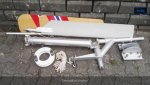
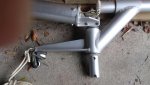
A wind vane called "Servopilot" (according to seller) has come up for sale at a low price. I can't find anything is this brand, if the name is correct.

IMG_2926.jpg

Any ideas of what it's worth, or If any good?
 
Update on my Seafeather:
Very good from a reach to as close to the wind as I get.
Quote good downwind, except when there's hardly any wind. Recently with a spinnaker only just filling, and almost no apparent wind, it struggled. But then I suspect that any type of windvane would struggle when there's no controlling reference force (wind).
I'm so far very pleased with it.
 
A wind vane called "Servopilot" (according to seller) has come up for sale at a low price. I can't find anything is this brand, if the name is correct.

View attachment 64390

Any ideas of what it's worth, or If any good?

It reminds me of the Windpilot but then most pendulum autopilots work on the same principle. It could well be a neat home-made example - if I am seeing correctly - using welded construction instead of castings. If such is the case I personally would have preferred stainless tubes instead of aluminium alloy.
All I can say is that if it were available to me here (Malta) I would be very interested in examining it more closely for use on my own boat (Centurion 32).
 
It reminds me of the Windpilot but then most pendulum autopilots work on the same principle. It could well be a neat home-made example - if I am seeing correctly - using welded construction instead of castings. If such is the case I personally would have preferred stainless tubes instead of aluminium alloy.
All I can say is that if it were available to me here (Malta) I would be very interested in examining it more closely for use on my own boat (Centurion 32).


It MAY have been produced in Norway, actually. Again according to seller...
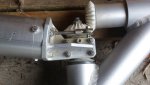
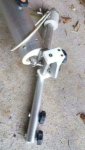
I've asked for some close ups of the gear.
 
Thanks for the new photos.
I'm not too sure about the reduction of the bevel gears; usually the ratio is more likely to be 1:2
Check what arrangement there is for 'automatic' disengagement of the paddle from the stock in the event of striking something in the water.
Check also for signs of splitting in the nylon parts where there are screws, pins, etc., going through them as well as for corrosion near the stainless hardware.
I still say that it is probably home-made; not in itself a bad thing because whoever built it was a craftsman and knew what he was doing and how to do it economically.
Having said all that, I would still be interested in it for use on my boat if it were available... at an attractive price. Pity that it is 3,500 kilometres away!

Good Luck.
 
. A hydrovane would not work at all as I could not set the main rudder to a single setting

The Hydrovane I had on a previous fin keeled mid 80's AWB worked brilliantly upwind, where you don't really need one and down wind it was very good. It only struggled beam reaching, as did I and the Autohelm- unless well reefed down. Sometimes it would get chucked off course and you had to get her back on track.

But off a beam reach we didn't have any issues.

I guess what boat it's fitted to has a lot to do with how well a wind Vane will cope. Personally I dislike all the ropes, pulleys, faff and chafe that goes with some wind Vane systems, especially on a wheel steered boat.
 
>A hydrovane would not work at all as I could not set the main rudder to a single setting

Assuming you can lock the steering with the rudder centred it's the only rudder position you need after you have balanced the sails so there is no lee or weather helm. Having done that it will steer straight in any direction and any wind or sea state including big seas from any direction as we found in a gale gusting 50 knots over Bicscay. The only bit of string on a Hydrovane is a loop on a pulley at the cockpit end which you use to change direction or you can go to the vane and turn the wheel on it where the string would go, not a good idea in heavy weather.
 
>A hydrovane would not work at all as I could not set the main rudder to a single setting

Assuming you can lock the steering with the rudder centred it's the only rudder position you need after you have balanced the sails so there is no lee or weather helm. Having done that it will steer straight in any direction and any wind or sea state including big seas from any direction as we found in a gale gusting 50 knots over Bicscay. The only bit of string on a Hydrovane is a loop on a pulley at the cockpit end which you use to change direction or you can go to the vane and turn the wheel on it where the string would go, not a good idea in heavy weather.

Reviving the thread, I am playing with the idea of adding a vane to our Discus (33'). Obvious question how to connect the main rudder properly? Also I wonder if our boat is small for the Hydrovane and I should look elsewhere? Their website shows 40'+ boats mostly.
 
Reviving the thread, I am playing with the idea of adding a vane to our Discus (33'). Obvious question how to connect the main rudder properly? Also I wonder if our boat is small for the Hydrovane and I should look elsewhere? Their website shows 40'+ boats mostly.
I spoke to Hydrovane at the Southampton Boat Show last year about fitting one to my 10m boat and it is not an issue.

The evidence of the performance of different self steering systems from the Golden Globe Race last year is interesting.
 
Top