DC Engine Wiring

Fire99

Well-Known Member
Joined
11 Oct 2001
Messages
3,918
Location
Bangor NI
Visit site
Hi all,

I've started to wade into my boat's DC electrics as there appear (from old paperwork I've found) to be some bad electrical decisions made, including bridging the house and starter batteries together, due to a lazy starter motor on one of the engines.
Whilst investigating I've found that one of the 240v charger (Sterling Pro Charge Ultra) outputs runs from the charger directly to the supply side of the DC Engine Isolator switch. Which means if the shore power is connected and the charger breaker is on, the engines are receiving 12v from both the batteries and the charger which my rusty mind would say is an odd decision.

Can anyone throw any light on why in normal practice anyone would do this? Many thanks..
 
Last edited:
Hi all,

I've started to wade into my boat's DC electrics as there appear (from old paperwork I've found) to be some bad electrical decisions made, including bridging the house and starter batteries together, due to a lazy starter motor on one of the engines.
Whilst investigating I've found that one of the 240v charger (Sterling Pro Charge Ultra) outputs runs from the charger directly to the supply side of the DC Engine Isolator switch. Which means if the shore power is connected and the charger breaker is on, the engines are receiving 12v from both the batteries and the charger which my rusty mind would say is an odd decision.

Can anyone throw any light on why in normal practice anyone would do this? Many thanks..
That's how my boat was wired at the factory and I don't see an issue with it.

12 volts is 12 volts isn't it (so doesn't matter if it's coming from the batteries, the charger or the alternator? Or am I missing something?
 
Mine is wired the same way so the charger can top up the batteries whilst the isolator switches are all off.

The fat 12v cable going from starter battery isolator to the engine would usually just be attached to the starter motor terminal which sits there doing nothing until the starter solenoid is activated via the start button or key.
 
Hi all,

I've started to wade into my boat's DC electrics as there appear (from old paperwork I've found) to be some bad electrical decisions made, including bridging the house and starter batteries together, due to a lazy starter motor on one of the engines.
Whilst investigating I've found that one of the 240v charger (Sterling Pro Charge Ultra) outputs runs from the charger directly to the supply side of the DC Engine Isolator switch. Which means if the shore power is connected and the charger breaker is on, the engines are receiving 12v from both the batteries and the charger which my rusty mind would say is an odd decision.

Can anyone throw any light on why in normal practice anyone would do this? Many thanks..
Thats how it should be.
 
Thanks guys.. That's useful know. I've now separated the house batteries from the starter battery so that side is back to how Trader intended, with the bridging relay now working correctly to bridge house/starter batteries when required.
Interesting about having a charger supply to the supply side of the Engine isolator. I've edited the post as my thoughts were wrong.. My thoughts have always been that chargers are not designed for the draw put upon them from cranking amps, so excuse my rustiness here but I still don't see why a battery charger would be connected on the supply side directly to the starter motor.

Out of interest, those with larger marine diesels (Cat 3126 / 3208 or equivalent size), what CCA are you running for your starter battery? I've done some research and my 225ah / 1200CA seems sufficient but I have read some people running significantly more.. What CCA's are you running for starting?
 
Last edited:
One other quick question If I may. There is some 'aftermarket' wiring so I'm checking normal practice here. The supply to the starter motors run through a DC Isolator switch in the fuse panel which is working correctly.
However, the other 135amp supply to each engine is currently permanently live, running from direct non-switched connections to the batteries. This seems a strange setup and potential fire risk in the event of a circuit failure, but I'll stand corrected if there is a reason for this? Any electrical bods throw some insight please?
 
One other quick question If I may. There is some 'aftermarket' wiring so I'm checking normal practice here. The supply to the starter motors run through a DC Isolator switch in the fuse panel which is working correctly.
Normal practice is to run the main battery cables to an isolator switch, then to the starter motor.
However, the other 135amp supply to each engine is currently permanently live, running from direct non-switched connections to the batteries. This seems a strange setup and potential fire risk in the event of a circuit failure, but I'll stand corrected if there is a reason for this? Any electrical bods throw some insight please?
Not sure what you mean by "other 135amp supply", where is this connected to ?
 
Hi all,

I've started to wade into my boat's DC electrics as there appear (from old paperwork I've found) to be some bad electrical decisions made, including bridging the house and starter batteries together, due to a lazy starter motor on one of the engines.
Whilst investigating I've found that one of the 240v charger (Sterling Pro Charge Ultra) outputs runs from the charger directly to the supply side of the DC Engine Isolator switch. Which means if the shore power is connected and the charger breaker is on, the engines are receiving 12v from both the batteries and the charger which my rusty mind would say is an odd decision.

Can anyone throw any light on why in normal practice anyone would do this? Many thanks..
Your description above isn't clear.

The "supply" terminal of the switch is connected to the battery. If you have the switch turned off the batteries get charged but no power goes to the engines. This is correct and the domestic batteries should be wired the same.

The "load" terminal is connected to the starter motors (or services in the case of the domestic isolator). The battery charger should not be connected to this terminal, or circuits are live if the shore charger is on and the isolators are off.
 
To add to Paul's comment, after the isolator switch, you don't need a fuse (overload protection) if the main power feed cable from the battery through an isolation switch to an engine cranking motor, is sheathed or supported to protect against abrasion and contact with conductive surfaces.

The guidance goes on to say "each battery or battery bank should be capable of being disconnected from the DC system circuits by a readily accessible manually operated on/off isolation switch immediately adjacent to the battery compartment".

Source - IET On Board Guide - Electrical Safety for Small Craft
 
Normal practice is to run the main battery cables to an isolator switch, then to the starter motor.

Not sure what you mean by "other 135amp supply", where is this connected to ?
Normal practice is to run the main battery cables to an isolator switch, then to the starter motor.

Not sure what you mean by "other 135amp supply", where is this connected to ?
Hi Paul,

Apols if I'm not being too clear here. (It makes sense in my own head..lol)

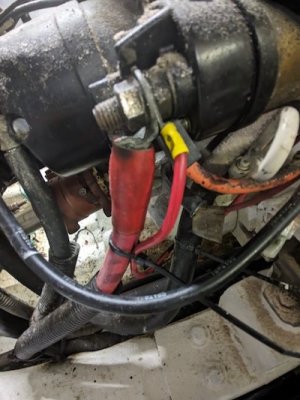
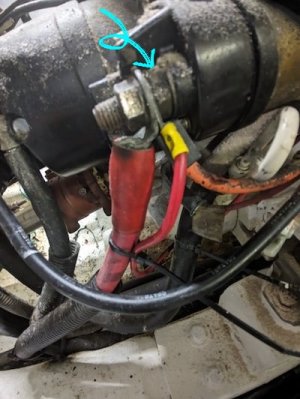
I've attached two pics. One is a live supply to the starter solenoid. This very large(obviously) cable is isolatable via the DC Isolator switch.

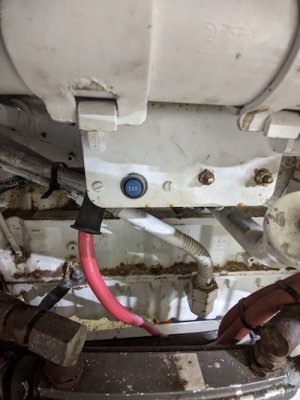
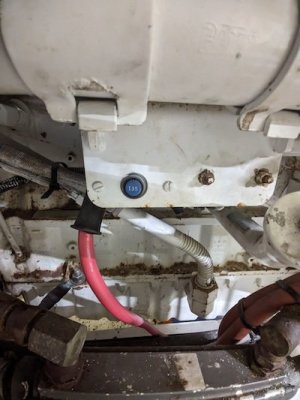
The 2nd pic is a live supply to a 135amp circuit breaker on the side of then engine. This supply is currently un-switched and directly fed from the batteries with no ability to switch / isolate.
 

Attachments

  • PXL_20250927_143238020.jpg
    PXL_20250927_143238020.jpg
    48.6 KB · Views: 14
  • PXL_20250927_143246593.jpg
    PXL_20250927_143246593.jpg
    43.1 KB · Views: 14
To add to Paul's comment, after the isolator switch, you don't need a fuse (overload protection) if the main power feed cable from the battery through an isolation switch to an engine cranking motor, is sheathed or supported to protect against abrasion and contact with conductive surfaces.

The guidance goes on to say "each battery or battery bank should be capable of being disconnected from the DC system circuits by a readily accessible manually operated on/off isolation switch immediately adjacent to the battery compartment".

Source - IET On Board Guide - Electrical Safety for Small Craft

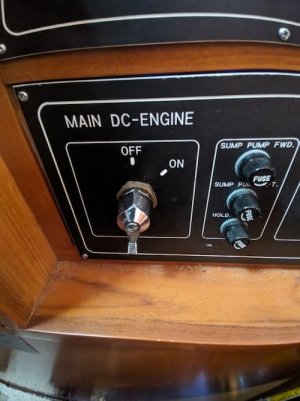
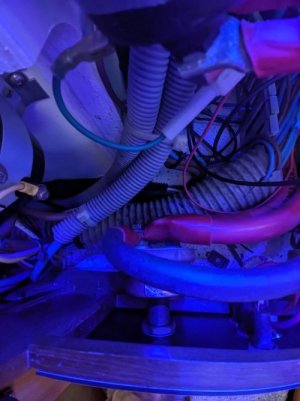
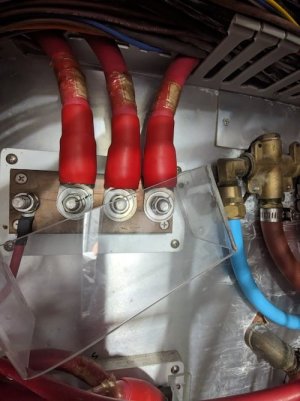
Thanks for this. I'll try and clarify and add a couple of pics. On the back of the DC Engine Isolator switch you can see on one terminal one very large red supply cable coming from the starter battery. The black cable with a red band around the end (which you can just see the band) is coming directly from the battery charger. So when the Main DC Engine swich is turned on, the starter solenoids and engine displays on the same circuit are receiving power directly from the battery charger as well as from the battery bank, which seems strange to me.
 

Attachments

  • PXL_20250927_144358722.jpg
    PXL_20250927_144358722.jpg
    58.3 KB · Views: 10
  • PXL_20250927_144732677.jpg
    PXL_20250927_144732677.jpg
    52.6 KB · Views: 7
Thanks for this. I'll try and clarify and add a couple of pics. On the back of the DC Engine Isolator switch you can see on one terminal one very large red supply cable coming from the starter battery. The black cable with a red band around the end (which you can just see the band) is coming directly from the battery charger. So when the Main DC Engine swich is turned on, the starter solenoids and engine displays on the same circuit are receiving power directly from the battery charger as well as from the battery bank, which seems strange to me.
Actually all the power is coming from the battery charger. It will have a higher voltage than the battery.

If you crank the engine, the battery will also supplement it because the charger cannot provide that much power.

There is nothing wrong with this configuration, it’s normal.
 
Actually all the power is coming from the battery charger. It will have a higher voltage than the battery.

If you crank the engine, the battery will also supplement it because the charger cannot provide that much power.

There is nothing wrong with this configuration, it’s normal.
Try again.. I need to proof read better. Many thanks for that. I was under the impression battery chargers didn't like that kind of demand being put upon them but I'll happily stand corrected on this one. One issue to tick off the list.. Thanks..
 
Try again.. I need to proof read better. Many thanks for that. I was under the impression battery chargers didn't like that kind of demand being put upon them but I'll happily stand corrected on this one. One issue to tick off the list.. Thanks..
The battery charger is not normally used for starting but if it's wired in the circuit and powered, it will just be current limited when the high current/very low impedance starter motor is activated.

The starter battery will be doing most of the work and once the engine is running, the alternator will take over charging the batteries via relays, diodes or a zero volt switch.
 
The battery charger is not normally used for starting but if it's wired in the circuit and powered, it will just be current limited when the high current/very low impedance starter motor is activated.

The starter battery will be doing most of the work and once the engine is running, the alternator will take over charging the batteries via relays, diodes or a zero volt switch.
That's great.. Thanks.. Really clears that up.

Any ideas on the post above which shows the two live feeds to the engine, the solenoid heavy cable being isolated via the Main DC Engine Switch but a second 135amp (slightly smaller gauge cable) supply which at present is coming directly from the batteries with no isolation / switching in between?
 
That's great.. Thanks.. Really clears that up.

Any ideas on the post above which shows the two live feeds to the engine, the solenoid heavy cable being isolated via the Main DC Engine Switch but a second 135amp (slightly smaller gauge cable) supply which at present is coming directly from the batteries with no isolation / switching in between?
It's impossible to say just looking at the photos. It might be worth tracing all the wires and doing a sketch/circuit diagram.

It looks "modified" by the fact the 12v terminal has crimps bolted on either side of the first nut. That wasn't a factory fit.

PXL_20250927_143238020.jpg
 
It's impossible to say just looking at the photos. It might be worth tracing all the wires and doing a sketch/circuit diagram.

It looks "modified" by the fact the 12v terminal has crimps bolted on either side of the first nut. That wasn't a factory fit.

View attachment 200018
Yeah that certainly doesn't look factory.. The main live feed here (The very large red cable) runs from a power distribution block (I'll show a pic attached) and in turn is isolatable via the Main Engine DC switch.. So that i'm not too concerned with at the mo..

However it's the other live inbound connection with the blue 135amp breaker that I'm struggling with at the mo (I'll re attach that pic) as when you trace it back it goes to a direct connection to the battery with no isolation options. I find it hard to believe there would be a constant battery live connection (with no isolation ability)
 

Attachments

  • PXL_20250927_154222003.jpg
    PXL_20250927_154222003.jpg
    60.5 KB · Views: 7
  • PXL_20250927_143246593.jpg
    PXL_20250927_143246593.jpg
    43.1 KB · Views: 13
I think you'll find the orange wire is factory fit, the small red one is not.

Where does the load side of the 135A breaker go to ? I suspect a windlass or bow thruster. If you can't see where it goes disconnect it from the battery and see what stops working. Unless it's an essential, always on, circuit (such as bilge pumps) i would move it to the switched side of the isolator, as it's on/near the engine you could move it to the busbar in the first pic, post#17. But, make certain of where it goes/what it does before making any changes.
 
I think you'll find the orange wire is factory fit, the small red one is not.

Where does the load side of the 135A breaker go to ? I suspect a windlass or bow thruster. If you can't see where it goes disconnect it from the battery and see what stops working. Unless it's an essential, always on, circuit (such as bilge pumps) i would move it to the switched side of the isolator, as it's on/near the engine you could move it to the busbar in the first pic, post#17. But, make certain of where it goes/what it does before making any changes.
Thanks Paul. The Windlass has its own feed which I've already traced I'm glad to say and the bow thruster is hydraulic but for some reason both engines have this 'extra' supply that comes in at the blue 135a breaker. I'll do some digging. I did my apprenticeship years go on industrial mains electrics and my automotive side is strictly 'work in progress' but I'm getting there, bar this mystery.
 
A thought about the orange wire on the starter, could go to a relay for glow plugs/stop solenoid etc, the relay being energised by thinner wires from the helm switches.
 
Top