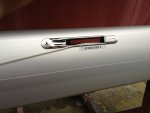
Cutting inspection "hole" in mast - possible, or downright stupid?

Robert Wilson

Well-Known Member
Joined
23 May 2012
Messages
8,053
Location
Second Coast, Ross-shire, overlooking Gruinard Bay
Visit site
Be gentle with me :rolleyes: I'm thinking of below decks at a convenient height for working access.
Is it possible, without weakening the mast, to cut out a small (maximum "fist" size) inspection hole in the side or front or rear and then have a stout cover-plate well-bolted on to the mast.
My keel stepped mast contains halyards coax-cable and lighting cables. Something is in the wrong place and "tings" right next to my ear when I'm in my bunk. It is infuriating and sleep-depriving.

Leaving aside the obvious such as non-corroding metals/electrolytic action, shape-conforming "plate" etc, would this foolishly/dangerously weaken the mast?

Any ideas/suggestions of how to do it, assuming it would be safe/possible/practical? And if so,at what height between deck-head and cabin sole?


Many thanks for advice, one way and/or the other.
 
You don't say how big your mast is. A fist sized hole could be relatively big. What about a small hole and an endescope?
 
Cutting a hole in the side of the mast on the center line would not reduce the for aft bending strength.

I would cut it narrow in width longer in height such the you can get an open hand in.

i would round the corners to reduce stress concentration.

Size may be 130/150 high by may be 25/ 30 wide.

Make the cover as wide as possible and height just a little higher than the hole.


I have holes in the bottom of my mast to fit halyard pulleys so the internal halyard an exit at the bottom. I do remove these to access any wiring inside my mast.
 
Last edited by a moderator:
I wouldn't take the risk of cutting a hole even with a cover plate.

I too wouldn't cut any hole in a mast that isn't necessary for it's function (holding the sails up securely). I'm also pretty sure that a cover plate won't return the strength to a mast that has had a hole cut in it either.

Might I suggest that you try tensioning some of the 'tinging' wires to see if it changes or stops the noise. Failing that, at your next mast-down inspection install the electrical wires in trunking in the mast. This will change their dynamic completely.
 
Be gentle with me :rolleyes: I'm thinking of below decks at a convenient height for working access.
Is it possible, without weakening the mast, to cut out a small (maximum "fist" size) inspection hole in the side or front or rear and then have a stout cover-plate well-bolted on to the mast.
My keel stepped mast contains halyards coax-cable and lighting cables. Something is in the wrong place and "tings" right next to my ear when I'm in my bunk. It is infuriating and sleep-depriving.

Leaving aside the obvious such as non-corroding metals/electrolytic action, shape-conforming "plate" etc, would this foolishly/dangerously weaken the mast?

Any ideas/suggestions of how to do it, assuming it would be safe/possible/practical? And if so,at what height between deck-head and cabin sole?


Many thanks for advice, one way and/or the other.

The right shape and size hole probably won’t weaken it, but in the event of an insurance claim I’d expect them to want you to prove that. Or even refuse to pay.

Why not get a yard to lift the mast by 4 ft for an hour? You can slacken rigging and take out all the pins and replace them yourself so save cost it shouldn’t be too expensive.

You can then inspect from below, and have some closed cell foam sheets to hand to shove up in all the right places.

*just thought - a yoga mat or one of those camping mats. Cheap and you can cut sheets or strips and size to push up and become your anti rattle.
 
Last edited:
Thanks for prompt replies, even though they conflict (as expected ;))
I had thought of an endoscope (and have one to hand), but if I find the culprit I would then have to de-rig, hoist out mast etc etc, which I'd rather avoid if possible (at lest for this winter)

Holes in the bottom of the mast for pulleys sounds an encouraging thought and I hadn't thought of that situation.

I've tried tensioning the wires, to no avail. They exit through "grommeted" holes in the foot of the mast.
I'm beginning to think the wires may have been re-routed out of the trunking when re-wired - but that was six seasons ago and I've only noticed it since 2015.

As to fixing the problem, if I could find it, I shall have to wait to see what it is. Re-routing the wires, if that is indeed the fault, would be easy and a big relief.

I do accept that cutting holes in masts should be avoided if at all possible.
I suppose I was hoping to be bombarded with encouraging comments e.g. "I've done that." "No problem, get your drill and saws out and have a go" etc etc.
Hey ho!

:encouragement:
 
It is not unusual to have cables or internal halyards slapping the mast inside and causing irritating noise. The solution is to withdraw the cable with a "messenger" attached to the end to pull it back and wrap it in a soft "gasket" at intervals of a foot or so. Foam rubber makes a good gasket and if you can bunch up several cables together it will help. Halyards are more difficult but usually not a problem if held away from the mast externally when not sailing. As others have said, you need to be more specific about the size of your mast but a fist sized hole would seem to be in danger of causing excessive weakness and I don't see how it would solve anything as the slapping will probably be way up the mast, not at the bottom. Difficult to generalise though. Many modern masts have an internal partition for cables in the front and all cables should be run down that not elsewhere. If its one of those a dummy cable with fat gaskets can be used to pull down the hole after all cables are in place stopping them from slapping. Plumbing insulation works well in some cases. I have just replaced all the standing rigging on a fisher ketch with 1972 masts. I found the internal sections on these still lined throughout with polystyrene foam. Lovely! Many modern masts don't have this luxury but if you have the mast on trestles its an easy job to bunch all the cables and wrap in a soft gasket of plumbing insulation. Not so easy with mast in place of course! There is no one solution for every case but cutting a big hole is not a good idea!
 
Looks like I shall have to put up with it another year and remove the mast (onto trestles) 2020/21. Some useful and encouraging suggestions, thank you.
The annoying thing is that the mast was on trestles from winter 2016 to spring 2018 when all the internal work easily could have been done - but the noise started after that :disgust:
 
If it is a keel stepped mast, it is highly likely there is a deflector plate above deck level to stop water draining to the bilge, in which case accessing the rest of the mast from below deck will be tricky.
 
True.

But a properly fitted strong wide cover would mitigate the loss of buckling strength.

The mast is keel strength and the access is below the deck so the deck would also aid in the prevention of buckling unlike my deck stepped mast.
 
Looks like I shall have to put up with it another year and remove the mast (onto trestles) 2020/21. Some useful and encouraging suggestions, thank you.
The annoying thing is that the mast was on trestles from winter 2016 to spring 2018 when all the internal work easily could have been done - but the noise started after that :disgust:
That is the only way :encouragement:

In my Kemp mast the vhf & wind inst cable run down the sail track, tucked in the corners
 
Last edited:
Lots of masts have slots cut in them for halyards to exit above the deck - sometimes half a dozen slots within a metre or two, though never two at the same height. Yours presumably must do too, unless your halyards are passing through the cabin ;).

A fist-sized hole would be too wide unless your mast is of superyacht proportions, but a 20mm x 100mm slot with rounded top and bottom would be no different to these halyard slots and should give enough access to do something with bits of bent wire, forceps, and suchlike. I cut my spinnaker halyard slot with a drill followed by a jigsaw and then installed the Selden fairlead plate sold for this exact purpose.

Here are some halyard slots on a random mast in the boatyard:
TQpgTjn.jpg

This one has two slots (on opposite sides of the mast) at the same height, which doesn't seem like best practice but given the labelling I imagine was done professionally and not caused a problem.

H0tmEMn.jpg

Pete
 
But a properly fitted strong wide cover would mitigate the loss of buckling strength.

Wall buckling is a funny business. If the reinforcing ring was any stiffer than the material it replaced, it could well make things worse

The mast is keel strength and the access is below the deck so the deck would also aid in the prevention of buckling unlike my deck stepped mast.

It would help a little with strut buckling, but not much because you really need a prop near the middle for that. It wouldn't have any effect on wall buckling, which will be the higher risk.
 
Having in mast furling for my mainsail, I have two inspection holes in the mast. They are necessary for connecting the halyard and the tack of the sail. The holes are oval, approximately 100mm x 50mm. If you look at Selden's web site, you will see that they supply black plastic cover plates for the holes. These cover plates merely snap in, so contribute nothing to strength. If it's good enough for Selden, it's good enough for me. A hole that size would give access to cables.
 
Wall buckling is a funny business. If the reinforcing ring was any stiffer than the material it replaced, it could well make things worse


It would help a little with strut but not much because you really need a prop near the middle for that. It wouldn't have any effect on wall buckling, which will be the higher risk.

I agree, as is flange and web buckling. We had a situation some years ago where we reduced the welding on a overhead conveyor track that reduced the stress in the structure and in effect made the structure could carry more load.
 
Top