Cutting down a trolling motor

JumbleDuck

Well-Known Member
Joined
8 Aug 2013
Messages
24,165
Location
SW Scotland
Visit site
My crew has acquired a nice second hand Bison trolling motor. It has a very long shaft, but is destined to be used only on small dinghies, so a bit of trimming seems like a good idea - about a foot of shaft can usefully go. Has anyone done this? It looks as if it should be a matter of "Remove bolt holding top casing to leg, separate, cut leg, drill, re-assemble" with wires either shortened at the top or cut and rejoined at some stage in the process, but I wonder if I am missing any potential pitfalls.

The borrowed Shakespeare trolling motor (rebadged Minn-Kota, I think) which inspired the purchase had been cut down, so I know similar things have been done before. Well, at least one similar thing, but I'd be very surprised if that was the only one ...
 
I did exactly as the OP described to a trolling motor.
I cut it down to the same shaft length as my 2hp 2-stroke.
When you cut the shaft mount it upside down in a vice to ensure any swarf falls clear rather than into the motor. Take care not to damage the wire insulation at the cut.
I cut the crimps off the cable ends to make it easier to thread the wires through the tube, shortened them as well and put on new crimps.
 
I did exactly as the OP described to a trolling motor.
I cut it down to the same shaft length as my 2hp 2-stroke.
When you cut the shaft mount it upside down in a vice to ensure any swarf falls clear rather than into the motor. Take care not to damage the wire insulation at the cut.
I cut the crimps off the cable ends to make it easier to thread the wires through the tube, shortened them as well and put on new crimps.

Many thanks, particularly for the "do it upside down" idea, which hadn't occurred to me.
 
I've never looked at one - We live and learn. What's in the box at the top of the shaft? I'd assumed, maybe wrongly, that the battery were a separate unit (or are they in the box?).

Jonathan
 
I've never looked at one - We live and learn. What's in the box at the top of the shaft? I'd assumed, maybe wrongly, that the battery were a separate unit (or are they in the box?).

Jonathan

On the one I had, the switching and electronic speed control PCBs were in the top end, mounted well clear of the water. I wouldnt want to cut the height down, awkward though it is, as i found even that high up they are subject to spray and damp, which are instant death to the electronics. Isnt that why they are mounted so high? We all know seawaters' propensity for getting in where its not wanted!
 
Not wanting to hi-jack your thread JD - I had wondered if it was possible to convert them to generate electricity - along the lines of a Watt N Sea. If, as Harry says. the electronics are prone to water damage there would be lot of legs floating around looking for a new lease on life.

I had never got beyond wondering.

Jonathan
 
I did it once, long ago. Just used a hacksaw, just an (aluminum?) tube with a wire going down the center. I put all the seals back in place and it worked fine was as waterproof
 
I've never looked at one - We live and learn. What's in the box at the top of the shaft? I'd assumed, maybe wrongly, that the battery were a separate unit (or are they in the box?).

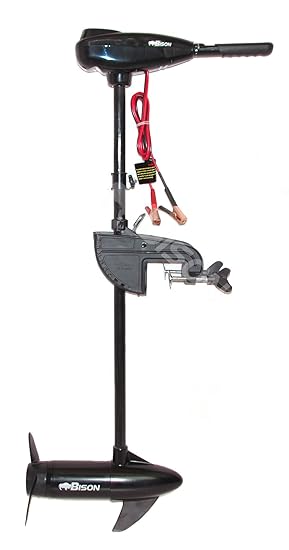
Control box at the top of the shaft, motor at the bottom, separate battery. Like this (battery not included):

61fOYAdpUkL._SY550_.jpg


On the one I had, the switching and electronic speed control PCBs were in the top end, mounted well clear of the water. I wouldnt want to cut the height down, awkward though it is, as i found even that high up they are subject to spray and damp, which are instant death to the electronics. Isnt that why they are mounted so high? We all know seawaters' propensity for getting in where its not wanted!

I think they are generally used to propel fishing boats (in the "boats used for fishing", not the "seine netter" sense) and so need long shafts to reach the water. We'll mainly be using it on calm days in fresh water, exploring bit of Loch Ken, and occasionally on quiet evenings on the sea, so the convenience of cutting down outweighs the hazards you point out. Very useful reminder, though, for which thanks - I'll pay close attention to sealing it all when I reassemble.
 
I have one, and still haven't cut it down - it's on the list though. One thing you might like to do is to replace the big croc clips for connecting to the battery - they are apt to pop off just when you don't want them to. I use in-line mains connectors, with the plug side connected to the motor, and the socket side connected to the battery. Actually, I use two separate 22Ah batteries, which are relatively easy to carry (especially since they are in handled fabric pouches), so that #2 can be swapped in should the first one show signs of fading. If I were following CDG practice, of course, I'd have 3 batteries - one for in, one for back and one for reserve. But I do have oars as well!

You do have to go over the connectors about twice a year with wet&dry paper to get oxidation off. Otherwise it's worked very well.

Steve
 
I have one, and still haven't cut it down - it's on the list though. One thing you might like to do is to replace the big croc clips for connecting to the battery - they are apt to pop off just when you don't want them to. I use in-line mains connectors, with the plug side connected to the motor, and the socket side connected to the battery. Actually, I use two separate 22Ah batteries, which are relatively easy to carry (especially since they are in handled fabric pouches), so that #2 can be swapped in should the first one show signs of fading. If I were following CDG practice, of course, I'd have 3 batteries - one for in, one for back and one for reserve. But I do have oars as well!

You do have to go over the connectors about twice a year with wet&dry paper to get oxidation off. Otherwise it's worked very well.

Many thanks, Steve, that's very helpful. I am planning to use Anderson connectors: one on the outboard, one on the battery (or on each battery) and one on the boat for recharging. Two batteries would be nice, but for simplicity I am inclined to go for single 36Ah deep-discharge AGM from Yuasa (https://www.tayna.co.uk/marine-batteries/electric-outboard/rec36-12/). Nice handled bags are available for that too. We also have oars for backup.
 
Top