Cutting and joining radar cable

Sea Change

Well-Known Member
Joined
13 Feb 2014
Messages
2,146
Visit site
Inching closer towards my radar installation...

I've forked out what feels like a small fortune on a brand new 15m cable to go with my otherwise very budget friendly secondhand installation (Raymarine e97 MFD, RD418D radome). I'm a bit nervous about cutting the cable but I think I will have to, in order to fit it through a gland at the helm end. And in practice I'm going to need to cut it when I unstep the mast anyway.

What exactly is so magical about this cable? At the radome end, it appears to just have six connectors- two larger ones which I assume will be the power supply, and four smaller ones which must be for data.

I also presume that there is shielding in there.

Do I need to do anything other than cut it and then join the individual wires using my chosen method? (I'd probably pick Wago connectors, with an eye to future mast unstepping).

And if I wanted to extend the cable... could I just use any shielded cable of the appropriate mm²? I don't feel any moral imperative to prop up shares in Raymarine...
 
Inching closer towards my radar installation...

I've forked out what feels like a small fortune on a brand new 15m cable to go with my otherwise very budget friendly secondhand installation (Raymarine e97 MFD, RD418D radome). I'm a bit nervous about cutting the cable but I think I will have to, in order to fit it through a gland at the helm end. And in practice I'm going to need to cut it when I unstep the mast anyway.

What exactly is so magical about this cable? At the radome end, it appears to just have six connectors- two larger ones which I assume will be the power supply, and four smaller ones which must be for data.

I also presume that there is shielding in there.

Do I need to do anything other than cut it and then join the individual wires using my chosen method? (I'd probably pick Wago connectors, with an eye to future mast unstepping).

And if I wanted to extend the cable... could I just use any shielded cable of the appropriate mm²? I don't feel any moral imperative to prop up shares in Raymarine...
My radar cable is cut where it goes into the radome. It works fine and has done for several years. I joined the four ethernet wires with stainless steel choc block. I used ferrules to terminate the tiny wires so they make good contact in the choc block. I wrapped the whole lot in foil and then used self amalgamating tape onto. I did the same for the power cables with a separate bit of choc block. I need to disconnect when I remove the mast so the choc block allows me to do this fairly easily
 
What about extending the cable?
Can I just use shielded cable for the data... and do I need to use shielded for the power too, or only where it runs alongside the data?
 
Suppliers of the kit commonly recognise the issue you describe and sell cables of various lengths that can be plugged together. From memory they are not cheap. And see post 3, above.

Before you cut the cable I would exhaustively look at the options, as you are doing.

When I installed our Simrad unit I simply drilled bigger holes to allow the supplied connectors to pass through the mast, deck and bulkheads. I went out of my way not to cut the cable. If you drill the mast make the new hole somewhere there are no other holes. One hole is fine, a series of holes in the same location in a neat horizontal line will weaken the mast.

How often are you going to drop the mast - how difficult would it be to simply pull the cable at the same time. We never dropped the mast in 25 years. I do note dropping the mast is common place in the UK where yachts are stored on the hard over winter. You can replace rigging with the mast in place.

Jonathan
 
Last edited:
Most radar cables are just Ethernet. Joining that up is not rocket science. Put the joint belowdecks where you won't be torture testing the waterproofing of your joint.

I have a Simrad Ethernet cable, the one with the proprietary yellow connectors, joining my helm plotter to the one at my nav table. I had to cut and rejoin that to get it pulled. It's worked perfectly for 12 years.
 
My secondhand radome came with 10m of cable. I purchased a brand new 15m length so that I could install the radome up the mast.

I'm very tempted to return or sell that 15m cable (which cost me over £200!) and use the 10m cable, with some standard ethernet cable below decks to gain the necessary extra length.
 
My secondhand radome came with 10m of cable. I purchased a brand new 15m length so that I could install the radome up the mast.

I'm very tempted to return or sell that 15m cable (which cost me over £200!) and use the 10m cable, with some standard ethernet cable below decks to gain the necessary extra length.
If you use stranded ethernet cable it will be fine.
 
Wifi radar isn't always reliable. For something meant to be safety equipment i'd rather have a hard wired solution.
I never understand that argument. WiFi is a well proven form of radio / wireless transmission.
And let’s look at the navigation equipment:
- Radar itself is …… well radio signal based, wireless
- GPS / GNSS is …… radio signal based, and very weak and easily blocked signals
- AIS is …… radio based
-EPIRB / PLB is ….. radio signal based
None of these can be “hard wired”.

Arguably a wireless connection can be more reliable as not subject to corrosion, cable damage etc
 
I never understand that argument. WiFi is a well proven form of radio / wireless transmission.
And let’s look at the navigation equipment:
- Radar itself is …… well radio signal based, wireless
- GPS / GNSS is …… radio signal based, and very weak and easily blocked signals
- AIS is …… radio based
-EPIRB / PLB is ….. radio signal based
None of these can be “hard wired”.

Arguably a wireless connection can be more reliable as not subject to corrosion, cable damage etc
It isn't an argument, it's fact. It isn't always reliable.

If you get a crackle on the VHF or you have to repeat yourself, so what, if the wifi signal is subject to interference you lose the radar, not great if you are using it in anger. I've been called out to boats with wifi radar that isn't working properly, fitted a cable and all is fine.

Bluetooth is wifi, has a range of a few metres, sometimes not that.
 
A plan is coming together.
I'm going to run the radar cable down the mast and in to the boat, then have a joint. The power will head off where it needs to go, and the data will switch to an ethernet cable, which is much cheaper per metre and also much easier to weave through the inside of the boat.
At the helm, I'll need to switch back to the radar cable with the Raymarine connector on the end. This will have to go through a gland on top of the pedestal.

I've got a choice here. I have a 15m brand new length of radar cable, which I could simply cut and use the ends of.

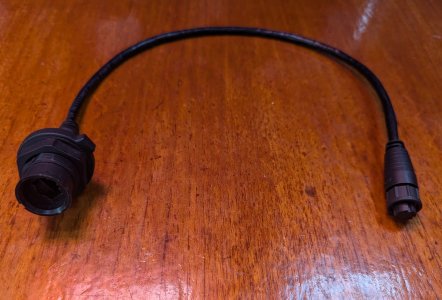
Or... I could use the 10m cable that came with the radome. The complication here is that the MFD end doesn't have the Raymarine connector on it. It has an ethernet plug, and I have an adapter to go on it. See photos.
I could then return my 15m cable, and hopefully get my £230 back.PXL_20250815_144157443~2.jpgPXL_20250815_144203486~2.jpg

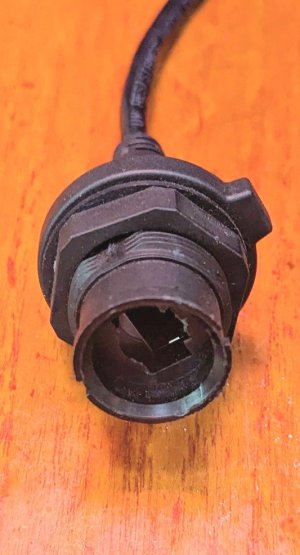
The ethernet socket is built in to a bulky fitting which looks a bit like it could be made in to a deck gland. But it hardly has any depth of thread on it.

Does anybody recognise this fitting?
 
The ethernet socket is built in to a bulky fitting which looks a bit like it could be made in to a deck gland. But it hardly has any depth of thread on it.

Does anybody recognise this fitting?
That's a RayNet to SeaTalkhs Adapter Cable. The STHS (ethernet) end is to fit the waterproof, locking SeaTalkhs cables, that's why it's bulky.
 
It isn't an argument, it's fact. It isn't always reliable.

If you get a crackle on the VHF or you have to repeat yourself, so what, if the wifi signal is interference you lose the radar, not great if you are using it in anger. I've been called out to boats with wifi radar that isn't working properly, fitted a cable and all is fine.

Bluetooth is wifi, has a range of a few metres, sometimes not that.
This is the right answer.

WiFi is great, but radar requires a reliable real-time datastream, a different task from sending and receiving packets. WiFi is subject to interference which can wreak havoc on that datastream, even if you would hardly notice it for an Internet connection.

I would never use WiFi for radar on my boat.
 
That's a RayNet to SeaTalkhs Adapter Cable. The STHS (ethernet) end is to fit the waterproof, locking SeaTalkhs cables, that's why it's bulky.
Had a sudden realisation this morning, I can just undo that nut and use the STHS adapter as a gland itself 🤦. Sometimes I don't see the wood for the trees...
 
This is the right answer.

WiFi is great, but radar requires a reliable real-time datastream, a different task from sending and receiving packets. WiFi is subject to interference which can wreak havoc on that datastream, even if you would hardly notice it for an Internet connection.

I would never use WiFi for radar on my boat.
Well Raymarine etc who supply the equipment don't seem to agree with you, otherwise they wouldn't supply wifi connected radars.
Wifi these days has high bandwidth and reliability.
Works fine for many in practice.
 
Top