
Curing an AC earth/DC ground connection...

ChasB

Well-Known Member
Joined
11 Nov 2006
Messages
543
Location
Limehouse
Visit site
I've got a water tank meter that doesn't work, and is rather inaccessible, and I didn't want to try fixing it and ending up instead with a leaking water tank! But I had a spare security camera, so I thought I'd do something clever and mount it down below where it could 'see' the water tank. It's 12V so it runs off the accessories circuit with it's own isolating switch and fuse.

However the cameras ground shares a connection with the BNC co-ax ground which runs to the AC powered TV and via that is connected to the on-shore earth. Oops! There go my anodes...

Currently it's unplugged.

Would fitting a galvanic isolater (which I was about to do anyway) cure this?

Just checking... /forums/images/graemlins/grin.gif
 
It is very likely that the AC powered TV uses what is called double insulated ie no earth on the TV. You can tell be the type of power cable used. If it has fat round cable it may be earthed if it has thin twin flex then no earth. Even then you can check with a multimeter on ohms (continuity) and see if there is any connection power earth pin to BNC body.

If you do find that yours fears are correct and the BNC body is connected to mains earth from the marina.
You could try parting the earth of the cable and fitting a small capacitor. About .1 microfarrad (100nannofarrad) ceramic capacitor from any electronics supplier. Thsi should break the connection and still enable the picture to get through. You might make up a little cable with a male and female BNC a little cable and the capacitor in line. To protect the camera you perhaps should put the same in the active wire as well.

The simplest answer is to disconnect the camera except when you actually want it to give you a picture.

A galvanic isolator may (will, if your concerns are correct) not help because your earth connection via the BNC connector will by pass or short circuit the isolator.

Of course if it is a complex 240V system then the mains earth should be connected to the boats earth for safety. And then via a galvanic isolator if you are concerned about electrolysis of fittings.
olewill
 
Thanks Will for a very comprehensive reply.

The TV is powered via a 2 core cable from a stand alone 12V transformer that uses a 240V 3 pin 'kettle' lead. Would the negative on the 12V likely be connected to the earth? It's a flat screen set with the only exposed metal being the connections. I'm on the boat tomorrow and I'll check to see if anything does actually run to Earth. I should already have done that. It never occurred to me it might not be earthed.

So if I read your post correctly, having a galvanic isolator doesn't mean that you needn't worry about the 12V ground and the 240V earth ever making contact?

Cheers.
 
[ QUOTE ]

The TV is powered via a 2 core cable from a stand alone 12V transformer that uses a 240V 3 pin 'kettle' lead.

[/ QUOTE ]

From this description do I understand that it uses one of those "lump" power supplies with mains in one side (via the "kettle" lead) and 2-core DC out the other?

In that case, the DC output is almost certainly fully isolated from the earth on the AC power inlet.
 
You are connecting the shore earth to the boat negative/earth. Not a good idea.

Now, if you only ever run the TV stuff from an inverter which is kept isolated, you'll be fine.
 
I'm wondering if I should run the TV direct from the boat's 12V supply - while it's in a marina it would take it's supply from the 240V charger. Or is that a bad idea?

On the other hand I could just swap out the camera's 12V switch to a dual-pole one which would break all connections when I switch it off.

Choices, choices. /forums/images/graemlins/grin.gif
[ QUOTE ]
the DC output is almost certainly fully isolated from the earth on the AC power inlet

[/ QUOTE ] So I would have thought too, but my multimeter tells me there's a connection between the 'video in' phono connection on the TV and the 240V earth pin on the plug.

While there I thought I'd check to see if there's a stray connection elsewhere. And yup there's 10 Ohms between my 12V ground and 240V on-shore earth. That's with the camera disconnected and the Vectron Centaur marine charger unplugged. Somewhere they are connected, like very connected. But where...? And what idiot...?

BTW with the charger plugged back in I get a reading of 250 Ohms. Anyone able to explain that? /forums/images/graemlins/confused.gif
 
Re 250 ohms with the charger plugged in and 10 ohms with the charger removed. Try reversing the multimeter leads. If they are true ohms then you should have the meter reading the same resistance both ways. However if there is some sort of stray voltage being developed which boosts the multimeter ohms reading it will detract from the reading when connected the other way. In which case you should try on low voltage scale. Multimeter is very sensitive to voltage so it could be electrolysis generating the voltage from dissimilar metals. olewilll
 
Cheers. I'll try that tomorrow.

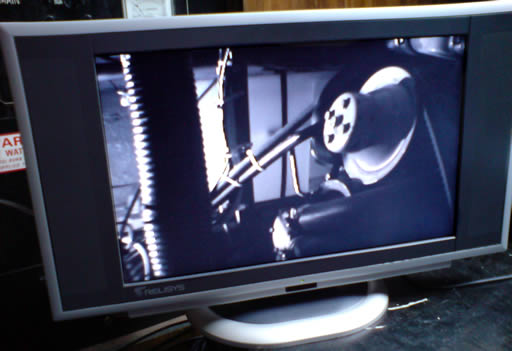
Just thought I'd post a pic of what the camera sees:
DOWN_BELOW.jpg


It's looking very film-noir down there.
/forums/images/graemlins/grin.gif
 
Because... [ QUOTE ]
I've got a water tank meter that doesn't work, and is rather inaccessible, and I didn't want to try fixing it and ending up instead with a leaking water tank! But I had a spare security camera, so I thought I'd do something clever and mount it down below where it could 'see' the water tank.

[/ QUOTE ]The half full water tank is in the background.
 
I'd read you OP but I couldn't (and still can't) make out from the picture how much water you have in the tank. Is it a plastic tank?
 
Having been down there way too many times the picture is unambiguous to me. Yes it is plastic and is the bright rectangular object in the background. The level is about half way up but is part obscured by some hosing. It's much more obvious as the level rises and the water blocks light reaching the empty portion above thus making it darker.
 
As long as it means something to you. How about positioning it so you can get some other useful information? Drips from the stern gland(s), alternator belt tension. With appropriate software, it could be a flame and smoke detector.
 
Are you taking the proverbial p?

This was way easier than attempting to mend the water meter. Since I bought the boat Every time the taps sputtered I've had to move furniture, lift an inspection panel, and peer in with a torch, and then keep doing so whilst filling the tank. The glamour of that kind of wore off...
 
If you're going to put a video camera in the engine room, why not arrange the field of view so that it covers as much information as possible? I look into my engine room, and use the IR thermometer, every six hours, checking for signs of leaks, wear, smoke, smells, noise, etc. It seems a shame to have such a powerful instrument as a camera dedicated to measuring the contents of the fresh water tank and nothing else. But it's your boat; I was only trying to make a helpful suggestion and sorry if I offended you.
 
Not offended, was amused.

It's only a security camera with limited resolution, no way to change the angle of view, and limited opportunities for mounting it safely. Still it's nice to see the engine turn without feeling like I'm in a hazard zone.
 
Top