Cu-electroplating of propellers: barnacles, cupper and zinc anodes.

It looks to me that the hub was antifouled?

It raises a question.

But if this is after a year it is amazingly clean, even if you pressure wash antifouing it would never look that 'smooth' Its not black like the blades (which would be consistent with Vyv's comments) its like marbled icecream - without a blemish.

In the 'before' image, blades and hub are similar, if not identical - the after image would enjoy a comment.

I am cautious as the results of any or all antifouling trials seem very location sensitive and the Baltic and Australina east coast enjoy a few differences - but I'm still intrigued.

Jonathan
 
This is very interesting. There was a boat made from cupro nickel some years ago that reported no fouling on the hull even through there was no paint or other protective coating on aby or the hull, just anti slip paint on the deck.

Vyv could this be a final solution for anti fouling on propellers. How do you think copper plating would take on a 316 stainless steel fixed propeller.

I remember the copper nickel boat. Looked dreadful, none of it painted, but as you say no fouling. Copper nickel and pure copper seem to be the only metals that resist fouling but unfortunately the erosion resistance of copper nickel is particularly poor.

I cannot think of a reason why stainless steel could not be copper plated with a nickel coat first but I know very little about plating.

My propeller, quite a large 3 bladed one (16 inch?) cost £100 for a beautiful copper finish. I am not posting pics as I hope YM will do a short piece about it before too long.
 
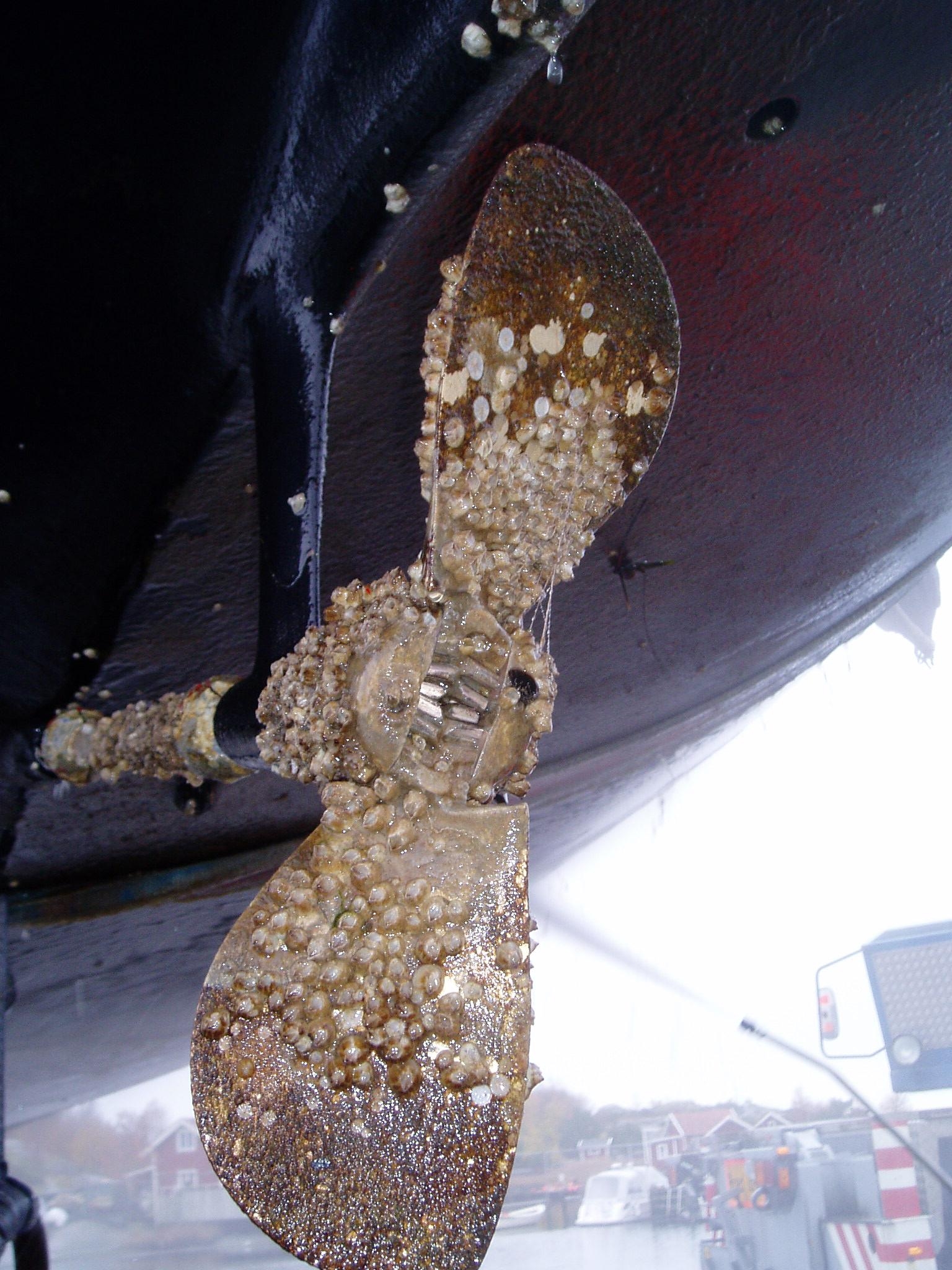
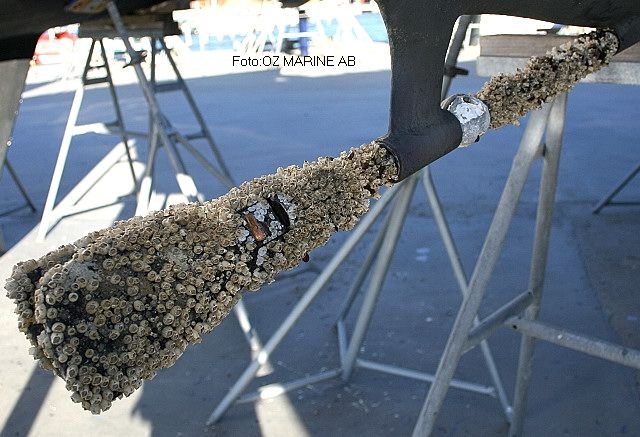
The Swedish "season" is from April to October. At the west coast, where the tests using copper plating takes place, typical propellers made from Bronze where zinc anodes are used will look like this at the end of the season.
Please note that the one with the worst grouth was painted before launcing using a antifouling paint containing about 50% copper. The same paint was used for the shaft support and the hull.
As you can see, no barnacles grow on this bearing housin in spite of being close to the zinc, but the shaft and the propeller had the growth. The zinc is not in electrical contact with the bearing support.

Please also note that an antifouling paint where the antifouling properties is due to poison and not copper, will not get its properties ruined by a zinc anode.

image3.jpg


http://www.batteknik.se/div/image4.jpg
 
The Swedish "season" is from April to October. At the west coast, where the tests using copper plating takes place, typical propellers made from Bronze where zinc anodes are used will look like this at the end of the season.
Please note that the one with the worst grouth was painted before launcing using a antifouling paint containing about 50% copper. The same paint was used for the shaft support and the hull.
As you can see, no barnacles grow on this bearing housin in spite of being close to the zinc, but the shaft and the propeller had the growth. The zinc is not in electrical contact with the bearing support.

Please also note that an antifouling paint where the antifouling properties is due to poison and not copper, will not get its properties ruined by a zinc anode.

image3.jpg


image4.jpg
 
The cost needs to be weighed up against the time to prepare a prop for treatment and then the cost of the treatment. If you do it yourself there is obviously minimal cost, apart from the Trilux - but it does take an age to clean down. If you have someone apply Prop Speed - I suspect costs might not be too dissimilar. The difference is that Cu plating might offer an extended life.

I'm awaiting Magnus to explain the different finishes.

Jonathan
 
... My copper plated propeller was black by the end of its exposure. I believe the compound to be copper oxy-chloride, which is the stuff that fouling does not like.

‘Copper oxy-chloride’ usually refers to Cu2(OH)3Cl (s) – I would informally call that a copper hydroxychloride, but given the perils of informal nomenclature it’s best always to give it its formal name of Dicopper chloride trihydroxide, or just use the formula.

Yes, I posted here http://www.ybw.com/forums/showthread.php?263637-More-coppercoat/page2 that Paratacamite, one of the mineral forms of Cu2(OH)3Cl (s), was indeed reported in a study of copper corrosion in the tropics to be the main copper patina ‘... formed under complete immersion, on the line of water and in the splash zone’.

But Paratacamite and the other three mineral forms of Cu2(OH)3Cl (s) are all blue-green*. So your black colour rather suggests to me that you have Copper(II) oxide, CuO (s) – the mineral form of which, Tenorite, is black**. Having said that, colour alone is not a conclusive guide to the composition of metal patinas – and perhaps your attribution of Cu2(OH)3Cl (s) is based on a chemical analysis?

In any event, I doubt that it matters much with respect to toxicity to fouling organisms, notwithstanding your view that Cu2(OH)3Cl (s) is ‘ … the stuff that fouling does not like’. My own view is based on reviewing many papers on copper toxicity to aquatic organisms, which show that copper toxicity is often best predicted by the free cupric ion (Cu2+) concentration in solution. That would I think be somewhat higher in contact with CuO (s) than with Cu2(OH)3Cl (s), if the latter is indeed the thermodynamically stable solid phase into which the CuO (s) would ultimately transform.

(I cannot entirely exclude the possibility that Cu2(OH)3Cl (s) might be more toxic than CuO (s) to an organism once settled on the solid surface, but the fact that the free cupric ion concentration in solution is so often a good predictor of toxicity would make me look carefully at any evidence for such a suggestion.)

* As also BTW is Malachite, a mineral form of Dicopper carbonate dihydroxide, Cu2(OH)2CO3 (s), which I had thought might be the thermodynamically stable copper solid in seawater. (It’s difficult to be sure without running a thermodynamic model, and in theory Malachite might be the more stable solid at lower chloride levels – i.e. at lower salinities.)

** Copper(I) oxide, Cu2O (s), yellow to dark red, might I suppose form on the metal surface before being oxidised to Copper(II) oxide, but if it did I imagine that the black colour of the latter would conceal any yellow-red colour below.

PS After carefully subscripting the numbers in the formulae in a MS Word draft, I find they do not 'stick' here, so my apologies for not fiddling around at this late hour to try to rectify that! :(
 
Last edited:
I've been doing some testing for an article, so I'm relatively sure of a few things.

a. I'm wondering about the longevity. Plain copper pipe in US east coast salt/brackish water corrodes at about 0.2-0.35 mils/yr. If only 0.2 mils, it would last 1 year, perhaps less with use. Thus, there must be some effect where the protection is extended by it being over a Cu alloy. I'm sure the base alloy is a factor. The local biological life and chemistry is probably also a factor. But 0.2 mils sounds very thin. If it were 0.2 mils in 3 years (0.06 mil/year), then Cu AC tubes would last 50/0.06=800 years, which they do not (perhaps 30-40, or about 1 mil per year in spots, 0.35 mil overall. So something is wrong.

b. The anode vs. fouling thing is true. In fact, the more active the anode, the more fouling. But pure copper is not that corrosion proof in seawater.

c. The patent is 5 mils. That is 40 times thicker.

d. Not a new idea. While the exact process is patentable, the concept is not; I saw an article in 1917 about Cu plating props. What this tells me that this idea is FAR from new and unless someone comes up with a new, proven wrinkle, I'm guessing it's been tried many times and it didn't work out too well.

e. Normally, corrosion will concentrate in the worn areas (gears). Thus, jamming will start before fouling.

I like the idea, but someone need to prove the math. I'm not seeing it, based on corrosion testing.
 
Last edited:
I've been doing some testing for an article, so I'm relatively sure of a few things.

a. I'm wondering about the longevity. Plain copper pipe in US east coast salt/brackish water corrodes at about 0.2-0.35 mils/yr. If only 0.2 mils, it would last 1 year, perhaps less with use. .....
mil = 1/1000 inch = 'thou' in UK speak
mm= millimetre = 40thou
0.2mm = 8 mil = 8 thou
8 mil / 0.35 mil/year = nearly 23 years, more if out of the water in winter?
 
I've been doing some testing for an article, so I'm relatively sure of a few things.

a. I'm wondering about the longevity. Plain copper pipe in US east coast salt/brackish water corrodes at about 0.2-0.35 mils/yr. If only 0.2 mils, it would last 1 year, perhaps less with use.

The copper coating thickness we use at the Swdish west coast is not 0.2 mils, but 0.2 mm, equals about 8 mils.
/Magnus
 
Copper plating 0.2mm thick would be roughly '2oz copper' in pcb manufacture speak. Commonplace and not wildly expensive.
 
mil = 1/1000 inch = 'thou' in UK speak
mm= millimetre = 40thou
0.2mm = 8 mil = 8 thou
8 mil / 0.35 mil/year = nearly 23 years, more if out of the water in winter?

Oops. My eyes saw mil. Yup, that changes the math. However, I made a second mistake also. My data was Chesapeake Bay brackish water. US Navy seawater testing showed 1.0-1.2 mil/year in seawater under stagnant conditions. That reduces it to 6-8 years. With flow, perhaps 5 years with localized failure a little sooner. This also squares better with AC tubes sometimes failing in 10-30 years (40 mils thick). This may still be acceptable.

But the question remains, if the idea is 100 years old....

I hope it gets some systematic study. It would be a more elegant solution.

But I still have reservations:
a. Folding props will have areas that wear.
b. The shaft will still need an anode for the shaft and packing. No anode, which is what it needs to work, is a long-term risk. Certainly it would require close monitoring.

MagnusS, I notice this is your first line of posts. It would be nice to know if there is a commercial affiliation here.
 
Last edited:
b. The shaft will still need an anode for the shaft and packing.

Surely that depends on the materials? A bronze shaft will probably outlast the owner without an anode and a stainless shaft will simply be the cathode in the pair with the prop. I suspect that most packing is of materials which do not enter the equation - and anyway it is a consumeable.

It seems to me that copper plating would be an ideal solution, but its performance may well vary according to the relative areas of prop to shaft and their geometry (line of sight and all that).

Rob.
 
Mention is made of salinity. And one might also make mention of temperature.

Magnus is referring to application in the Baltic, where salinity is 'lower'(?) and temperatures also 'lower' (?) - I tend possibly erroneously to think of the Baltic as both cold and brackish. It certainly does not enjoy the Gulf Stream. It would be useful to have a view of a typical prop that has not be Cu plated and maybe had something like Trilux.

Vyv, I recall, is testing out his prop in North Wales (?) which enjoys the Gulf Stream (though I would not be too keen on swimming) and the waters possibly have typical salinity - but it would be useful to know what fouling was typically, pre-copper plating.

We enjoy sea temperatures in the summer of 26 degrees C and its currently spring and around 19 degrees C. Fouling is high, clean water.

We are intrigued because with a typical AF we were getting 12 months, but the last 3 months we were fighting growth. We have now changed to Jotun SeaQuantum Ultra and we will achieve 2 years. Our segmented anodes would last 12 months, and I think we might have been better to renew at 10 months. We have simultaneously, with the J SQ, used Velox and the anode life is comfortably 2 years but the Velox is really only lasting 12 months. Our next plan was to use J SQ, Velex but recoat the Velox at 8 months, then 8 months - to give us the 2 years (we can do this as we can beach, wipe down, wash, abrade and coat between tides). But if Cu plating is as suggested - it might give us the 2 years to match the J SQ and anodes. We have not worked out what do do with the saildrives to give is 2 years.

Jonathan
 
The salinity of Baltic surface seawater is <3 in the north to ca. 10 ppt at the entrance. For the western part of Liverpool Bay, it averages about 32 to 33 ppt – but that will obviously be a lot lower, and variable, in an estuary. The chloride levels will be essentially in proportion to the salinity, but as far as I can see from a very quick check the pH and carbonate levels (which may also affect copper chemistry) are broadly similar. But of course it all depends where a boat resides for most of the time!
 
The salinity of Baltic surface seawater is <3 in the north to ca. 10 ppt at the entrance.

The tests that the OP refers to take place on the Swedish westcoast, not in the Baltic proper.
Along this coast the salinity of the surface water is only a little lower than in the oceans, around 30 ppt on average.
Besides, fouling by barnacles is a problem for boatowners also in the Baltic, as some species are very tolerant to low salinity.
 
MagnusS, I notice this is your first line of posts. It would be nice to know if there is a commercial affiliation here.

Please not that the trial is a multiple year effort made byhttp://www.sxk.se/welcome-swedish-cruising-association having 40000 individual members. Our indications are that the plating lasts at least 3 years, and most probably 5 or more (season mid April trough to mid October).
 
The tests that the OP refers to take place on the Swedish westcoast, not in the Baltic proper.
Along this coast the salinity of the surface water is only a little lower than in the oceans, around 30 ppt on average.
Besides, fouling by barnacles is a problem for boatowners also in the Baltic, as some species are very tolerant to low salinity.

Thanks - and my apologies for not having read back carefully enough to have seen that. I was also considering the potential impacts of differing salinity/chlorinity, carbonate and pH on the copper chemistry, rather than the different fouling organisms.
 
Top