Cu-electroplating of propellers: barnacles, cupper and zinc anodes.

MagnusS

New Member
Joined
10 Oct 2016
Messages
22
Visit site
A yellow-metal propeller can be made of either a brass-related or a bronze-related alloy. In both cases, some minor amount of Cupper Ions leave the surface and stops the barnacles from attaching. BUT: As soon as a sacrificing anode is connected, it stops those Cupper Ions to be releases, and the barnacles will attach and grow.

It is only the seawater-resistant NiBrAl-alloys that are really good for seawater use, and for these alloys, no sacrificing anode is required. By this, they will release Cupper, and will not get much barnacles.

However, the brass-related alloys MUST have some form of sacrificing anode for protection, and as a result from that, they will get lots of barnacles.

In Sweden, SXK (Swedish Cruisers Organisation) have organized a series of trials where more than 30 different yellow-alloy alloys, both of the Brass and the NiBrAl-types, fixed blades and folding all have been electro-plated with Cupper to a thickness of about 0.2 mm, in combination with NOT using any Zinc Anodes.

Cupper is a little less noble than both the Brass:s, and the NiBrAl:s and since it surrounds these, no significant corrosion has been noted even for the Brass-oriented propellers (without Zinc anode).

Note: Any propeller for a Saildrive must be constructed in such a way that the outer part och the hub is electrically isolated from the inner hub. By this, the inner hub and the Saildrive forms its own galvanic system, and the outer hub and the folding blades forms another. This prevents the Saildrive anode to interact with the outer hub and the blades.

So far the trials have been ging on for tree seasons without redoing the electro-plating. There has been no barnacles worth mentioning for any of the propellers during this timeframe, andd the treatment seems to last for at least a couple of more years still.
 
Magnus,

Interesting post.

I believe Vyv Cox is conducting a similar trial here (UK) and from memory its on a 3 bladed fixed prop.

You don't mention what sort of props the trials are conducted on. Do the trials include folding props and specifically something like a 3 bladed Volvo prop and does the 0.2mm coating impact the ability to fold and equally important ability to assemble, they have some well fitting stainless rods holding the blade onto the hub.

Jonathan
 
After one winter my copper plated manganese bronze prop was totally foul-free. No anode and no obvious corrosion.

If what MagnusS says about brasses and bronzes releasing copper ions is true would you not expect a manganese bronze prop to be foul free, with no signs of corrosion, after one winter anyway even without the copper plating.
 
If what MagnusS says about brasses and bronzes releasing copper ions is true would you not expect a manganese bronze prop to be foul free, with no signs of corrosion, after one winter anyway even without the copper plating.

Not in my experience, nor many others'. The previous prop was also manganese bronze, no anode fitted, and it fouled quite badly. Unfortunately it cracked along the hub forcing replacement. I had it copper plated before fitting it.
 
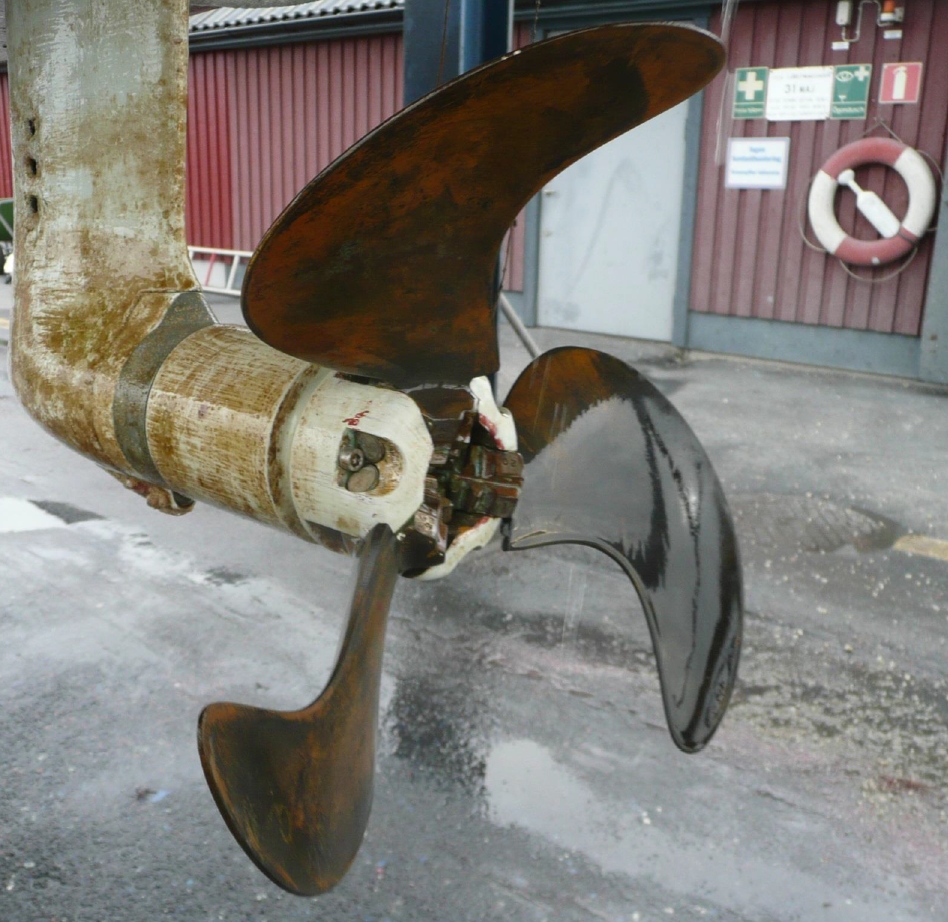
Some of the propellers being tested using electrolytic copper plating ar Volvo 2- and 3-bladed propellers. During around year 2000 these were casted using brass related alloy (I have access to a metallurgic test result proving this, not made by Volvo). These propellers will corrode if their zinc anodes are missing. However, copper-plating prevents them from corrosion AND barnacles as long as the zinc is left out. Please see the picture below, "before use" and "after one season".

Any propeller for an S-drive MUST have an electrical isolation between its outer hub and the inner hub. THis must be verified after mounting the propeller, because some makers nut locking device may cause an electrical short.

NOTE1: After propeller is mounted to the S-drive, make 100% shure by OHM-measurement with one pin to the S-drive ring-zinc anode and the other pin to the propeller outer hub and baldes, that there is at least 30000 ohm between thes (dry salt free condition).

NOTE2: Make shure by installing a minus disconnect switch between the boat main ground and the engine and S-drive that can be disconnected (check by ohm measurement again) to assure there is no possible ground path between the AC shore safety ground and the S-drive. (Later models of Volvo S-drive have this feature buildt in) .

Image1.jpg

Image2.jpg
 
A bronze propeller w/o copper will withstand barnacles to some extent, but the release of ions is far less due to the alloy anticorrosion properties.
Note that the plated cupper being slightly less noble than the brass or the bronze will get a slightly increased formation of cupper ions due to it is slightly sacrificing itsef for these.
 
It is not traditional corrosion only thet can ruin a propeller. If the boat has more or less continous AC shore power and no isolation transformer where the shore power safety ground discontinues and can not get in contact with the prop, a ground potential difference between the shore ground differs from the water ground surrounding the propeller, this can cause severe electrolytic corrosion of the propeller.

A common cause for barnacle growth on propellers is also the US/UK tradition to electrically short all submerged metal parts with each other, and install zink anodes to solve the corrosion problems this causes.

It is only meaningful to copper plate a propeller if one also verifies by measurements the no, absolutely no, electrical connection exists between the propeller and the rest of the boat grounding system including zinc anodes in it.
 
Magnus,

In your Post # 7 you show 2 images, one of the as coated prop, new, and the other after one year.

I'm puzzled:

After 1 years the copper coated prop blades are black. Part of the copper coated hub is white, the other part of the hub is a sort of streaky brownish on white. Each of these items was coated the same way? and the inner part of the hub and outer are one piece. The saildrive leg, which is aluminium, or alloy, and has no copper at all and is identical in colour to the aft part of the hub.

Jonathan
 
And

I would be interested in the results of a

coppercoated prop

compared to the copper plated and regular prop

It would be very difficult to get Coppercoat to stick to a propeller. I coated my P-bracket with it and it was all gone by the end of the season.

My copper plated propeller was black by the end of its exposure. I believe the compound to be copper oxy-chloride, which is the stuff that fouling does not like.
 
Several propellers of this Volvo type have been treated. I do not have pictures of all of them before-and-after.
It has shown that the increase in overall dimensions by typically 0.2 mm can create some tolerance problems that needs some fine tuning by filing etc if not carefully covered before the plating.
One owner selected to only cu-plate the baldes, and to epoxi-paint the hub. That is the one on the "after" picture. However, this does not change the results for the blades.

Please also note that the painted hub has kept its paint. It is quite common that the paint on a bronze etc. propeller having a zinc anode will loose the paint more or less. It seems as the galvanic process ionic exchange due to the zinc will sort of creep under the paint surface and push it loose. Without a zinc anode, the paint will stick significantly better.
 
The inner hub is not visible on the pictures. There is a non-metallic layer between th inner and ocuter hub. The blades are attached to the uoter hub. Best way to verify this is to dismount the propeller (to assure the main nut locking does not electrically short between them) and the measure ohms between inner and outer hub.
 
It would be very difficult to get Coppercoat to stick to a propeller. I coated my P-bracket with it and it was all gone by the end of the season.

My copper plated propeller was black by the end of its exposure. I believe the compound to be copper oxy-chloride, which is the stuff that fouling does not like.

This is very interesting. There was a boat made from cupro nickel some years ago that reported no fouling on the hull even through there was no paint or other protective coating on aby or the hull, just anti slip paint on the deck.

Vyv could this be a final solution for anti fouling on propellers. How do you think copper plating would take on a 316 stainless steel fixed propeller.
 
Roger,

I am as intrigued as you.

If electro copper plating is so effective one has to ask why prop makers (and there are a lot of them) do not sell copper plated propellors?

Jonathan
 
This is very interesting. There was a boat made from cupro nickel some years ago that reported no fouling on the hull even through there was no paint or other protective coating on aby or the hull, just anti slip paint on the deck.

Vyv could this be a final solution for anti fouling on propellers. How do you think copper plating would take on a 316 stainless steel fixed propeller.

It is probably possible to do. However, it seems to be more complicated than for "yellow alloy". Pls see:
http://www.finishing.com/153/52.shtml
 
Roger,

I am as intrigued as you.

If electro copper plating is so effective one has to ask why prop makers (and there are a lot of them) do not sell copper plated propellors?

Jonathan

It might happen, but the environmentalistic talibans might act to forbid it if it tends to become a large scale trend.

Another reason may bee that (according to the owner and chief designer for one of the most renowned folding propeller makers that I have met and discussed the matter with) quite many propeller buyers are so firm in their belief of the necessity of having zinc anodes onto any and all submerged metals that they DEMAND them on the propellers, regardless of any attempt to explain why not. So - adding zink to the cupper plated propeller will render the CU useless, and only adding costs.
 
Magnus,

In your Post # 7 you show 2 images, one of the as coated prop, new, and the other after one year.

I'm puzzled:

After 1 years the copper coated prop blades are black. Part of the copper coated hub is white, the other part of the hub is a sort of streaky brownish on white. Each of these items was coated the same way? and the inner part of the hub and outer are one piece. The saildrive leg, which is aluminium, or alloy, and has no copper at all and is identical in colour to the aft part of the hub.

Jonathan
It looks to me that the hub was antifouled?
 
Top