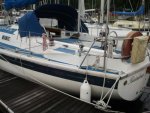
Cruising chute/gennaker single handed

I understand your point. However, the major pulling will be more or less 'vertical' along the luff of the sail and down to the tack line. The only 'horizontal' pull against the furler will be the resultant component of the other two. Given the flattish angle between the luff and the tack line this component force will not be that great. Consider the pull on a Barber-hauler when compared with the massive load on a Genoa sheet; it is nowhere near, plus the fact that the furler is some 15 metres long.
Probably a fairly stout furler foil then!
I've never bent the pulpit, but I know a man who can fix it if I do.

My old boat, we used to let the backstay off downwind, making the forestay and furler quite slack, which would be a bad idea with a tacker I suspect...
My next boat, I hope to have a bowsprit to take a big asy clear of the pulpit.
 
This picture shows the layout better :

Port Qtr.jpg

It's clear the cheek block next to the forward pushpit stanchion isn't for the jib sheet, nor will it work for the spi sheet...... or will it ? I'm thinking of running the chute sheet through the block, forward to the jib sheet car and then back to the sheet winch. Not sure of the angle between the clew and the block, but it looks right from there to the winch.

Fitting a pad eye to the toe rail, in place of the cheek block or even a strop from the aft cleat won't work, the angles to the winch will be completely wrong. The line would only work if it went forward to the jib car, then back to the winch. The only way i can see of avoiding going forward to the jib car is if a block was shackled to the pushpit, about the height of the lower guard wire.

I'll try the cheek block first, see how that works.

I've got a 90mm long vertical tube fixed to the port bow roller cheek, so i've ordered an M10 eye bolt to fit to that. Will shackle a block to that and hope it clears the bi-colour. Some blocks or bullseyes on the stanchions should get the tack line back to the Lewmar 16 aft of the sheet winch.
 
A 'flying block' on a strop that is fastened to the aft mooring cleat will work.
Remember that the pull of the sheet is not horizontal along the deck but upwards towards the clew. This will lift the flying block off the deck and bring it more or less level with the aft winch. You can adjust how high it goes by altering the length of the strop; you will know by how much after you have used the sail a few times and gotten used to where the block hovers when the sail is drawing well. Aim at getting it more or less level with the base of the winch but NOT level with the drum so that you'll avoid riding turns.
It takes more time to explain than to do it.
 
A 'flying block' on a strop that is fastened to the aft mooring cleat will work.
Remember that the pull of the sheet is not horizontal along the deck but upwards towards the clew. This will lift the flying block off the deck and bring it more or less level with the aft winch. You can adjust how high it goes by altering the length of the strop; you will know by how much after you have used the sail a few times and gotten used to where the block hovers when the sail is drawing well. Aim at getting it more or less level with the base of the winch but NOT level with the drum so that you'll avoid riding turns.
It takes more time to explain than to do it.

OK, i'll have an experiment next time i'm out and the wind is right. Thanks for all the feedback (to everyone who posted).
 
PuffTheMagicDragon, Is there any chance you can post a photo of the stainless fittings on the end of your Tacker? This idea could be the answer to my prayers!

Cheers

I can do that, no problem, but it will be a few days before I can go down to the boat again.

Edit: if you mean the fittings at the end of the 'tacker' itself, they are just two SS triangles that are sewn to the ends of the webbing that is round the plastic collar. This 'collar' is wrapped round the furled Genoa and the fixed snap-shackle that is on the tack-line is clipped to both of then, thus closing the 'collar'. At the end of the tack-line there is a swiveling snap-shackle that is clipped to the sail.

2nd Edit: I have enlarged a part of an existing photo and it shows the two triangles on the webbing being held by a bronze snap-shackle that is wedged onto the splice that holds a swivel SS snap-shackle attached to the clew. I think that this makes things clearer. If you need a specific photo let me know exactly what you require and I shall endeavour to supply.
IMG_0396%20-%20Copy_zpsrfhakckt.jpg
 
Last edited:
Was out bank holiday Monday and gave the cruising chute a try, single handed apart from Simon, the autopilot. The check blocks on the quarters work fine for the sheets. The sheet goes through the block, forward to the jib sheet car and then back to the sheet winch. The sheaves in the cars take two lines, so it all worked easily enough. I ran the tack line through the spare bow roller to the port bow cleat, not ideal as it would chafe in a couple of places, but OK for trying the sail.

Wind was 6-6.5 knots and COG was 4 knots.

https://drive.google.com/open?id=0B4DI_YUZi2taSGlxQ1pvTldyQ00
 
Top