Cruising chute/gennaker single handed

PaulRainbow

Well-Known Member
Joined
16 May 2016
Messages
19,510
Location
Suffolk
Visit site
When i bought my boat (Westerly Discus) it came with what looks to be a brand new North Gennaker, which i assume to be a few years old. It's fitted with a snuffer and is in a bag which hanks onto the guardrails. The tack is fitted with an 8mm line, to which is fitted a block and cam cleat, similar to this :http://www.marinesuperstore.com/dec...campaign=MSS&gclid=CImEytLboM4CFYafGwodZWoBcA and a big carabiner clip.

There is a line attached to the clew. I found a video by North, here : https://www.youtube.com/watch?v=Lp4ZtBNvgPo Pretty sure this is a newer model than mine, but the principals should be the same ?

So, i'm not sure why, in the video, he's attaching the sheets to a line attached to the clew, why not straight to the clew ? My line seems long compared to his.

Also not sure of the best place to fix the tack line. I've got a double bow roller with only one roller on use, but i'd be concerned about the line snagging the bi-colour, especially when tacking. I could also rig a bridle to the pullpit rail, at the top of the two front-most stanchions.

Anyone use a cruising chute on a similar boat ?

How do you rig yours, particularly bearing in mind i'll likely be single handed, apart from Simon, the trusty auto-pilot :)
 
You need to be able to control the height of the tack. Attach a pulley or a plain thimble at the end of a short length of rope to somewhere convenient near the roller. Pass your (long to reach the cockpit) tack line through the pulley or thimble and tie the end to the line that is on the sail's tack. Do this on the inside of the pulpit, this way the sail can go from one side to the other when tacking or gybing without the tack line fouling your bicolour. That is what I used to do when I had a Centaur.
On my present Centurion 32 I used to do the same but now I have a slightly different arrangement as I described yesterday on another thread on this forum.
The main problems with asymmetrical sails are caused through loading it badly into the snuffer. Do this properly - on land - at the start of the season and you should have no problems with twists, 'wineglasses', 'toffees' or whatever they are called in your area.
I sail mostly solo and I have used the asy regularly since I first had one. Great sail for solo sailors.

IMG_0396_zps3dzji1ih.jpg
 
Last edited:
Thanks for the reply.

You need to be able to control the height of the tack.

Obviously the point of the block and cleat, but a poor idea as it means a trip to the bow.

[qoute]Attach a pulley or a plain thimble at the end of a short length of rope to somewhere convenient near the roller. Pass your (long to reach the cockpit) tack line through the pulley or thimble and tie the end to the line that is on the sail's tack. Do this on the inside of the pulpit, this way the sail can go from one side to the other when tacking or gybing without the tack line fouling your bicolour. That is what I used to do when I had a Centaur.[/quote]

Won't work on the inside of the pullpit, the bracket for the bicolour is welded to the top rail and is mostly inside the pullpit.

On my present Centurion 32 I used to do the same but now I have a slightly different arrangement as I described yesterday on another thread on this forum.

Looked the other thread up, your new method should work perfectly for me i think. The line from the bow roller to the "tacker" should keep it all away from the bicolour. Where might i get one of the buckets you refer to please ?

How do you attach your sheets ?

I've got a pair of cheek blocks on the aft end of the side decks, i presume these are for a spi/gennaker, doesn't look like the angles will be perfect but i'll try them.
 
Nothing to add re rigging of sheets/guys etc but a trick I use when using a cruising chute single handed...
A bit of a cheat this but makes life easier and safer......
1) Hoist chute in snuffer, making sure all ropes set up correctly.
2) Start engine and motor hard down wind, this does two things. A) The auto helm now has an easier life and will maintain a constant course, and B) The apparent wind has now been reduced making the unfurling of the sail appear in less and more consistent air.
3) Lift snuffer, unfurl sail, return aft, stop engine and set sail as apparent wind returns to its real value.

As I say a bit of a cheat, but anything helps if sailing single handed. Similar procedure can be used for lowering the sail. Of course you can, depending on conditions, also do this using the more traditional method of hoisting/lowering in the lee of the main.
Enjoy your chute, they make down wind a lot more enjoyable !
Richard
 
Nothing to add re rigging of sheets/guys etc but a trick I use when using a cruising chute single handed...
A bit of a cheat this but makes life easier and safer......
1) Hoist chute in snuffer, making sure all ropes set up correctly.
2) Start engine and motor hard down wind, this does two things. A) The auto helm now has an easier life and will maintain a constant course, and B) The apparent wind has now been reduced making the unfurling of the sail appear in less and more consistent air.
3) Lift snuffer, unfurl sail, return aft, stop engine and set sail as apparent wind returns to its real value.

As I say a bit of a cheat, but anything helps if sailing single handed. Similar procedure can be used for lowering the sail. Of course you can, depending on conditions, also do this using the more traditional method of hoisting/lowering in the lee of the main.
Enjoy your chute, they make down wind a lot more enjoyable !
Richard

That sounds sensible for single handed action. Remember these sails are not brilliant for true downwind sailing. so successive gybes and deep reaches are often better.. Provides you keep your speed up through the gybes it is less of an issue. A cruising chute / gennaker in light/medium air is great!
 
How do you attach your sheets ?

I tend to only rig one, as most of my cruising chute use is on something like a cross-Channel passage where it will be on the same tack all day. I just use a bowline to attach it to the sail.

I've got a pair of cheek blocks on the aft end of the side decks, i presume these are for a spi/gennaker, doesn't look like the angles will be perfect but i'll try them.

It's possible, but if they're rigidly mounted to the deck then I would suspect they're actually turning blocks for the jib sheets. Hard to be sure without a picture. Chute sheet blocks more likely to be loosely mounted to point in any direction; mine are shackled to the toe-rail and supported (when not in use) by a short length of bungee to the lower guardrail.

Pete
 
I tend to only rig one, as most of my cruising chute use is on something like a cross-Channel passage where it will be on the same tack all day. I just use a bowline to attach it to the sail.


It's possible, but if they're rigidly mounted to the deck then I would suspect they're actually turning blocks for the jib sheets. Hard to be sure without a picture. Chute sheet blocks more likely to be loosely mounted to point in any direction; mine are shackled to the toe-rail and supported (when not in use) by a short length of bungee to the lower guardrail.

Pete

As are ours- intended for a conventional spinny but work well with a cruising chute
 
It's possible, but if they're rigidly mounted to the deck then I would suspect they're actually turning blocks for the jib sheets. Hard to be sure without a picture. Chute sheet blocks more likely to be loosely mounted to point in any direction; mine are shackled to the toe-rail and supported (when not in use) by a short length of bungee to the lower guardrail.

Pete

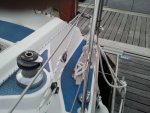
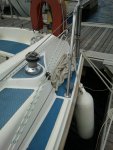
You can just see one in these pics. I can take a better one if need be. Will try running a jib sheet through one in the morning. The sheets were rigged from the cars to the winches when i bought the boat, but that's no guarantee, there were a few oddities with the rigging. I've always thought the angle from the cars was a bit steep but never thought of running the lines through the blocks as i thought they were spi blocks.

Not sure where else to run the chute sheets though, i've got a solid toe rail. If the blocks don't work i might have to fix some pad eyes or something to it.

2016-07-06 20.45.47.jpg2016-05-24 14.23.36.jpg
 
Just to add a couple of bits.

Let us know eventually what type of chute/spinn you have.

If it's a 3 sided chute with a definite luff the clew will probably be quite high so it will be easier to set.

You will be surprised how close to the wind you can fly it.

Can echo the adjustable tack . Going downwind you can get it to fly "further out" and get away
with not using a pole. If you start to roll tighten up on the tack.

And if it all goes wrong in a squall you can just let go the sheets and let the sail "flag" . I'm still learning so would welcome any other tips. Love the motoring downwind tip.

Have fun.
 
Last edited:
Re the bucket, I happened to have some buckets, courtesy of my son when he was managing a pharmaceutical company and they were the containers for some of their raw materials. All you really need is a strip of strong and flexible plastic. Think discarded laundry baskets, basins, buckets; most anything will do. The plastic only serves to provide a smooth sliding surface. The strength lies in the polyester webbing.
Re the sheet, I normally only rig one, as do many others. However, since I have made the tacker, I intend to try useing a long doubled sheet with an alpine butterfly in the middle and fastened to the clew with a soft shackle.
On the Centaur, I used to pass the free end of the sheet through a block that was lashed on a loop of rope (grommet). I looped the grommet through the aft mooring cleat and then passed the block through the emerging loop of the grommet, making what looks like a cow-hitch or lark's head:
0021-121x300.png


On my present boat I have snatch-blocks on the aftermost car on the Genoa track. You use and adapt what you have; use your imagination and improvise. Experiment on a fine day. There are no hard and fast rules; the 'right' way is what works for you on your boat and not what you see on a book.
Above all else, have fun because, after all, that is what sailing is all about. ;)
 
You can just see one in these pics. I can take a better one if need be.

Weird. The angle of that block looks all wrong for both jib and spinnaker sheets.

The way it's installed over the treadmaster suggests it's not part of the original design, which makes it particularly unlikely to be for the jib sheet. If a previous owner fitted it for spinnaker sheets then I think he did a pretty bad job (it won't lead well to the sail and even worse to the winch). Maybe part of some idiosyncratic rigging or even mooring system that only its installer would understand?

Pete
 
Re spin sheet blocks pic: a fine location for boats with diposible pushpits.

Otherwise best removed pdq I would say.
 
Re spin sheet blocks pic: a fine location for boats with diposible pushpits.

Otherwise best removed pdq I would say.

??

It's not going to work as a sheet block, but I can't see what harm it would do to the pushpit.

Unless you're looking at the flying block with the (I assume) furling line in it? We're talking about the cheek block on deck, next to the pushpit leg.

Pete
 
Missed them on the iPhone earlier ....oops!

Now fully agree with your point re sheets. Regarding the pushpit 'whatever-it-is', the size of the ropes and the existence of a block makes me wonder about the perpendicular leverage.

General point when setting up for a spi, both As and Ss: the load forces can build up pretty quickly, exponentially so when for example one decelerates rapidly after dunting a big wave ....worth bearing in mind at the setup stage.
 
Regarding the pushpit 'whatever-it-is', the size of the ropes and the existence of a block makes me wonder about the perpendicular leverage.

My assumption is that the jib's on a continuous-line furler, and this is the cockpit end of the loop. The block shouldn't carry any significant load, it's just there to keep the line tidy. It's on a length of bungee to keep a bit of tension in the loop. If you did try to furl the jib by pulling the wrong half of the line the wrong way, you'd probably snap the bungee before hurting the pushpit.

The line is the size it is in order to give sufficient grip on the drum.

Pete
 

Not sure I want to do that to the furler. Soner or later you will have the chute up in more breeze than you first thought of, or you will want to luff up to avoid something. There can suddenly be a lot of load on the tack.

The best way to run the tack line varies from boat to boat.
 
My assumption is that the jib's on a continuous-line furler, and this is the cockpit end of the loop.

Certainly not a prob if it's only bungee that is ever attached. Incidentally I'm intrigued if that is indeed a continuous line jib furler as such systems are typically used for free flying dyneema luff jibs deployed at specific wind strengths on racy boats. They're also useful on cruisy boats for flat small blade jibs when the degree of furl destroys the shape of the standard furling headsail. Not cheap though!
 
Not sure I want to do that to the furler. Soner or later you will have the chute up in more breeze than you first thought of, or you will want to luff up to avoid something. There can suddenly be a lot of load on the tack.

The best way to run the tack line varies from boat to boat.

I understand your point. However, the major pulling will be more or less 'vertical' along the luff of the sail and down to the tack line. The only 'horizontal' pull against the furler will be the resultant component of the other two. Given the flattish angle between the luff and the tack line this component force will not be that great. Consider the pull on a Barber-hauler when compared with the massive load on a Genoa sheet; it is nowhere near, plus the fact that the furler is some 15 metres long.
 
My assumption is that the jib's on a continuous-line furler, and this is the cockpit end of the loop. The block shouldn't carry any significant load, it's just there to keep the line tidy. It's on a length of bungee to keep a bit of tension in the loop. If you did try to furl the jib by pulling the wrong half of the line the wrong way, you'd probably snap the bungee before hurting the pushpit.

The line is the size it is in order to give sufficient grip on the drum.

Pete

Full marks there Pete, that's exactly right. The furling line is 8mm and the tensioning line is 6mm braid. Neither is under any real load, apart from a light load on one "end" of the furling line when part furled.

When i bought the boat it was a two handed/two man job to unfurl the jib. It needed a hand to pull the unfurling side of the furling line, otherwise just pulling a sheet allowed both sides of the furling line to wrap around the furling drum. I added an extra stanchion block, the block in the aft of the loop, the cam cleat and the tensioning line. The jib now unfurls by pulling a sheet and can be furled one handed.
 
Top