Crossing the SW Sunk

I asked the question about speed before I really thought about the distance covered. 4 minutes total is irrelevant. I appreciate the difficulties but nevertheless I think it gives some useful data.

 
I'll try and extract some detail from the log but briefly we came back across earlier today a little to the North of the recommended track and at around half tide had no less than 4.4m all the way across. The depths seemed more consistent with a simple sandbank too in that they got gradually shallower, stayed about the same for a while and then went deeper

my empirical impression is that the SW Sunk must be moving north
 
Not data but we crossed today at 09:00 and it is shallower around the northern waypoint, I found more water by running slightly to the north of the track. I saw around 3 metres all the way accross the middle. 1.5 - 2.0 at the edge of the track to the south. My IMPRESSION was that it has moved NE a bit.

Regards

Ian & Jo
 
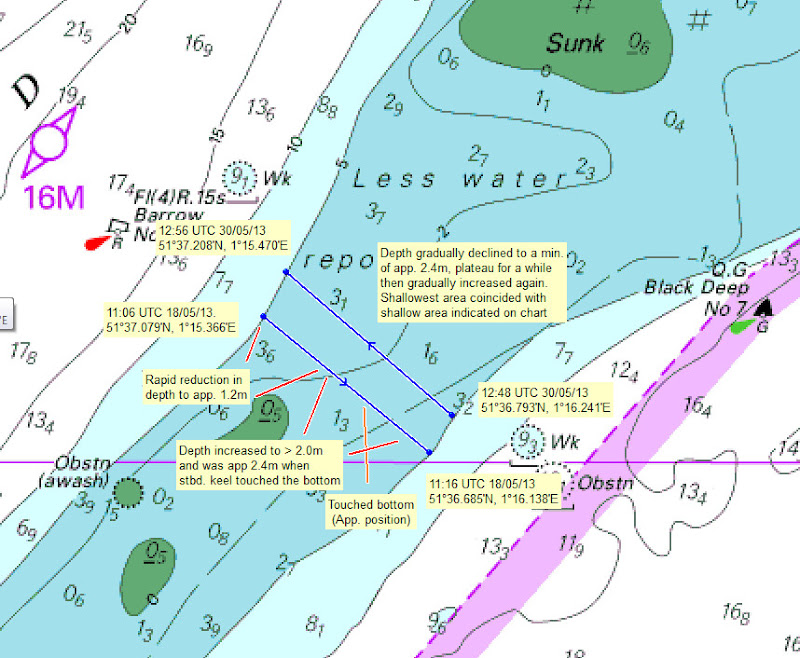
Finally got around to extracting some data from the logs

SWSunk.jpg


Our depth sounder is not calibrated and is located roughly 0.2 to 0.3m below the waterline, I have made allowance for the offset in the depths quoted

Tide tables for SE Long Sand on the 18th May gave Low Water at 11:13 of 1.47m

For the 30th May, LW was at 09:44 of 0.77m followed by HW at 15:52 of 4.61m.

On the outbound leg, we crossed as planned at , or close to, low water but should have had enough water in the fairly flat conditions given the neap tides

On the return, we crossed (again exactly as planned!) at half tide on the flood.

The downside of doing so was that we had several hours of foul tide on the way up from N. Foreland in order to reach the SW Sunk at that time (and the same would apply coming the other way - the big gain of crossing at Low Water was carrying a fair tide almost the whole way from N. Fambridge to N. Foreland)

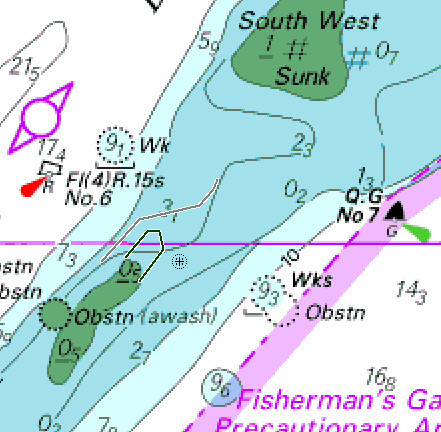
SWSunk2.jpg


My impression, for what it's worth ... and I emphasise this is JUST a guess ... is that the drying patch to the South of the crossing has extended Northwards as I've sketched on the chart above. The depths we logged at the state of tide when we crossed would be roughly consistent with a drying height of around 0.5m at LAT which fits

The depths and tide on our return would suggest about 0.5m of water over that area at LAT so not enough to make it viable at all states of the tide even on the more Northerly track

In both cases, unless I've got my sums wrong (and I'm still learning this stuff so please don't rely on my maths!) we found a good deal less water than expected based on the last survey
 
Out of interest, what's Mystique's knoll and why is it called that?

Sorry, been varnishing so didn't see the post. Mystique is a nice Mobo based at Fambridge. Planned to go to Calais and carefully plotted their course across the SW Sunk; not having seen the CTTE chartlet, they opted to cross where the nice 3.7m is charted (see Peter's image), only to find that it dried at least a foot!. Went hard aground. Having shafts, the moment they touched, they had to stop engines as reversing would have grounded the props. As the tide returned, their 44ft Mobo started to pound a little but eased a touch because the Walton LB had been out and stretched out their anchor chain. It's written up in one of the early East Coast Sailing Magazines if you look at the back copies. I just named the knoll after Mystique - daft really. On the latest Imray charts, you will see that they had adopted my soundings for their; UKHO gave us a 'Less water reported' warning as you can see on Peter's image.

Peter - helpful stuff. I'll see what it looks like on my chart but it seems quite clear that it is quite different from last year.
 
Sorry, been varnishing so didn't see the post. Mystique is a nice Mobo based at Fambridge. Planned to go to Calais and carefully plotted their course across the SW Sunk; not having seen the CTTE chartlet, they opted to cross where the nice 3.7m is charted (see Peter's image), only to find that it dried at least a foot!. Went hard aground. Having shafts, the moment they touched, they had to stop engines as reversing would have grounded the props. As the tide returned, their 44ft Mobo started to pound a little but eased a touch because the Walton LB had been out and stretched out their anchor chain. It's written up in one of the early East Coast Sailing Magazines if you look at the back copies. I just named the knoll after Mystique - daft really. On the latest Imray charts, you will see that they had adopted my soundings for their; UKHO gave us a 'Less water reported' warning as you can see on Peter's image.

Peter - helpful stuff. I'll see what it looks like on my chart but it seems quite clear that it is quite different from last year.

If you're going to give it a name, it's as good as any. :) Thanks for the info, Roger.
 
As I was looking forward to our first Thames Estuary crossing from Burnham to Ramsgate (and yes I've got the book and I printed the crossing waypoints out) I'm now a little apprehensive. If I'm following the CTTE chartlet across the SW Sunk what state of the tide will I need to cross when my draught is 1.5 metres? From the chartlet it looks like even at low tide I would cross okay on the recommended route but now I'm not so sure after reading this post. As Roger's book is on the boat and I'm not, I was planning to get to the Whitaker Beacon at low tide and take the flood down to Ramsgate although I know it would be pushing me south eastwards part of the time not due south.
 
As I was looking forward to our first Thames Estuary crossing from Burnham to Ramsgate (and yes I've got the book and I printed the crossing waypoints out) I'm now a little apprehensive. If I'm following the CTTE chartlet across the SW Sunk what state of the tide will I need to cross when my draught is 1.5 metres? From the chartlet it looks like even at low tide I would cross okay on the recommended route but now I'm not so sure after reading this post. As Roger's book is on the boat and I'm not, I was planning to get to the Whitaker Beacon at low tide and take the flood down to Ramsgate although I know it would be pushing me south eastwards part of the time not due south.

You're right to be not so sure - you're planning to do pretty much what I planned to do and IMO you probably won't have enough water over the SW Sunk - as already mentioned we saw less than 1.2m of water at LW neaps on the CTTE recommended track

On the more Northerly track we took on the way back my estimate is a depth of about 0.5m at LAT so you might be all right depending on whether it's springs or neaps but I'd be a bit reluctant to risk it myself until Roger has had a chance to run a new survey
 
When we came back from Ramsgate to Burham last summer, we must have gone the long way as we didn't get near the SW Sunk - we went inside the Thanet windfarm, west along the ?Princes? channel, north east up the ?Swin? channel and into the Crouch. (Proper names on the chart/log on board). Could we have gone a different way?
 
As I was looking forward to our first Thames Estuary crossing from Burnham to Ramsgate (and yes I've got the book and I printed the crossing waypoints out) I'm now a little apprehensive. If I'm following the CTTE chartlet across the SW Sunk what state of the tide will I need to cross when my draught is 1.5 metres? From the chartlet it looks like even at low tide I would cross okay on the recommended route but now I'm not so sure after reading this post. As Roger's book is on the boat and I'm not, I was planning to get to the Whitaker Beacon at low tide and take the flood down to Ramsgate although I know it would be pushing me south eastwards part of the time not due south.

I've always taken the advice to leave Burnham around 2-2.5 before HW to get to Whittaker at HW. The journey up The Crouch is a slog, of course, but the tide should be in your favour for the rest of it. And it means you'll have water for the SW Sunk.

As it stands, I would think twice about crossing it more than 2 hours either side of HW.
 
Arriving at High tide Whitaker confuses me. Taking today’s tides off Belfield as an example, I have 05.57 low water Whitaker Beacon which is similar to low water Dover at 05.59 and the tidal flows in East Cast Pilot at 5 hours before Dover HW (11.19) are either slack or south so getting to the Whitaker itself at High Water as opposed to low water should mean an adverse tide all the way to Ramsgate.
Arriving at the Whitaker at low water leaves me roughly 4 miles to Barrow No 5 and a further 3.5 to Barrow No 6 before attempting the crossing. At 4 – 5 knots that will be at least an hour and a half – possibly two - after low water Whitaker Beacon and the tide will be rising (Belfield says 1.39 at the Whitaker Beacon at 7.30 a rise of half a metre). What’s the informed opinion – will I get across? Looking at the overlay on Roger's chartlet it looks like the track is still viable but there will be a couple of humps of 0.2 and 0.7 to the south, but a dogleg with a waypoint slightly to the northof the track half way across should avoid them. All advice welcome as I've no problems negotiating the Swin or the Ray Sand channel - they are known qauntities to me but the estuary corssing is new!Does anyone know when Roger will be doing his survey?
 
Last edited:
Arriving at High tide Whitaker confuses me. Taking today’s tides off Belfield as an example, I have 05.57 low water Whitaker Beacon which is similar to low water Dover at 05.59 and the tidal flows in East Cast Pilot at 5 hours before Dover HW (11.19) are either slack or south so getting to the Whitaker itself at High Water as opposed to low water should mean an adverse tide all the way to Ramsgate.

Exactly what I thought too ??? Crossing at or near LW (if a safe LW crossing point can be found) when heading South gives you a fair tide all the way out of the Crouch to the crossing and then the tide turns and gives you a fair(ish) tide all the way to the North Foreland

Arriving at the Whitaker at low water leaves me roughly 4 miles to Barrow No 5 and a further 3.5 to Barrow No 6 before attempting the crossing. At 4 – 5 knots that will be at least an hour and a half – possibly two - after low water Whitaker Beacon and the tide will be rising. What’s the informed opinion – will I get across?

Depends when you go, springs or neaps.

Today, for example, at 2 hrs after LW SE Long Sand (04:45 0.88m) I wouldn't reckon on finding much more than about 1.6m on the more Northerly track which would be just about OK for us but a bit near the knuckle with a 1.5m draught!

Next Friday though you'd be looking at LW SE Long Sand at 09:10 of 1.08m giving about 1.85m. Hmmm

I reckon you need to be talking (as we did) half tide or higher e.g. at least 3 hours after LW to be sure of definitely having enough water. Means an additional hour of foul tide on the leg towards Ramsgate but hey ho

We crossed (going the other way) between 51°37.079'N, 1°15.366'E and 51°36.793'N, 1°16.241'E which is about about a cable (roughly 200m) North of the recommended track but for all I know we got lucky and avoided disaster by millimetres!!!

Does anyone know when Roger will be doing his survey?

When he gets the chance I presume. Whenever that is I shall be fascinated by the results!
 
When he gets the chance I presume. Whenever that is I shall be fascinated by the results!

I tried last Monday and called it off because the sea was too lumpy for accurate results plus I had no desire to clump the sand in a lumpy sea! Currently looking at the end of next week (Thurs/Fri). The tide is right for me to drop down from West Mersea with the ebb, arrive there on a rising tide, do the survey and return on the second half of the flood in time to get the club launch home! Hope these winds drop a little. I have found by experience that 10kts of wind is about the max if I want to avoid excessive roll. It's a pain because that generally means that I need to do a lot of motoring to keep to the schedule - which reminds me that I need to change the filters after shocking the fuel!
 
Arriving at High tide Whitaker confuses me.

Well, I'm happy to cede to greater wisdom on here, but by my calculations (and the Imray tide app) the tidal stream is pushing East after high water. As you cross the black deep, this inevitably mean NE, but you're more or less pointing across it at right angles anyway to aim for Fishermans Gat with the tide. The tide should be with you by the time you reach Fishermans and, unless you're much faster than me, it will have turned in your favour by around N. Foreland by the time you get there. I had around 7 - 7.5 SOG from Fisherman's Gat on, which I never see through the water I can assure you. But, of course, you take the hit getting out of the Crouch and have to go the long way round the Sunk. Swings and roundabouts, really.
 
Top