Crossing Thames Estuary

That makes more sense, yes next week looks better ? That’s why we came up to Ipswich for a few days, going home by train Tomorrow lunchtime, would like to come and briefly say hi if you on board
Should be onboard all morning Dave, give me a call before coming, to be sure. I'll PM my number.
 
It was very different back then.

I found it quite scary - you had to know exactly where you were, it seemed, miles from shore, to avoid ending up on a sandbank (which could be very dangerous), especially allowing for getting one's position wrong, engine breakdown or wind changes etc., when deep water was criss-crossed and immediately adjacent to very shallow, even sometimes drying, depths, and one minute you might be touching the bottom and the next you were scrambling to keep clear of a big ship bearing down on you fast. (There were more ships back then.)

But it was also a wonderfully mysterious and atmospheric place, especially in poor visibility, with strange structures - weird beacons (now mostly gone), forts, etc.- scattered about, and ships foghorns sounding.
It was indeed mysterious, and my then novice pilotage skills didn't help either. It was necessary to approach every buoy close enough to read its name. On one terrifying occasion I found myself in rapidly shallowing water just when I thought I was safe, with the echo-sounder reading less than five feet. It was only when it passed zero that I realised that the whirly thing had already passed sixty feet.
 
I found it quite scary -

I find the thought of crossing the estuary properly scary now and have yet to find sufficient confidence to give it a go.

So far the east side of Cork Sands and the seaward side of the Gunfleet wind farm are as far as I've dared venture off the coast in the last six years and err... well, that's about a quarter of the way across.
 
I find the thought of crossing the estuary properly scary now and have yet to find sufficient confidence to give it a go.

So far the east side of Cork Sands and the seaward side of the Gunfleet wind farm are as far as I've dared venture off the coast in the last six years and err... well, that's about a quarter of the way across.
Given a modicum of common sense and modern aids it is almost a doddle these days if you wish to stick to buoyed channels, There is is nothing wrong with doing this but with a bit more confidence you can skirt the shallows to shorten the distance or even cross some of the sands. I wouldn't cross the Gunfleet myself except at the Spitway but the Little Sunk passage is wide and safe while the SW Sunk needs care and recent information, which I don't have. We crossed from the Blackwater to Whitstaple in our first cruising year in our then Westerly Cirrus drawing 3' 6" with its fin and no electronic aids or even a radio, in 1972, and that didn't feel more than moderately adventurous.

The only hard bit is to make the tides work well for you. I maintain that unless your name is Charles Stock this isn't truly possible, but we always made it eventually.
 
Coming from the Orwell it often seemed a race against time to get to the North Foreland before the North going tide started. If late then those last few miles into Ramsgate seemed to take forever.

One time we did get it right but decided to push on to Dover where we ran out of tide just at the South Foreland eventually arriving in the tidal marina just as the clock chimed pub closing time.
 
I maintain that unless your name is Charles Stock this isn't truly possible, but we always made it eventually.

Or our very own Roger Gaspar - I've got his Crossing the Estuary book and all the theory I need but lack the cojones to put it all into practice. I'd love to live the dream and get down to Poole harbour and the Dorset coast where I sailed as a Yoof but although I've done Walton to Ramsgate once before as crew a long time ago as a solo skipper faced with the prospect of going out of sight of land on my own it still seems a very big ask.
 
Coming from the Orwell it often seemed a race against time to get to the North Foreland before the North going tide started. If late then those last few miles into Ramsgate seemed to take forever.

One time we did get it right but decided to push on to Dover where we ran out of tide just at the South Foreland eventually arriving in the tidal marina just as the clock chimed pub closing time.
On my first trip right round Kent - we’d done Normandy via Boulogne several times - I set out from Mersea island anchor at 6am intending to stop at Dover but found ourselves there at 2.30 with plenty of tide, so we carried on and got to Brighton at 2.30 am intending our Sadler 29, with the rising wind having followed us round the whole way, having started as an easterly. One of my better trips.
 
Or our very own Roger Gaspar - I've got his Crossing the Estuary book and all the theory I need but lack the cojones to put it all into practice. I'd love to live the dream and get down to Poole harbour and the Dorset coast where I sailed as a Yoof but although I've done Walton to Ramsgate once before as crew a long time ago as a solo skipper faced with the prospect of going out of sight of land on my own it still seems a very big ask.
You need to plan for the whole passage, but at any point you only have to sail to the next waypoint, so basically you are just sailing a series of 5 to 10 mile legs, which is well within your ability.
 
Finally back home so may I just add: You need permission from the Port of London Authority to cross or use the Black Deep. Call up VTS on Ch 69 as you approach while on the Little Sunk. It is very unlikely to be refused although they might want you to heave-to while a container ship passes - typically they travel at 19-20 knots and have no room. The London Array also do like you to call up any maintenance vessel prior to entering Foulger's Gat. Again very, very unlikly to be refused but if that huge Jack-up vessel was getting into position adjacent to a turbine one side of the Gat, their concentration would be important.
 
Basedat SYH, going south from Harwich, I always refer to be at Stone Banks at around low water. This gives the last of the ebb out of the river, then flood up the Wallet or the Swin and Black Deep, depending how far south you are going. If there is enough wind to keep moving, it's then possible to catch favourable Tides around the Forelands to reach Dover, but it will be running foul before you reach Dungeness. Last did this a couple of weeks ago, stopping at Dover and then Eastbourne en route to Fecamp, and Honfleur. After a week enjoying the pleasures of Honfleur we returned,stopping only at Eastbourne, managing the Eastbourne - SYH leg in a longish day, getting berthed at dusk, just in time for last orders on the lightship.
 
You need to plan for the whole passage, but at any point you only have to sail to the next waypoint, so basically you are just sailing a series of 5 to 10 mile legs, which is well within your ability.

Of course.

I know how to do the theory but haven't yet managed to fight off the doubts and put theory into practice when the land disappears over the horizon and you're out there on your own.

I'll have a go. One day...
 
Of course.

I know how to do the theory but haven't yet managed to fight off the doubts and put theory into practice when the land disappears over the horizon and you're out there on your own.

I'll have a go. One day...
The land only disappears for a while & there are so many wind mills that you always have an idea of where you are going to avoid dissorientation. One point I always tell people doing it for the first time, is to look back & take notes of anythng that gives a bearing. ie the end of Gunfleet Wind farm or the red lights on the masts between Clacton & Walton as they clear a particular point on your trip. The transformer unit in the London Array. The mast at the southen end of the London Array. Keep a note of depth changes. The spit at the end of the southern side of fishermans Gat is narrow so the depth goes down & up quite quick as you cross it. Look for the tower & sail round it using the depth sounder & keep the windfarm on the right
So when you return you have little transits or know what to look for to help you back, or points to guide you
It is a milk run
 
Of course.

I know how to do the theory but haven't yet managed to fight off the doubts and put theory into practice when the land disappears over the horizon and you're out there on your own.

I'll have a go. One day...
There is probably a Latin word for fear of being out of sight of land, or there ought to be. I suppose it comes from concerns about being disorientated, something that seems to affect some people more than others. I have often found when taking people out for a jolly off Harwich harbour that they lose their bearings, even with the Naze and Felixstowe in sight, even one forum member who I found to be steering about forty degrees off course.

Db’s advice is good, and I think the trick for a novice is to get into the habit of more or less continuously checking visual cues along with the compass. A good sailor will also instinctively know where the wind is coming from too, which also provides a reference point. When you get used to it, I hope you will find that there is great satisfaction to be had from really being out of sight of land or anything, and the chance to enjoy something approaching real remoteness, perhaps with a passing dolphin or a visit from a fulmar.
 
Of course.

I know how to do the theory but haven't yet managed to fight off the doubts and put theory into practice when the land disappears over the horizon and you're out there on your own.

I'll have a go. One day...

Once you've done it, at least with a chart plotter and decent weather, it doesn't seem nearly as complicated or difficult as you likely fear.

The layout of the banks and channels is very confusing looking at the chart for the whole estuary, but you are only progressing through a tiny portion of that whole, and at a very sedate pace given the scale of the whole thing. Once you've chosen your intended route, you only have to deal with fairly simple pilotage.

The sandbanks, especially, do deserve respect (shipping also) - know where you are in relation to the nearest banks (and deep water channels), and don't push your luck crossing banks or cutting corners passing round the ends of them. (Depths do change over time - treat charted depths with a degree of scepticism.)

To reduce your anxiety about it, perhaps arrange to cross first time with someone who has done it before - in company with another boat (of a similar speed), as crew on someone else's boat, or with someone who's done it before aboard yours. (You could probably find such opportunities if you ask on this forum.)

Go for it! And enjoy it. (y)
 
Where are you based Sailing steve?

I'm in the Backwaters - and have a shallow enough draft to (just) cross the shallows around Pye End at LW so I'd plan to be off the Naze around then. I'd go on neaps as that gives a bigger safety margin with depths and less stream to combat if the trip takes longer than planned.

I'm probably not the only person on here who appreciates the work you've put into your Crossing the Estuary book as well as the weekly NTMs you post - many thanks for both.
 
If it was easy and stress free it probably wouldn't be so much fun.
Two things have tripped me up in recent years. 1/ complacency, a nice sunny day & gentle breeze, it's easy to relax and not pay attention to navigation.
2/ cross tide effect in narrow swatchways. You can think you're steering straight for that buoy but could be going at 45 degrees off course.
 
I'm in the Backwaters - and have a shallow enough draft to (just) cross the shallows around Pye End at LW so I'd plan to be off the Naze around then. I'd go on neaps as that gives a bigger safety margin with depths and less stream to combat if the trip takes longer than planned.

I'm probably not the only person on here who appreciates the work you've put into your Crossing the Estuary book as well as the weekly NTMs you post - many thanks for both.

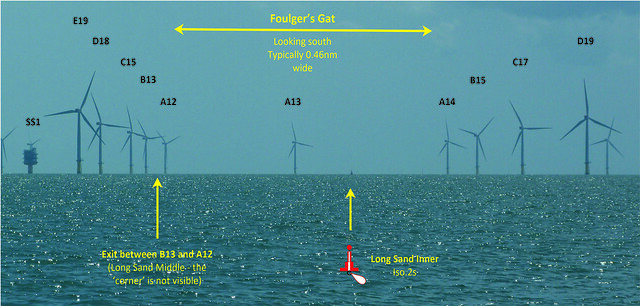
I was thinking, later in the season you should come out with us when we check on the Little Sunk. From the Blackwater via Spitway and Swin and proding around the Sunk Sand opposite the Wind Farm could be quite interesting:

Foulger's Gat by Roger Gaspar, on Flickr

It's half way across there are a lot of little things that give confidence.

I fear I must be antient. First time we had the beacons and had to use the North Edinburgh Channel. Couple of years later I worked out Decca and we when through the Fisherman's Gat using it which then wasn't marked at all. Somehow I got interested in how the sands and tides all worked. Going north through the Fisherman's was nice conditions but 10 minutes further along the Black Deep, Decca was saying we had 11kts SoG (wot with an old wooden boat!) and turning out of the Black Deep was a desperate beat to windward of Harwich Harbour holding the spring ebb and freshened NW wind. A bit wet. So I thought the sands and tides could be usedto advantage - hence the tables in the book which allow you make many choices - e.g. heading south starting at the right time to arrive with a south going tide down North Foreland. Or if wanting to get up with the tide all the way up the Blackwater what time do we have to depart from Ramsgate. All so easy.
 
Top