what would be the best galvanised shackles to use for mooring chain ? i have previously used jimmy green galvanised shackles which i think are basically green pin shackles hot dipped.
Green Pin shackles are an excellent product, as are Crosby shackles. You would not go wrong with either - if sized correctly.
Using galvanised shackles is a bit of a waste of time, the galvanising wears off quickly. But you may not be able to source either ungalvanised so you might find you don't actually have a choice. If you are using the shackle at the seabed the wear is a combination of corrosion and abrasion, with abrasion being the most critical. You thus want lots of steel as it will last longer, so bigger rather than smaller.
But you don't say how or where in the mooring assembly you are going to use the shackles, nor how big is the vessel - so my comments lack focus. You also omit to mention how often you check your mooring every quarter, annually, every 5 years.....
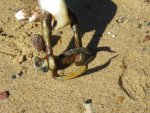
This is a shackle that failed, infrequent servicing. The shackle sits on, or near, the seabed - you can see the wear on the chain (and shackle). The shackle was ungalvanised. The wear is effectively caused by abrasion - you can see that much of the shackle is not worn at all. The chain is a G30 quality, not an alloy steel, the chain is also ungalvanised. The shackle is alloy, the chain wears more quickly than the shackle (the shackle steel is hard, the chain soft, the chain abrades more quickly. So a good alloy shackle is what you want. These shackle pins are peened or welded closed.
Green Pin shackles are an excellent product, as are Crosby shackles. You would not go wrong with either - if sized correctly.
Using galvanised shackles is a bit of a waste of time, the galvanising wears off quickly. But you may not be able to source either ungalvanised so you might find you don't actually have a choice. If you are using the shackle at the seabed the wear is a combination of corrosion and abrasion, with abrasion being the most critical. You thus want lots of steel as it will last longer, so bigger rather than smaller.
But you don't say how or where in the mooring assembly you are going to use the shackles, nor how big is the vessel - so my comments lack focus. You also omit to mention how often you check your mooring every quarter, annually, every 5 years.....
I check it all the time summer time as It's a drying mooring so easy to check, I fitted the riser chain myself last year but didn't use any silicon or thread lock so I will replace the old shackles with new myself, I did use monel wire on them though.
I check it all the time summer time as It's a drying mooring so easy to check, I fitted the riser chain myself last year but didn't use any silicon or thread lock so I will replace the old shackles with new myself, I did use monel wire on them though.
If its a drying mooring peening is possible - but then you need to chop it off.
It it's a drying mooring it will be easy to check the state of all the components. We lease our mooring space from the State government - they now demand (rightly so) a receipt of annual service prior to renewing the lease. We own our mooring but have it serviced commercially, its 10m deep and is composed of 2 x concrete blocks one is 1t the other 0.5t. Its difficult to service oneself
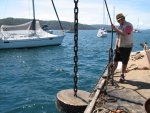
This is our original mooring. It now has an extra 0.5t block. There is also a sweep chain attached 'higher' up. The sweep chain is attached to the heavy duty chain (recycled from mining) with a swivel and shackles. The mooing pennant is then attached to the sweep chain with a shackle, previous photo, with hosepipe to protect the splice. I think your moorings have chain (instead of our mooring pennant) which is supported by the buoy - so a different design.
The heavy duty chain last forever but the shackles and swivels are regularly replaced - left unattended they last around 3 years.
That's our cat, in the background behind the man's back - I come to watch the mooring servicing and have left our cat on a Police mooring
In NW Scotland the local supplier, Gael Force, recommend Green Pin shackles and I have found them excellent - although of course I have no control experiment with another type! We use the Bow shackles type 'BN' from Van Beest which have a nut and cotter pin for security instead of needing mousing (and we use loctite as well).
But I echo Neeve's point that where you are makes a huge difference. Where my mooring is the bottom is very soft mud into which the chain sinks so the environment at the shackle on the seabed is pitch dark and anaerobic, meaning that steel simply doesn't rust and the wear is pretty much zero, in stark contrast to his aerated and sunlit sandy sea bed. Mechanisms for wear-out are bound to be different!
It's possible that galvanising is a waste of time but it's so much nicer to handle a new galvanised shackles than black ones which will already be rusty, and the black ones are impossible to obtain with any idea of their provenance or WLL, so I always go for Galvanised. This applies both to the shackles at the bottom of the riser as well as at the top.
At the bottom, the inspection and the replacement - to change the riser chain rather than because the shackle has corroded - is done by a diver, for whom shackles which are clean and easy to do up while underwater are key. For the upper assembly, where all the corrosion and wear occurs, we replace the shackles and swivel as soon as the galvanising has gone - which is every 2 years or so. Riser chain lasts longer, maybe 4 or 5 years(1), and the sea-bed anchors and heavy (28mm) chain between them lasts pretty much for ever.
(1): when replaced we make it over length by 2m or so. That way, when it's getting corroded at the top we just cut off and throw away the top metre. This allows us to extend the chain life a few years before it needs replacing.