Crimping electrical wire terminals?

Crimper is as per pic two above. Cheapie from Maplins.........

This cheapo DIY stuff is a direct shortcut to an electrical desaster. Using these kid's toys will result in an unacceptable highly variable crimping force. Either invest in a real crimping tool or ask a certified electrician to do the Job for you. The connectors btw are color coded: Red = 1.5mm2, Blue = 2.5 mm2, Yellow= 4mm2.
 
The connectors btw are color coded: Red = 1.5mm2, Blue = 2.5 mm2, Yellow= 4mm2
Thanks for that info - I've been wondering about that. I've got some electrical work to do today and am hoping my new ratchet crimpers will arrive from Amazon Prime.
 
I recently switched to one of these from EBay after reading comments on here:

$_12.JPG


and also switched to these kind of crimp connectors:

Cembre-Heat-Shrinkable-Butt-Crimp-Connectors-Halogen-Free-WL-M.jpg


and with the rewire I've done so far have been more than happy with the results, coupled with a bit of heat shrink where I felt it would help.
I don't suppose you've tested the joints made with these. have you?

I don't know if this is the best way, but Maine Cruising made some tests by hanging weights off the crimped joints: http://www.pbase.com/mainecruising/wire_termination&page=5

I would have high confidence in the Klauke 507's that sarabande recommends, but they're over £100 + VAT. If I thought a I could get a pair from eBay for £15 which would do the job just as well, I would be delighted.

Maybe someone could make a PBO article of testing.
 
Have I been extraordinarily lucky then? I've been using a Maplin crimper for at least ten years with a significant success rate. Not a heavy user, probably tens of crimps per year, but not a lot of failures, certainly better than 1 in 10 but I've not been counting. I make a point of squeezing the handles VERY hard, and screwing up my face as I do it.

From the cost/benefit analysis, I would recommend the Maplin route for anyone who is keeping a boat working rather than setting out on rewiring a project. Then a pricey set could be justified.

Derek
 
"I make a point of squeezing the handles VERY hard, and screwing up my face as I do it."
I have used a similar technique up to now using cheap crimpers from a car accessory shop. I give each joint a tug after crimping and have about a 1 in 20 failure rate.
 
I don't suppose you've tested the joints made with these. have you?

I don't know if this is the best way, but Maine Cruising made some tests by hanging weights off the crimped joints: http://www.pbase.com/mainecruising/wire_termination&page=5

I would have high confidence in the Klauke 507's that sarabande recommends, but they're over £100 + VAT. If I thought a I could get a pair from eBay for £15 which would do the job just as well, I would be delighted.

Maybe someone could make a PBO article of testing.

I've done about 50 of these over the last 3 month during an extensive rewire of the boat, i came back to one line last week after purchasing a new autohelm and was pleasantly suprised at just how good the connection was with the glued terminals. Certainly I have had no issues with the crimp tools off EBay other than them being simply not man enough to make up a a battery lead crimp (which to be fair was a big ask). The crimp is spot on each time and so much easier to locate on the piece then the thinner jobbies.
 
I would have high confidence in the Klauke 507's that sarabande recommends, but they're over £100 + VAT. If I thought a I could get a pair from eBay for £15 which would do the job just as well, I would be delighted.
As long as the dies are properly shaped I can't see that a crimp made by a cheap ratchet crimper should be any different than that made by an expensive one. The dies can only be squeezed together until the faces meet so as long as that happens there can be no difference in the quality of the crimp. There may well be other factors, ease of use, longevity etc, that make a Klauke worth the extra but quality of the crimp is probably not one of them.
I notice even Klauke sell the 'cheap' pressed metal pliers type of crimper much deprecated on here.
 
at the risk of starting a debate to put anchor threads to shame, I think that the precision crimpers achieve an electrically better and more consistent finish than the pressed metal ones because of the dies and the way that the closing pressure is regulated.


A few foot pounds of inadvertent extra pressure on a cheapie crimper from someone who has has 3 Weetabix for breakfast can distort or even cut the terminal ferrule, and damage the cable wires. Good crimpers will squeeze the dies together until the optimum size and constriction is achieved within the shape and dimensions of the dies. It is not possible to overcrimp unless you are using the wrong terminal connectors for the size of wire, or conversely. And Klauke has an adjustment to take up any wear in the ratchet so that the correct clearance can be achieved.

Other crimpers are also available, but I do like mine, even to the extent of having a big pair (K05) for battery terminals !
 
Nothing wrong with cheapo crimpers when used properly. Rule of thumb for sizes, use smallest terminal that cable will enter. If cable is much smaller than smallest (red) crimp then double it up before entering it into terminal. Always pull smartly on cable when joint completed to ensure cable is tightly held.
 
I agree with PCUK. A skilled person can make consistent and effective crimps using a hammer and V shape in a piece of metal, but good crimping kit enables amateurs like myself able to produce proper safe connections, and saves professional leckies large amounts of time and enables them to produce work to an insurable standard.
 
Like to mention also that crimps are different.

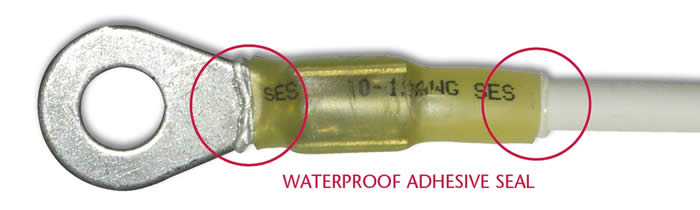
El cheapo versions and certified crimps with built in sealing certainly fall into different categories.

sealedwire.jpg
 
I find my crimps made with the pictured type 1 crimper have to be tightened with a squeeze from the type 2 ones! I assume it is down to poor quality terminals. Could the knowledgeable ones post some links to good sources of terminals, or what specs to look for.
 
Personally I prefer to steer clear of any pre insulated terminals but favor open barrel terminals and separate boots or heat shrink, my rationale for this is that it is possible to inspect each crimp for security and strand damage including the strain relief crimp on the insulation, something that is simply not possible with pre insulated stuff, especially the cheapo plastic covered type. Also the “ass cheek” crimp type give a far more reliable and consistent result than squashing a barrel onto the conductor, using tinned terminals and cable with whatever snake oil grease you favour adds to the longevity. Links to terminals below, open barrel types are available in all configurations, spades, rings, bullets, pins et al. DIY quality crimp tools are available now at realistic prices too.
Terminal examples. http://www.furneauxriddall.com/acatalog/Non_Insulated_Terminals-p1.html
Crimp tool examples, you may find cheaper. http://www.amazon.co.uk/Uninsulated-Terminal-Non-Insulated-Ratchet-Crimping/dp/B00DHG3AEW
Useful video. https://www.youtube.com/watch?v=LXDedfvmI_0
 
I find my crimps made with the pictured type 1 crimper have to be tightened with a squeeze from the type 2 ones! I assume it is down to poor quality terminals. Could the knowledgeable ones post some links to good sources of terminals, or what specs to look for.
I got my last lot of insulated terminals from... http://www.altecautomotive.co.uk/crimp-terminals-insulated-un-insulated-all-sizes-99-c.asp.
They seem to be reasonable quality and I've had no failures yet. They also supply heatshrink tubing which is nice for strain relief and a nice finish to the connection.
Delivery was quick and efficient.
 
Are you sure of that? The manufacturer's website claims:


According to the manufacturers of Contralube:

Myth 2 – Lubricants interfere with conductivity
Tests on lubricated and nonlubricated connectors show virtually no difference in contact surface resistance. A contact surface is a series of microscopic peaks and valleys – like a mountain
range. Current flows through the peaks – the mountain tops, known as asperities. A contact lubricant fills in the valleys, protecting the metal from oxidation and is squeezed out of the asperities, allowing the current to flow.

Couple of comments on Contralube's observations (which I think are for connectors such as plugs, not permanent joints) - the first is that all lubricants are designed to make things move against each other easily, exactly what you don't want in a fixed joint such as a crimp. The second is that their description of "lubrication" allowing asperities to touch would be described as a failure of lubrication under most circumstances by an engineer. In practice the lubricant may not have anywhere to flow away to anyway if you are closing down on two metal surfaces.
 
Ah, with you now. Yes, that makes sense though we (RAF in the 70's and 80's) usually used either adhesive heatshrink or a drying lubricant and a stretchy tube applied with three prong pliers type things - I never knew why one would be specified sometimes over the other. Also totally agree with your last sentence - a properly done crimp should effectively just one lump of metal with no air gaps at all. Decent crimping tools (including decent dies) are essential.
Aha. Good old Hellerine. It's still available today. Used it for years in the RAF. I also always use decent crimping tools, false economy to have to do it any other way, over crimped connectors can fail without warning due to stress fatigue as well as corrosion or poor connection (which can generate heat when current flows). Not worth a fire or a breakdown for.
 
I find my crimps made with the pictured type 1 crimper have to be tightened with a squeeze from the type 2 ones! I assume it is down to poor quality terminals. Could the knowledgeable ones post some links to good sources of terminals, or what specs to look for.

Have you adjusted the release point on the crimping tool?
 
It should be noted that on the ratchet type crimping tools, the connectors/terminals only go in one way. I haven't got mine to hand but I think the wire is inserted on the side of the coloured dot.
 
Top