
Crazed plastic navlight fresnel lenses (again)

Lomax

Well-Known Member
Joined
22 Sep 2016
Messages
375
Visit site
I know this has come up before, and that it is a common problem for which the only correct remedy is to replace the lens or the entire navlight. But hey, I've got a full set of these really rather lovely Den Haan DHR35 navigation lights on my boat, and they're otherwise in quite good condition. As the lenses are non-replaceable, and a complete light cost something like £80-90, I'm willing to try some pretty drastic methods to improve their condition. I do really like the look of them, and there's in the region of £350 to save - so any suggestions? Heat? Solvents? Silicone oil?
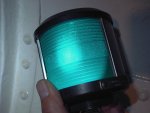
DHR35_navlight.JPG

(Picture taken while shining a torch into the housing)

Edit: The lenses are made from polycarbonate, not acrylic (or "perspex").

Edit 2: Ok, I found a better price at "Yachtshop.eu" - €62.40 a piece, here: http://www.yachtshop.eu/en/categories/3/Navigation+lights+up+to+20+and+50+m Though €250 is still a considerable amount of money...
 
Last edited:
Frustratingly, the acrylic lens is a full 360 degrees also on the sector lights (they all have identical round housings), and from what I can see the unexposed part is pristine - but it doesn't seem they can be disassembled further, which would be necessary in order to rotate the lens so that a "fresh" portion is exposed. Hmmm. It looks like they've been glued together. I'm tempted to try some (mild) violence... Is anyone here familiar with these lights?
 
Last edited:
Turns out one of my favourite YouTubers, Ben Krasnow of the "Applied Science" channel, has done a video on different techniques for removing scratches from acrylic, one of which he calls "vapour polishing" - in fact I think I've already watched this years ago, but forgot about it!


I've seen similar methods being used to smooth 3D printed objects but the polymers and solvents used differ (typically ABS plastic, "polished" with acetone vapour). This might be my best bet, though methylene chloride is pretty nasty stuff! Good thing I have a quality respirator...
 
I got hold of some stage light acetates, red and green, and lined the inside of the lamps, worked a treat.
 
Crazing is not scratchs on the surface. I don’t think that you can uncraze it

I know, but... worth a try? I'm not expecting them to clear up completely, but perhaps enough that I won't need to replace them just yet.

I got hold of some stage light acetates, red and green, and lined the inside of the lamps, worked a treat.

This might be useful to compensate for UV bleaching, but I would be wary of it reducing the light output further. Perhaps lightly coloured gels.

But it's not just the colour, the crazing also scatters the light in all directions, reducing the lamp's visibility. How much/seriously it does that will vary, of course.

That's why I suggested silicone oil; it should penetrate and fill at least some of the crazes, while having a refractive index closer to the acrylic than the air it displaces. I've had some pretty impressive results restoring faded plastics with it in the past, the cause of which is often similar (diffraction). A paraffin wax might work too, though I don't like the idea of smearing a petroleum product onto acrylic. In any case, the lenses don't need to have the optical quality of a photographic lens, or even a window - they just need to let enough light through in roughly the right direction; small imperfections should not affect their fitness for purpose.

I think there's a chance.
 
Last edited:
Crazing is not scratchs on the surface. I don’t think that you can uncraze it

You're absolutely right there. People often say "crazing" when they mean discolouration or scratching. Crazing can't be polished out - it's too deep.

Edit to add: how much does a new lamp cost, and how many hours are you prepared to spend trying to polish your old one?
 
Last edited:
You're absolutely right there. People often say "crazing" when they mean discolouration or scratching. Crazing can't be polished out - it's too deep.

Yeah, well, I'm not "people".

Edit to add: how much does a new lamp cost, and how many hours are you prepared to spend trying to polish your old one?

Cheapest price I've found is €62.40 a piece, and I've got four of them. I'm not prepared to spend much time on this, but definitely curious about "vapour polishing" - I do enjoy a bit of experimentation... I'm thinking scrub them down with toothpaste and a toothbrush first (more to clean than to polish), rinse and dry, and then pass them back and forth over the top of a glass bottle with a little methylene chloride in, which sits in a ~45 degree water bath (methylene chloride boils at 40). Outdoors. If that doesn't work at all (possible), or only leads to a very slight improvement (likely), I'll slather some silicone oil over the front and leave them for a few days, in the hope that might improve clarity further. Unless anyone has better ideas?
 
Top