Crank V-Pulley refurbishment possible?

j24jam

Well-Known Member
Joined
17 Jul 2011
Messages
281
Visit site
The Crank V-pulley on my Yanmar has been diagnosed as the cause of excess belt dust and belt eating that has happened on my 4JH engine.

Its pitted, and generally rusty.

Can these be refurbed to a good standard or is a £250-350 new one the only option?

If refurb is an option, please recommend who could do that.
 
It will likely need to be balanced if you are having it cleaned up. Might be best to take it to an engine builder after a machine shop - if they have equipment for balancing flywheels they could probably do the pulley.
 
A machine shop could easily clean up the vee groove, take a new belt to check it fits without bottoming out. What sort of vee belt is it? - maybe it can't transmit the power, try a CRE belt(Cogged Raw Edge) which transmits more power, and make sure it is sufficiently tightened.
 
A machine shop could easily clean up the vee groove, take a new belt to check it fits without bottoming out. What sort of vee belt is it? - maybe it can't transmit the power, try a CRE belt(Cogged Raw Edge) which transmits more power, and make sure it is sufficiently tightened.
Pretty certain the standard belt on my 4JH4AE is a CRE belt. It doesn't produce much dust but was swapped for a new one after about 5 years. The replacement still looks fine but will probably be replaced as it will be about 7 years old when I get to the boat next year after 2.5 years in storage.
 
On my 4JH2-DTE the belt isn't a CRE belt, but having done some research, seems like a sensible swap to make over to a CRE belt of suitable size.
 
It will likely need to be balanced if you are having it cleaned up. Might be best to take it to an engine builder after a machine shop - if they have equipment for balancing flywheels they could probably do the pulley.
Skimming it is not a good idea, the belts drive on the V sides and making them wider lets the belt slip. Balancing would not be necessary ifthe op went ahead, the lathe cuts equally all around the pulley
 
Skimming it is not a good idea, the belts drive on the V sides and making them wider lets the belt slip. Balancing would not be necessary ifthe op went ahead, the lathe cuts equally all around the pulley
The belt 'shouldn't' be sitting anywhere near the bottom of the groove, and a 'light' skim won't jeopardise that. I do agree on the balancing though (on a 3,000 rpm engine!), as long as the skim only touches previously machined surfaces. A workshop that has engine experience will know all this.

I'd suggest asking Paul Knight of Knight Marine where he'd go.
 
Re
Its pitted, and generally rusty.

Is it rusty inside the V-groove?
Is it pitted inside the V-groove?
How can that be when there is a slipping belt whizzing around?
In that case it should polished and shinny, shouldn't it?

Could the "excess belt dust and belt eating that has happened on my 4JH engine.", simply be a misaligned or loose belt?

gary
 
Re
Its pitted, and generally rusty.

Is it rusty inside the V-groove?
Is it pitted inside the V-groove?
How can that be when there is a slipping belt whizzing around?
In that case it should polished and shinny, shouldn't it?

Could the "excess belt dust and belt eating that has happened on my 4JH engine.", simply be a misaligned or loose belt?

gary
Agree, it should clean itself up. I have seen lots of belts on rusty pulleys, after a few hours they are not rusty!
Are you sure that the pulleys are in line and that you have the correct belt width, cogged belts are better than plain.
Pitting will not unduly wear a belt if it is correctly adjusted and in alignment.
 
Pitting will not unduly wear a belt if it is correctly adjusted and in alignment.

I disagree with this, a pitted pulley will prematurely wear a v-belt in short thrift. I worked as a marine engineer for many years and we would see this a lot on the VP KAD engines when the water strainers would leak above the alternator. The pulleys would get pitted and then would tear through belts. There was no misalignment in these cases - swapping out the pulley fixed the problem instantly.
 
Just waiting for the engineer to get it off then I will take a look at it.

It could be misaligned... The belt is the correct one and was tensioned correctly.
 
I disagree with this, a pitted pulley will prematurely wear a v-belt in short thrift. I worked as a marine engineer for many years and we would see this a lot on the VP KAD engines when the water strainers would leak above the alternator. The pulleys would get pitted and then would tear through belts. There was no misalignment in these cases - swapping out the pulley fixed the problem instantly.
I can understand a constantly wet belt wearing quickly but my experiences with old engines that have been left in the rain till they are very rusty convince me that the belt soon cleans the pulley surfaces and from then on the wear is not a problem.
 
I can understand a constantly wet belt wearing quickly but my experiences with old engines that have been left in the rain till they are very rusty convince me that the belt soon cleans the pulley surfaces and from then on the wear is not a problem.

If there is surface rust and they are clean then this maybe true, but I can speak from years experience that pitted pulleys have caused premature belt wear. I guess it also matters what the belt is doing - a more loaded belt such as an alternator, power steering and compressor will wear faster than a water pump drive belt for example.

So I do accept that there are cases where my observations may not apply ?
 
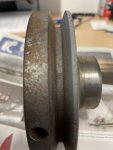
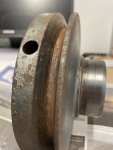
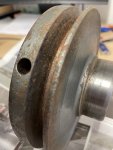
I've got the pulley in hand now and its not as bad as I thought it may be. Whats the consensus - a bit of emery paper should clean it up? Or onto a lathe?

IMG_5028.JPGIMG_5030.JPGIMG_5031.JPG
 
Anyone with a decent lathe could sort that out. The groove will probably need to be made deeper so that the working faces can be skimmed. It would end up smaller in diameter but I doubt that would be any problem.
EDIT: In view of the above comment I just point out that if I was to machine it I would mount in on a mandrel turned to fit the bore of the pulley, tapered or plain as required, and it would run perfectly concentrically after machining.
 
Top