
cr@p battery setup - practical solution to bettering

guyd

Well-Known Member
Joined
24 May 2009
Messages
208
Location
Minehead
bossingtonhall.co.uk
Im not after the holy grail of battery solutions, and to be fair, the setup I have is pretty awful at the moment. Boat 2008 Arvor/Quicksilver 7M 23ft fast fisher.

2nd battery installed by PO?

usual 1/2/both switch (yeah yeah) which powers everything, engine, leisure, lights, fridge. In practice, one can moor up / anchor up and fish, and switch 1/2/B to (say) 2, isolating 1. Switch back to 1 when starting engine, go home. Im ok with this, mostly.

I dont like that I have added two shore power, multi stage, battery chargers to charge each battery, and a VSR (so the alternator can charge 2 when running engine on 1) and when 1 gets up to charge with the battery chargers, it kicks in the VSR which equalises the two batteries - which isnt going to charge them correctly.

is there an easy way I can stop the VSR operating from the shore power chargers, yet keep it working from the alternator?

Batteries are located under the rear deck, next to engine. Space is limited.

There is a slightly bizarre earth / negative cable running from the batteries to a switch under the helm, which did nothing - big fat battery size cables, yet on or off, everything worked (it must have found an alternative power path like ther terminator in the crusher). Ive removed it and connected them together as a single earth point.
 
Im not after the holy grail of battery solutions, and to be fair, the setup I have is pretty awful at the moment. Boat 2008 Arvor/Quicksilver 7M 23ft fast fisher.

2nd battery installed by PO?

usual 1/2/both switch (yeah yeah) which powers everything, engine, leisure, lights, fridge. In practice, one can moor up / anchor up and fish, and switch 1/2/B to (say) 2, isolating 1. Switch back to 1 when starting engine, go home. Im ok with this, mostly.

I dont like that I have added two shore power, multi stage, battery chargers to charge each battery, and a VSR (so the alternator can charge 2 when running engine on 1) and when 1 gets up to charge with the battery chargers, it kicks in the VSR which equalises the two batteries - which isnt going to charge them correctly.

is there an easy way I can stop the VSR operating from the shore power chargers, yet keep it working from the alternator?

Batteries are located under the rear deck, next to engine. Space is limited.

There is a slightly bizarre earth / negative cable running from the batteries to a switch under the helm, which did nothing - big fat battery size cables, yet on or off, everything worked (it must have found an alternative power path like ther terminator in the crusher). Ive removed it and connected them together as a single earth point.

In practice, unless the "priority" battery is at a very low state of charge, your VSR will close almost as soon as the alternator is up and running. The idea that the alternator will almost fully charge one battery before it closes is something of a myth

You can manually disable the VSR while using the shorepower chargers with a switch in its negative connection. Maybe someone will suggest a way of using a relay that is normally open but which is closed by the alternator so that the VSR only operates when the alternator is running.

BUT It would be much simpler with a single shorepower charger, a dual sensing VSR and just allow the VSR to always operate to charge both batteries from either source.

Once you start improving the charging circuits in this way you are really better of ditching the 12B switch in favour of separate isolators and an emergency linking switch
 
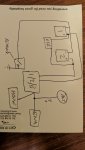
Pic of scribble of what I think it is wired as

I guess the negative switch wsa intended to be a negative isolator so that the battery (ies) could be completely isolated but that it has been bypassed. You diagram does not show how all the circuits are connected to battery negative

Nothing wrong with the way the VSR is wired. If it is a dual sensing one it will operate to always charge both batteries no matter whether 1 or 2 is selected by the 12B switch. A single charger could be connected to either battery and the VSR will charge both
 
Last edited:
is there an easy way I can stop the VSR operating from the shore power chargers, yet keep it working from the alternator?

You could put a switch in the negative connection to the VSR. Or to automate this switch, put a small normally open relay in this negative line, and let it be energized by some terminal that is live when the engine is running.
Or ditch the VSR and use one heavy duty relay to parallel the banks, using the alternator D+ terminal to control it.
 
In practice, unless the "priority" battery is at a very low state of charge, your VSR will close almost as soon as the alternator is up and running. The idea that the alternator will almost fully charge one battery before it closes is something of a myth

Very true.

You can manually disable the VSR while using the shorepower chargers with a switch in its negative connection. Maybe someone will suggest a way of using a relay that is normally open but which is closed by the alternator so that the VSR only operates when the alternator is running.

Fit a normally open relay, connect terminals 85 and 87 to -12v, connect terminal 30 to the VSR negative and connect terminal 86 to the alternator D+

Not my favourite solution.

BUT It would be much simpler with a single shorepower charger, a dual sensing VSR and just allow the VSR to always operate to charge both batteries from either source.

I agree with this, much simpler. One other solution would be to leave the two mains chargers and to fit a Victron ArgoFET, rather than the VSR, but i'd still go with a VSR and a single mains charger, batteries will charge up just fine like this.

Once you start improving the charging circuits in this way you are really better of ditching the 12B switch in favour of separate isolators and an emergency linking switch

Definitely :encouragement:

The redundant negative switch could be used as the emergency switch, just needs a couple of separate isolators. Makes much more sense than two mains chargers, IMO.
 
You could put a switch in the negative connection to the VSR. Or to automate this switch, put a small normally open relay in this negative line, and let it be energized by some terminal that is live when the engine is running.
Or ditch the VSR and use one heavy duty relay to parallel the banks, using the alternator D+ terminal to control it.

Sure we've covered this before, it's a bad idea. If something goes wrong the hard wired relay will not open if a battery fails and its voltage drops. He already has a VSR, so nothing extra to do or buy, just remove one mains charger.
 
Sure we've covered this before, it's a bad idea.

Sure we have and I guess we just have to disagree on this.
You seem to base your advice on the notion that sudden and catastrophic failure of a starter battery WHILE THE ENGINE IS RUNNING is a fairly common event. My view is that this scenario, while possible, is rather unlikely from the individual boat owner's perspective.
Why? A decent starter battery, with no other duty than to start the engine, should last 8 - 10 years if it is properly looked after. At the end of its life, it is much more likely that it is taken out of commission because of reduced capacity or other gradually developing fault than by catastrophic failure. Also, that this fault is discovered while attempting to start the engine.
Even if it does to go suddenly and catastrophically, there are close to 9 000 hours in each year in which it might decide to do so. Many (sail)boat engines run for 50 hours or less per year.
So to sum up, I think you base your categorical advice, 'bad idea', on an assessment of risk that is not realistic. There are upsides and drawbacks to every option for charge splitting and they should be balanced against each other.
All IMHO of course.
 
Having separate mains chargers for either battery is quite good. A fault in one battery won't affect the other. Each gets the charge which it needs. Each charger will indicate the health of its battery. What's not to like?

So, turning off the VSR when the engine isn't running seems to be all that is needed.
A relay in its negative line is straightforward. Have it switched by turning on the engine, e.g. the + line to the oil warning light.
(I'd prefer a solid state solution of course...)
 
Sure we have and I guess we just have to disagree on this.

I accept that you cannot see sense, even when it's spelt out for you.

You seem to base your advice on the notion that sudden and catastrophic failure of a starter battery WHILE THE ENGINE IS RUNNING is a fairly common event.

I base my advice on the fact that it can, and indeed does, happen. In your lifetime you will own a few batteries and a few less boats. Chances are i'll see more batteries and work on more boats in a single month than those figures. I've been playing this game for over 40 years, with cars and boats, so i've seen a few battery failures.

In the past month i've seen failed batteries on at least five boats. I've also seen owners faced with power problems due to charging issues, caused by poorly thought out installations and the odd user error connected with 1-2-B switches.

When i design and install a power/charging system i try to think of every single thing that could go wrong, either through faulty equipment or user error. I then build in a backup for as many of those as possible. I can't stop things from failing, but i can build in a way of overcoming that failure, as much as is reasonable.

I would never fit a hard wired charging relay. If a battery fails the relay can discharge all batteries on the boat, whilst the owner can be oblivious. First he'll know is when he turns the engine off and the alternator stops running the electronics. At this point he'll be totally without power, which means no VHF to call for help. If he dropped the anchor he'll have to haul that by hand, assuming he can sail away. If it's a mobo, he's in trouble, possibly serious trouble.

Why, when there are a host of other solutions, would anyone be insane enough to fit a device that could cause such problems ?

In the grand scheme of things, they might not be common occurrences. As i said, i know a lot of people who have had battery failures, some of whom were left stranded. I don't know anyone who has been overboard this year, but most people still wear life jackets.

To sum up, bad idea :encouragement:
 
Why, when there are a host of other solutions, would anyone be insane enough to fit a device that could cause such problems ?

Because, as I tried to explain in post #8, the risk of this very specific failure scenario (not battery failure in general) is so small. Also because there are benefits to the 'simple relay route' not present in the other handful of options.

In the grand scheme of things, they might not be common occurrences. As i said, i know a lot of people who have had battery failures, some of whom were left stranded. I don't know anyone who has been overboard this year, but most people still wear life jackets.

I am all for life jackets, but like most people I don't wear it at all times in and around the boat.
Not sure that makes me/us insane.
Maybe we are just capable of assessing risk?:)
 
Because, as I tried to explain in post #8, the risk of this very specific failure scenario (not battery failure in general) is so small. Also because there are benefits to the 'simple relay route' not present in the other handful of options.

You have no way of accessing the degree of risk as you have insufficient data regarding battery failure modes, other than from your own limited exposure to battery failures. I am exposed to battery failures on a regular basis and have been so for many years. I see several battery failures where this could cause an issue.

There is absolutely no benefit to fitting such a relay over fitting a more suitable device.
 
There is absolutely no benefit to fitting such a relay over fitting a more suitable device.

An open minded person might have asked: Really, what are those benefits, please?

Ah, forgot. Why discuss with someone who is ’insane’...

Seriously, I’m out of this thread.
 
Paul, surely by definition you are exposed to a massively higher proportion of failures because of your job QED.

One battery charger connected to One battery can effectively charge it irrespective of its state if it is then paralleled to a second battery how does the battery charger know the state of the second battery and that's what voltages to apply for best charging?

I'm only podling about in the Bristol Channel within sight of land at all times so disaster scenarios are not really on the cards. My handheld VHF will be sufficient if I have a total battery failure.

That all said I shall change the 12b two separate isolators and Bridge switch.

I look at the practicality of adding a wire to the VSR negative to control it.

Thank you very much everybody for yourl time
 
I am trying to understand this thread because I am about to buy a Victron Cyrix battery isolator to replace a relay that I think is faulty & is just a simple non voltage sensitive device (I think) It is just a simple Tyco relay.
Why I am reading this hread is because my Dolphin multi stage charger has 2 outlets ( 3 really but I do not have anchor winch) for domestic & starter.
Does this mean that I effectively have what the OP has, ie 2 shore power chargers ( even though it is one it is pushing out 2 supplies)
If so, is that, from what the OP's original post suggests, undesirable & should I disconnect the domestic battery bank & only have it to supply the starter & then let it charge the domestics through the battery isolator.
Looking at the book- The 12 volt bible - that shows a charger to just to one battery when a VSR is fitted which is what some are saying above.
It just worries me that if I put the charger on to the starter only will I get maximum charge to the domestics?

Sorry for opening the thread again but I am not electrically savy
 
Paul, surely by definition you are exposed to a massively higher proportion of failures because of your job QED.

Absolutely, and because of that, i see various types failure each year that most owners won't see in a lifetime.

One battery charger connected to One battery can effectively charge it irrespective of its state if it is then paralleled to a second battery how does the battery charger know the state of the second battery and that's what voltages to apply for best charging?

The charger can only sense the voltage at the battery to which it is connected, so technically it cannot allow for the voltage of the other battery. It wouldn't matter if it could, because it can obviously only output a single voltage. In the practice though, the batteries are in parallel, so they slowly balance out and the voltages are both the same, so the charger is working the same as it would if it was charging a large bank of several batteries. Some chargers have a separate low amperage circuit for the engine battery.

I'm only podling about in the Bristol Channel within sight of land at all times so disaster scenarios are not really on the cards. My handheld VHF will be sufficient if I have a total battery failure.

Very easy to fit a system where chances of catastrophe are minimised without having to get over technical or over complicated.

That all said I shall change the 12b two separate isolators and Bridge switch.

:encouragement: As i said earlier, you can use the redundant negative isolator for the emergency switch.

I look at the practicality of adding a wire to the VSR negative to control it.

From post #6
Fit a normally open relay, connect terminals 85 and 87 to -12v, connect terminal 30 to the VSR negative and connect terminal 86 to the alternator D+

If you really don't want to use just one charger and leave the VSR as it is, there is another option, fit a Victron ArgoFET. This will charge both batteries from the alternator, whilst keeping them separate when the engine is not running, allowing the two chargers to work independently. A single solid state device that would remove the need to the VSR and the relay. This would be a my preferred solution.
 
I am trying to understand this thread because I am about to buy a Victron Cyrix battery isolator to replace a relay that I think is faulty & is just a simple non voltage sensitive device (I think) It is just a simple Tyco relay.
Why I am reading this hread is because my Dolphin multi stage charger has 2 outlets ( 3 really but I do not have anchor winch) for domestic & starter.
Does this mean that I effectively have what the OP has, ie 2 shore power chargers ( even though it is one it is pushing out 2 supplies)
If so, is that, from what the OP's original post suggests, undesirable & should I disconnect the domestic battery bank & only have it to supply the starter & then let it charge the domestics through the battery isolator.
Looking at the book- The 12 volt bible - that shows a charger to just to one battery when a VSR is fitted which is what some are saying above.
It just worries me that if I put the charger on to the starter only will I get maximum charge to the domestics?

Sorry for opening the thread again but I am not electrically savy

Your charger is a single charger, with the outlets kept in isolation by diodes. It will all work perfectly fine as it is, with the Victron Cyrix.

If you have the Dolphin manual, it's worth checking to see if they recommend linking any unused outlets, some chargers do.
 
Top