CQR Anchors - Genuine or Fake?

[ QUOTE ]
Another thing Eric Hiscock wrote was "when anchoring with sternway the CQR or the Danforth anchor can, and should, be given plenty of chain straight away"

[/ QUOTE ]
It does sound slightly ambiguous but I'm sure he didn't mean that you should dump 15 fathoms of chain on top of the anchor.

The key is "when anchoring with [significant] sternway" and I think he means that the chain should be laid along the seabed so that the pull is as near horizontal as possible before the anchor bites. That's what I try to do anyway.
 
[ QUOTE ]
It does sound slightly ambiguous but I'm sure he didn't mean that you should dump 15 fathoms of chain on top of the anchor

[/ QUOTE ]

I don't think he meant that either.
 
Just gotta love the massive anchor theory even if it is quite flawed on a lot of occasions especially these days. 15-20 years ago I would have totally agreed but not anymore.

My 32fter had a 12kg CQR (manson version) which was OK for anchoring on but nasty nasty nasty when talking everything else i.e handling, stowing, boat performance were all negatives. It was hanging off 10mm chain/16mm warp. Going on the older theories this anchor was undersize already and the rode a smidgen big.

It now has a 4.5kg anchor hanging off 7mm chain/12mm warp which is so much better in everyway. Going on most theories this system is way lite. I would not recommend it to most people but have been trying a counter-theory of mine out for the last 6 months. I think I maybe onto something but not quite there yet.

Note: I don't have the horsepower to set either anchor by motor.

Horses for courses gentlemen not just a blanket "go monster", that's plain silly.

I'm willing to bet anyone out there a dozen dozen coldies (now that's serious /forums/images/graemlins/smile.gif ) my 4.5kg anchor will out hold and set of your 12kg CQR's in 95% of bottoms. In the other 5% is a lottery anyway.

I'll also bet my anchoring system does not detract from boat performance like many above will. PS. I don't make bets I may lose. As you may guess I already know what the results will be /forums/images/graemlins/smile.gif

As for failures of knock-off CQR's, yes there has been a few cases here. All of them were 3rd tier knock-offs i.e out of the east. Seen the odd 2nd tier issue but nothing to spooky and certainly nothing more than the genuine CQR. By 2 tier I mean quality knock-offs like the Manson, Kingston and one or 2 others.
 
I am pretty sure that you no longer get a "Lifetime Guarantee" on a new genuine CQR, and not entirely sure whether Lewmar will warrant your "Lifetime Guarantee" if you had a Simpson Lawrence Model.

Given this, and that "second tier" CQR's tend to give a statutory 1 year guarantee, I really can't see the point of going Lewmar if you are buying new. Normally You can buy 2 or three "second tier" versions compared with the price of a similar sized Lewmar. If you buy one "second tier" per season you will be under full warranty for three years and still save.

P.S Second hand - now that is a different matter - but a "Genuine" Simpson Lawrence - Made in Scotland - is rarely on the market if at all!
 
[ QUOTE ]
[ QUOTE ]
Hiscock stated that 35lb was a minimum weight for the anchor to dig in to soft bottoms. I am inclined to agree from observations while diving

[/ QUOTE ]

Another thing Eric Hiscock wrote was "when anchoring with sternway the CQR or the Danforth anchor can, and should, be given plenty of chain straight away" . He also wrote of the CQR "..it is impossible to foul it".

I have never seen this advocated by any one else, in fact most people seem carefully lower the CQR to the bottom, presumably through fear of it being fouled by the chain and then slowly pay out chain. This is the exact opposite of what Hiscock recommends and I wonder if this perhaps accounts for the reports of the CQR anchor sometimes failing to bury itself, because it doesn't get the horizontal pull it needs, straight away. I have a video of one of Hiscocks films and it clearly shows him anchoring Wanderer III by throwing a 35lb CQR over the side and letting the chain run out freely. In view of his advice being backed up by a proven record of years of cruising all over the world and around UK waters, I'm inclined to go with it.

[/ QUOTE ]

I partially agree with him .... because the cqr relies on it being on it's side to dig in. Most others can tolerate a shank being lifted by short chain when initially deployed. But I would not "just let go" .... I normally have an amount of chain ranged on deck ... I check Echo sounder for what depth and let go anchor + let chain run free for depth + maybe 50% .... and then start snubbing at intervals to prevent "birds-nest" of chain piling up and also to get anchor to start biting ... Once full scope out - then a burst of astern to set. Often I reckon by time full scope is out my method has set the anchor anyway ....
 
[quote Another thing Eric Hiscock wrote was "when anchoring with sternway the CQR or the Danforth anchor can, and should, be given plenty of chain straight away"
I have never seen this advocated by any one else, in fact most people seem carefully lower the CQR to the bottom, presumably through fear of it being fouled by the chain and then slowly pay out chain. This is the exact opposite of what Hiscock recommends and I wonder if this perhaps accounts for the reports of the CQR anchor sometimes failing to bury itself, because it doesn't get the horizontal pull it needs, straight away..... In view of his advice being backed up by a proven record of years of cruising all over the world and around UK waters, I'm inclined to go with it.

[/ QUOTE ]

Slowly lowering the chain is not necessarily the opposite of the Hiscock chuck-it technique. The key is to get the anchor on the sea-bed and then the chain without putting any load on the anchor until all the scope you need is down there. The aim is to have the first pull on the anchor absolutely horizontal!
Personally, I give it a gentle, teasing tug on full scope, then anothe, and another, increasing power with each one. Watching transits, I keep increasing the pulls until it holds full power astern without moving. If a real blow is coming, I let the weight of cable pull me forward again, then accelerate astern up to about two knots, sometimes more, to use tons of momentum to really bury it!
 
[ QUOTE ]
I am pretty sure that you no longer get a "Lifetime Guarantee" on a new genuine CQR, and not entirely sure whether Lewmar will warrant your "Lifetime Guarantee" if you had a Simpson Lawrence Model.

Given this, and that "second tier" CQR's tend to give a statutory 1 year guarantee, I really can't see the point of going Lewmar if you are buying new. Normally You can buy 2 or three "second tier" versions compared with the price of a similar sized Lewmar. If you buy one "second tier" per season you will be under full warranty for three years and still save.

P.S Second hand - now that is a different matter - but a "Genuine" Simpson Lawrence - Made in Scotland - is rarely on the market if at all!

[/ QUOTE ]

CQR's, Manson, Delta, Rocna and a few others have lifetime Guarantees. Lewmar will honour the SL guarantee.
 
If you read the anchor reviews published by the magazines, there have been pretty dire warnings about genuine CQRs as well!
Most reviews are sponsored by folks trying to sell new anchors, the genuine CQR was put back into production by Lewmar because it is fully Lloyds approved and is slightly better in ultimate holding power than the Lewmar Delta. (Also Lloyds approved). The Delta was selected by the RNLI for use in its inshore lifeboats because it works well in any type of bottom and like the CQR does not weed foul like a Danforth or Bruce. Most if not all copies have the wrong tip to weight ration, wrong C of Q and incorrect hinge function. Oddly enough some Danforth anchor copies are nearly as bad, as they fail to backflip when the wind shifts. SV Penope on You tube did a test on a CQR copy and all of the results were poor, BUT, the test results on a genuine one were real good, and demonstrated why the genuine CQR is still the most popular main and storm anchor in the Pacific North Western area, both on fishing and sail boats, as the bottom type and weather are both very problematic. Finally if you can't use at least 4 to 1 of an all chain rode, the GENUINE BRUCE is a better choice unless the bottom is weedy.
 
Most reviews are sponsored by folks trying to sell new anchors, the genuine CQR was put back into production by Lewmar because it is fully Lloyds approved and is slightly better in ultimate holding power than the Lewmar Delta. (Also Lloyds approved). The Delta was selected by the RNLI for use in its inshore lifeboats because it works well in any type of bottom and like the CQR does not weed foul like a Danforth or Bruce. Most if not all copies have the wrong tip to weight ration, wrong C of Q and incorrect hinge function. Oddly enough some Danforth anchor copies are nearly as bad, as they fail to backflip when the wind shifts. SV Penope on You tube did a test on a CQR copy and all of the results were poor, BUT, the test results on a genuine one were real good, and demonstrated why the genuine CQR is still the most popular main and storm anchor in the Pacific North Western area, both on fishing and sail boats, as the bottom type and weather are both very problematic. Finally if you can't use at least 4 to 1 of an all chain rode, the GENUINE BRUCE is a better choice unless the bottom is weedy.
An unusual resurrection of a thread.

But considering this refreshment came from Lifeboater then

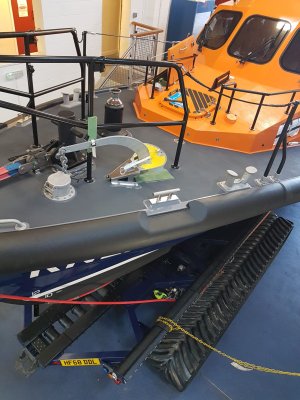
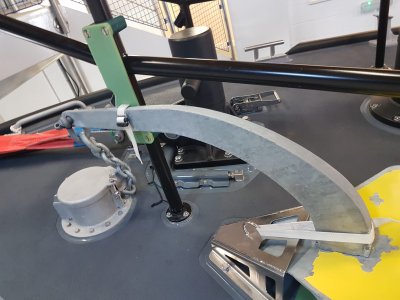
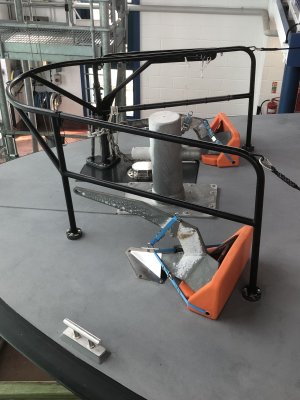
The RNLI now use Spade anchors on their current Shannon Class vessels.

IMG-20220607-WA0008.jpeg
IMG-20220607-WA0003.jpeg

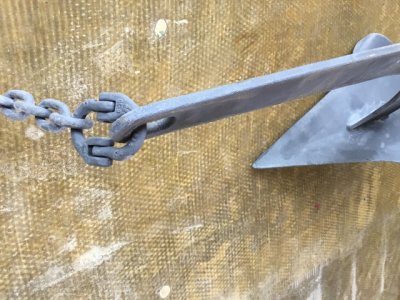
I wonder if anyone will note the unusual feature of this specific Spade.

Jonathan
 
An unusual resurrection of a thread.

But considering this refreshment came from Lifeboater then

The RNLI now use Spade anchors on their current Shannon Class vessels.

View attachment 190152
View attachment 190153

I wonder if anyone will note the unusual feature of this specific Spade.

Jonathan

Shackle pin through the shank, therefore can’t articulate and could be subject to a side load which exceeds pin WLL for the offset pull.
 
Shackle pin through the shank, therefore can’t articulate and could be subject to a side load which exceeds pin WLL for the offset pull.
Very quick - and spot on.

I've had the images, I have a series from the RNLI, for a couple of years and I'd never noticed.

Oddly - and my memory has recently been tested, I recall our Spade shanks, a bit smaller than the ones on the featured Shannon, take an appropriately sized shackle with the bow through the slot (A80 and S80 accept a 3/8th, 10t UTS and 2t WLL bow shackle.

Jonathan
 
it clearly shows him anchoring Wanderer III by throwing a 35lb CQR over the side and letting the chain run out freely. In view of his advice being backed up by a proven record of years of cruising all over the world and around UK waters, I'm inclined to go with it.
Surely the idea is to stay on the boat & just chuck the anchor & rode on its own :unsure:
 
An unusual resurrection of a thread.

But considering this refreshment came from Lifeboater then

The RNLI now use Spade anchors on their current Shannon Class vessels.

View attachment 190152
View attachment 190153

I wonder if anyone will note the unusual feature of this specific Spade.

Jonathan
This was seen on the RNLI Tenby Tamar class lifeboat last week, a pair of Deltas…

The Tamar may not be the most modern boat in the fleet, but in Pembrokeshire they are the backbone as they are designed for steep slipway launch

IMG_5512.jpeg

Yes, a very old anchor thread to resurrect, was someone looking for more bloodsport than the Oval Office recently?
 
Last edited:
Yep, never make a living out of making and selling anchors. :)

.
I'd be the first to agree but

I see lots of Rocnas on bow rollers (and I saw lots of Deltas on bow rollers at boat shows)

Fortress make nothing but anchors - they have about 10 employees, they subcontract the protrusion items and use independent anodisers. I almost never actually see Fortress on bow rollers

Anchor Right employ 7 - 8 employees, subcontract the cutting and galvanising. Anchor Right also make bow rollers. Anchor Richt are strong in Oz/NZ but are late entrants in the UK and Canada/N Am


Manson, Ultra (aka Boyut?), Knox, Tie Down Engineering (Danforth) - anchors are part of their portfolios.

For some its a stand alone business and all of the names mentioned (except Knox - the most recent to appear) appear to have made a profit (or are all charities?).

Jonathan
 
This was seen on the RNLI Tenby Tamar lifeboat last week, a pair of Deltas…

Delta had been the anchor of choice for the RNLI. The new Shannon Class introduced a change of thinking and some clever promotion by a savvy retailer and Delta was rejected in favour of Spade. Spade is a SHHP, Super High Holding Power anchor, Delta only HHP. It was a marketing coup for Spade and a slap in the face for Lewmar - the anchors are so prominent on the foredeck - underlined by the yellow Spade patch. Lewmar came to the party late with Epsilon (also SHHP) - and based on forum comments they, Lewmar, seem to have issues as stocks seem low or non-existent - but maybe anchors are not a profitable business for them? At the Sydney show where Delta would be usually prominent I saw one Epsilon - they seem to have lost the plot.

Jonathan
 
This was seen on the RNLI Tenby Tamar lifeboat last week, a pair of Deltas…
Yep, I spoke to one of their senior chaps in the Poole HQ, and he said that the UK Spade decision was a mistake due to serious rust issues and they also got bent too often. I looked at a Poole based offshore boat and it has a newish UK Spade, BUT no sign of the yellow paint. He said they were replaced for free, so at the present time they are sticking with the Spades. The UK Spade is not a new generation anchor or design, it was around when Practical Sailor did a real good anchor test with the UK Spade and my favourite short scope general purpose anchor, a bronze Herreshoff made in the USA.

One word of warning about anchors, DO NOT BUY COPIES OF THE CQR, they have been proven to be very bad due to incorrect tip ratio to anchor weight, wrong center of gravity in vertical position terms, wrong hinge action in angle or frictions terms and in some cases, incorrect shape. I've even seen one copy that was electro plated rather than hot dip galvanised. 90% of the CQR's in Poole, (My newly aquired long keel Rowan 22 is in a Poole marina), are copies, some of them real good looking copies.

One other safety related rant: DO NOT BUY CHEAP UNMARKED FAR EASTERN ANCHOR SWIVELS, mostly listed in Fleabay, Amazinzone or Temu. They are made of ultra cheap 300, (Might be below 300), grade contaminated recycled stainless steel. In the idea rather expensive world, they should be made from 318 stainless. The fatigue life of any cheap stainless, even 316 is very low, as is its ultimate shear strength in comparison with cheap mild steel. The fact that these new disposable swivels are very shiny means nothing at all. Alas many boaters are easily fooled. If you are buying anchors, try to stick to Lloyds, ABS, (American), or the German shipping standards for approval. Lewmar do make genuine CQR's and ABS approved Bruce anchors.

Finally don't use anchors that weed foul, small ones in particular unless you can guarantee there are no weeds or plastic bags on the bottom. Weed fouling is the no 1 cause of losses at anchor when the scope was correct and the anchor swivel or other part did not fail.

LATE MODEL BRONZE HERRESHOFF, ANYONE KNOW OF A 16lb BRONZE ONE FOR SALE PLEASE PM ME:

Umm can't seem to post a picture or Edit for some odd reason.
 
Top