CQR Anchors - Genuine or Fake?

Shackle pin through the shank, therefore can’t articulate and could be subject to a side load which exceeds pin WLL for the offset pull.
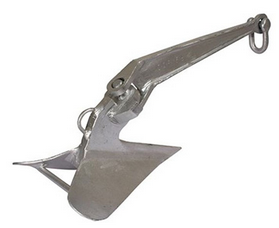
The CQR always came with a shackle fitted with the pin through the shank. It was probably way oversized so side load was not a problem and the articulation came from the smaller chain joining shackle. Also the hinge allowed the shank to align with the direction of pull. Perhaps the RNLI had years with a CQR and carried on the practice with newer anchors.
1740826981413.png
 
Bizarre thread resurrection.
And also RNLI boats are not necessarily good for examples of best anchors for cruising yachts. All Weather Lifeboats almost never anchor. They are away from base for short periods, and can hold near geostationary under power when on station for a rescue.
Inshore D Class do sometimes use anchors - but in very exceptional way, for veering into shallow waters for a rescue, then pulling out again very quickly.
I suspect most on here have spent many many more days & nights on anchor than the entire RNLI fleet in a year. Very different use case between RNLI and cruising yacht.
 
Replying to a few comments, I steer well clear of new anchor designs that have no approval like the Epsilon, and that anchor has had some rather negative reports. It takes a long time to tweek a new design to improve its performance. Around 100 years from the first Herreshoff to the latest bronze version. I wonder if the Mk 2 Rocna is better than the Mk 1 which was reported by several sailing mag's as failing to reset after a sudden 180 veer.

Try not to mix up anchor performance classes like Super High Holding Power unless they have a Lloyds, ABS or German approval, as most of the anchors in the highest catergories are far too easily bent. The Fortress which has no sensible approval or certification is probably the highest rated anchor and top of the holding power vs weight tables, BUT, it is also top of the bent shank tables and like any bottom scraper, subject to weed fouling. Once the hinge gets jammed, it's game over in reset terms. So if you use one, it needs checking on a regular basis. I did inherit an almost new one that I might keep a spare.

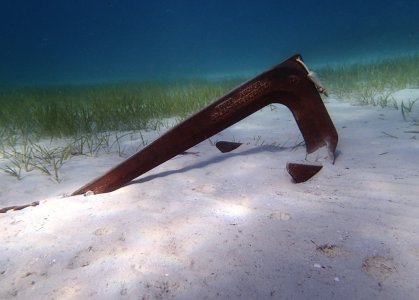
The genuine CQR always has a heavy shackle with a welded pin, it also has a raised plate for the CQR lettering on the bend just in front of the hinge. Looking for a second CQR and a larger Bruce as a spare and in the latter case, use in an area with few weeds but rocks. It's very easy to get a plough anchor like a CQR or Delta jammed in rocks and although a trip line is a good idea, I remember one yacht lost its main anchor, (Delta copy, so not worth much), late last year in a rock jam whilst fishing near Old Harry rocks in Dorset. The trip line snapped then a final attempt to weigh anchor broke the copy of a Lewmar swivel.

PS: If anyone has done the inside passage from Punta Arenas, (Magellans Channel/Straits), in Chile, please PM me with any info on types of seabed for the dozen or so anchorages listed in the RYA guide as not requiring lines ashore. Need to know max depth and comments about how good the holding is. Unlike my last circumnavigation I will be carrying 2 chain rodes but need to decide if I should buy a Bruce or second CQR. It would also be good if someone could post details of how to figure out if a Bruce is a genuine one, or a copy.
 
Replying to a few comments, I steer well clear of new anchor designs that have no approval like the Epsilon, and that anchor has had some rather negative reports. It takes a long time to tweek a new design to improve its performance. Around 100 years from the first Herreshoff to the latest bronze version. I wonder if the Mk 2 Rocna is better than the Mk 1 which was reported by several sailing mag's as failing to reset after a sudden 180 veer.

Try not to mix up anchor performance classes like Super High Holding Power unless they have a Lloyds, ABS or German approval, as most of the anchors in the highest catergories are far too easily bent. The Fortress which has no sensible approval or certification is probably the highest rated anchor and top of the holding power vs weight tables, BUT, it is also top of the bent shank tables and like any bottom scraper, subject to weed fouling. Once the hinge gets jammed, it's game over in reset terms. So if you use one, it needs checking on a regular basis. I did inherit an almost new one that I might keep a spare.

The genuine CQR always has a heavy shackle with a welded pin, it also has a raised plate for the CQR lettering on the bend just in front of the hinge. Looking for a second CQR and a larger Bruce as a spare and in the latter case, use in an area with few weeds but rocks. It's very easy to get a plough anchor like a CQR or Delta jammed in rocks and although a trip line is a good idea, I remember one yacht lost its main anchor, (Delta copy, so not worth much), late last year in a rock jam whilst fishing near Old Harry rocks in Dorset. The trip line snapped then a final attempt to weigh anchor broke the copy of a Lewmar swivel.

PS: If anyone has done the inside passage from Punta Arenas, (Magellans Channel/Straits), in Chile, please PM me with any info on types of seabed for the dozen or so anchorages listed in the RYA guide as not requiring lines ashore. Need to know max depth and comments about how good the holding is. Unlike my last circumnavigation I will be carrying 2 chain rodes but need to decide if I should buy a Bruce or second CQR. It would also be good if someone could post details of how to figure out if a Bruce is a genuine one, or a copy.
Lewmar's Epsilon has Lloyds certification for SHHP.

Spade has been certificated as SHHP, I believe from Lloyds. This was needed to allow use on the RNLI Shannon Class.

Fortress has SHHP from ABS (as does Ultra)

The original Rocna, made in NZ (not the cast version) had a SHHP certification from RINA - I'm not aware that the cast model nor the Mark 2 version has been similarly approved.

Manson's Supreme is Lloyds rated as SHHP.

Anchor Right's Excel was approved by a now defunct Australian Certification body as SHHP, I was an observer at the hold test procedure.

In order to keep the certification the anchor and makers need to be audited, I think annually, by the certification authority - whether certification is kept upto date is unknown - but if Fortress wanted continue to supply to their Border Force etc - they would need to update. Certification is needed if vessels are in survey. If you do not wish to address the market for vessels 'in survey' there is no need for any certification.

Classification Society approval for HHP or SHHP is very expensive and is not a cost that can be easily passed onto the public, by increasing product prices. There are many exceptional anchor, like Knox, that would meet Certification standards but are not, yet, approved.

There are many tests, the YM test in 2006 and a number by Voile et Voileurs (available in YM) - but google and you will find them, all of which contain hold data. Some tests are conducted by the anchor maker's themselves, like the Fortress Chesapeake tests in soft mud - simply strip out the sponsoring company's products. Proof Testing, where the integrity of the anchor is tested - is seldom completed - you are on your own.

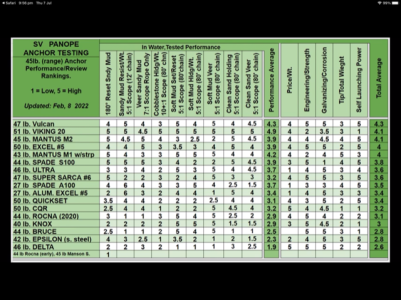
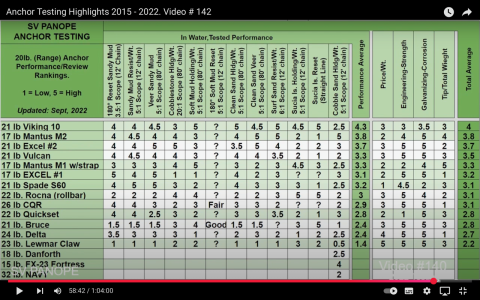
The Panope videos are useful - but no hold data is given and the integrity, its strength, of the anchor is determined by 'looking' - the same as you and I. The Panope spread sheets also contain a comment on prices - in America - the data would be different, for example for Knox if you are buying in the UK. So parts of the spread sheets are very subjective.

Take the Panope spreadsheets and add the hold data from the 2006 YM test and the Voile articles - and you have as good an analysis as you can get.


Two of the Panope spread sheets, taken at random - there is a spread sheet for, nearly, every video. One interesting facet of the spread sheets - anchors are sold on the basis that small anchors are scaled versions of big anchors. The Panope spread sheets show different performance of the same, or similar, designs and, arguably, Rocna the most successful of the modern designs - is not highly rated. Similarly Epsilon is caned - but according to Lloyds is as good as Spade (or Excel)...... Draw your own conclusions.

Jonathan


IMG_9522.PNG

Screen Shot 2024-12-17 at 9.03.32 pm 2.png
 
Links to the 2006 YM test, sponsored by West Marine

https://www.westmarine.com/on/deman...P0x4Hu4LqMtnvk9uTeULjX3PMCgJKkyQB5nD4IVZwFA4-

and you can google one of the Voile tests

Yachting Monthly -Anchor Test Nov09 copy.pdf

There was another Voile test - but I did not easily find a link, both Voile tests were re-published in YM or YW.

As fas as I know you cannot buy a new original CQR. Lewmar sell a copy - but it is no longer drop forged, whether that impact its performance I don't know, nor care. I do care that the current iteration from Lewmar is not now made in Scotland - but that's unrealistic nostalgia.

- Technology, design, steel qualities and fabrication techniques have improved immeasurably in the last 9 decades and there are a host of designs that now offer twice the hold, Rocna, Supreme, Spade, Viking, Knox, etc etc. and due for release soon the new kid on the block, Odin (from Viking Anchors and made - topical location, in Kiev, Ukraine). These better anchors are freely available (and if you are lucky you can buy a second hand one on eBay) - excepting Odin and a new production run is scheduled soon, check the website or email the owner of Viking

Extolling the virtues of the original CQR is like extolling the virtues of a split screen Beetle - fine if you hanker after old cars or old anchor designs but the CQR has no place on a modern yacht, nor a perfectly restored old yacht (excepting if the CQR is used solely as decoration and the working anchor is immediately accessible). The RNLI voted with their feet, not their wallets as Spade will be factorially more expensive than a Delta, and have discarded Delta on the new lifeboats and replaced with Spade. I cannot imagine that considering a CQR was part of the alternatives.

Anchor testing is inordinately expensive and time consuming, and whatever, or whoever conducts the tests will be roundly criticised by someone. Someone will say 'something' is wrong - so its a thankless task. The major impediment is money and time and the printed media is short of money, if not time.

The alternative is a motivated individual like Steve Godwin - but he has retired from that fray and similarly enjoyed critical comment - its a thank less task.

Jonathan
 
Last edited:
The anchor(s) chosen by the RNLI doesn't interest me in the slightest. Their very occasional use of an anchor bears no relationship to the normal use by the average cruising yachtsman. We need an anchor which can be relied on to perform while unwatched and unattended. We sleep at night. We go ashore. Lifeboats are never left unattended. There is little comparison in the anchoring requirements of lifeboats and yachts.
I also have no interest in having the latest shiny bling, glittering on my bow roller. I'm very happy to use one of what is now considered to be an example of an older generation of anchor, which has served me faithfully, and in which I have full confidence. Maybe I'm slightly biased, as I also am an example of an older generation.
 
Unfortunately there is no cure or for us wanting to buy stuff for our boats whether we really need it or not.
Good observation about us and the RNLI
with regard to anchoring.
 
Of course there is no comparison with the way we anchor and how the RNLI might anchor.

The RNLI don't choose their anchor location, with shelter etc. They would only anchor under severe conditions etc. They don't plan to anchor - they will be home for dinner, or breakfast.

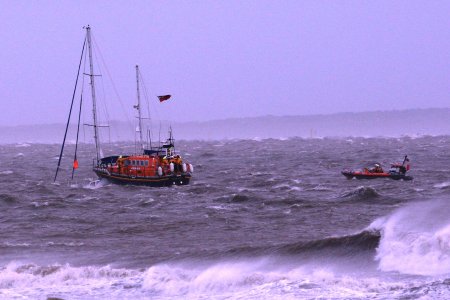
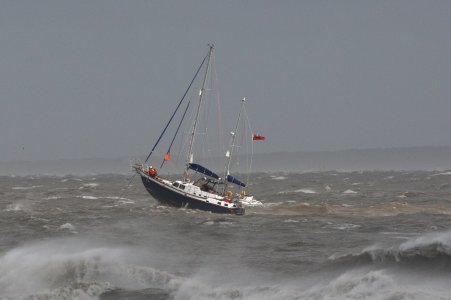
I met the crew of the lifeboat about 2 weeks after this event. Its the Mersey estuary off New Brighton. I also spoke to the owner of the yacht. The wind was from the North West and the tide was high. The owner of the yacht had misjudged the tide, or arrived to late to enter the Marina. He knew the NW wind was forecast last and chose to anchor, expecting to move to the marina the following day. This was the following day.

The conversation went something like this


"Excuse me sir but would you like us to help you retrieve your anchor and escort you to a safe anchorage'

"No thank you I am quite comfortable and safe here"

"Not a problem sir - we will anchor off your stern until you retrieve your anchor, we will then shadow you to your choice of a safe anchorage"


a long pause


"Thank you and if that is the case I will accept your offer"

The anchor for the yacht was retrieved, the shank was bent.

The RNLI may not use their anchors very often - but the conditions under which they might anchor can be more severe than anything we would choose to endure. Their anchors have to be adequate. You are correct in that the lifeboat would be manned during the time they were at anchor.


shout to Quo Vadis (strong gale 9) 009.JPG

The man with the white helmet on the bow of the yacht is a crew member off the lifeboat. You can see the anchor rode and the lifeboat has a line to the bow of the yacht, which can be seen on the Hi Res images but maybe not here on YBW. The inshore Lifeboat had been on another call and was simply sanding by as they were in the area.

Image 8 to Quo Vadis (strong gale 9) 013.JPG

I hope you do not choose to anchor under such conditions.

Jonathan
 
You don't say what anchor the yacht was using, nor how the shank became bent. The anchor was obviously holding well, but it would be extremely uncomfortable aboard. If I ever found myself in similar circumstances, I probably wouldn't attempt to retrieve the anchor there and then, but would buoy the rode and slip it. I carry sufficient alternative anchors, chain and warp.
 
Unfortunately there is no cure or for us wanting to buy stuff for our boats whether we really need it or not.
Good observation about us and the RNLI
with regard to anchoring.
If you read the complete thread, as the cricket will still be on, it had already been mentioned that the RNLI seldom anchor.
You don't say what anchor the yacht was using, nor how the shank became bent. The anchor was obviously holding well, but it would be extremely uncomfortable aboard. If I ever found myself in similar circumstances, I probably wouldn't attempt to retrieve the anchor there and then, but would buoy the rode and slip it. I carry sufficient alternative anchors, chain and warp.

In this instance the lifeboat would be pulling the yacht forward on the tow rope and there are 2 people on the yacht - retreiving the anchor would be quite possible. Why the anchor bent? -just an observation made by the Lifeboat man on the yacht. My bet, not worth very much, change of tide or (and equally likely) - they were a bit aggressive with retrieval and they 'generated' a super snatch load when the rode went taught and they were thrown up by a bit of large chop - it does look a bit frisky. If you take in the rode when the bow is well down the next wave will generate a nasty snatch on a deep set fluke.

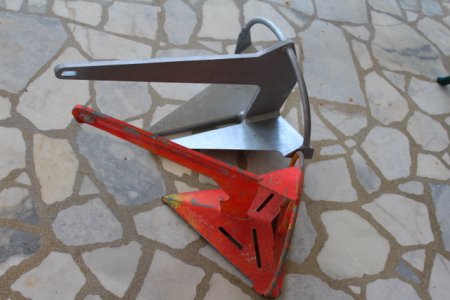
The anchor was a Super SARCA, Anchor Right's first anchor. They had had a distributor in the UK and sold quite a few, apparently. At the time the anchor had a mild steel shank - it was changed later to Bisplate 80. I also bent the shank of a SARCA. I was never a fan of the design, I did not like the idea of a tripping slot, the shank/fluke interface was in the wrong place (like a Mantus) - but it has a lot of desciples in Oz/NZ. It has an uncanny resemblance to the Knox (whose shank its in the right pace). John Knox did have a sample of the SARCA so......

The SARCA is the orange one.

IMG_1341.jpeg


Anchor Tests: Bending More Shanks - Practical Sailor

If you can access the article, it might be behind a paywall - the bent anchors are at the end of the article, a series of pictures of each anchor.

Jonathan


Jonathan
 
Last edited:
Top