
Could someone explain my diode?

demonboy

Well-Known Member
Joined
11 Oct 2004
Messages
2,237
Location
Indonesia
www.youtube.com
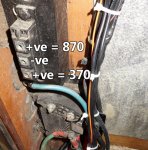
I have a diode mounted in my engine room (top of picture).

When I switch my multimeter to diode check and place the negative on the middle terminal, I get two different readings for the top and bottom terminals.
diode.jpg

Could someone explain what the application of this diode would be, why there are two different readings and how I would rig up the alternator to the COM stub on my battery selection switch? I am assuming the alternator would be connected to either the top or bottom terminal, and a lead from the middle one going to the COM. Is this correct?

I've been told the semi-circle object in the bottom of the picture is also a diode but I can't get a reading from it.
 
Last edited:
I've never seen anything like the thing at the top of your pic.

The curved item below it is indeed a diode splitter, made by Paris Rhone and often supplied by Volvo Penta. I believe it could be mounted straight on the back of an alternator if required. The 2 outputs are on the right hand side in your pic, and I think the top left terminal is the input.
 
I have a diode mounted in my engine room (top of picture).

When I switch my multimeter to diode check and place the negative on the middle terminal, I get two different readings for the top and bottom terminals.


Could someone explain what the application of this diode would be, why there are two different readings and how I would rig up the alternator to the COM stub on my battery selection switch? I am assuming the alternator would be connected to either the top or bottom terminal, and a lead from the middle one going to the COM. Is this correct?

I've been told the semi-circle object in the bottom of the picture is also a diode but I can't get a reading from it.


I'd agree the semicircular item looks like the diode splitter that can be fitted directly to the back of an alternator.

Regarding the other thing I would have assumed that it is aslo a diode splitter ... I take it that if you reverse the meter connections you get no reading bewteen the centre and end connections.

The readings you do observe should be the forward volts drop in mV. I'd expect 600 or 700 ish but ceratinly more or less the same. I think I'd feel inclined to regard it as defective
 
Just to add a cautionary note, diode splitters have a maximum current rating. If you're going to use one, you need to ensure it's rated to cope with the alternator's max output.
 
Diode test on a digital multimeter can be just low ohms measurement or actual diode volt drop. However with low voltage and low current results can be variable. Yes one would imagine the reading should be the same for both diodes. However a far better test would use a 12v source and 12v 20w or so lamp. Connect the lamp to the battery it should light fine. Connect it via one diode it may light OK if not reverse the diode or battery connection. Try the other diode they should give similar results. You could try measuring the voltage drop across the diode when conducting. It should be around the .7 volt depending on temperature.
Presumably the diode pair were used for isolating and charging 2 battery systems. They could be used in conjunction with the 1,2,both switch to provide charge (but with .7v loss) regardless of switch position. However selecting the switch to any or both batteries should hopefully provide full charge. Unless the regulator is set up to account for diode volt drop or is battery sensed.
No easy answer good luck olewill
 
I think that you may find that the block is either an assembly of high current diodes in a configeration that the previous owner found useful, or (to me) more likely an assembly of thyristors from an old thyristor motor controller. Possibly some one has been using it as a switching device for use on the DC charging circuit. Are there any small terminals that would have the trigger leads on?
Google Thyristor images and have a look see. Alternatively this might just be a load of old b*****ks.
 
Regarding the thyristor suggestion, it does appear to have much smaller wire inputs above the top terminal, and they are numbered. Either way, as VicS asks, they do not show a reading when switching the multimeter leads, which is why I think it's a diode. However there is no other writing on it to tell me what the rating is.

I've reverted to using the other diode underneath. This was the original diode the original alternator was connected to, and since I will be connecting the old alternator once more, this should be ok.
 
It looks similar to one of these to me.
http://uk.farnell.com/ixys-semiconductor/mdd95-16n1b/diode-2-mod-1800v-120a-to240aa/dp/1841868

Your multi-meter's diode reading is probably in mV and these are Schottky diodes (low forward voltage (Vf) types). The difference in readings is because 370 is the Vf for one diode and 870 is the Vf of 2 diodes in series. Note that the bottom terminal is the common connection and the diodes are connected anode to cathode - not an arrangement suitable for a charge splitter. This part is suitable for a rectifier to supply positive and negative from an AC source.

Speculating even further (and probably a long way from reality) - maybe the previous owner obtained the top diode block, couldn't get it to work so replaced it with the one below that everyone recognises.
 
Last edited:
Top