Could Have been very Dangerous

Bigplumbs

Well-Known Member
Joined
7 Nov 2015
Messages
8,161
Location
UK
Visit site
In May we towed our 17 Foot speed boat to Devon for the Annual speed boat rally we attend. The tow was a good 7 hrs

On the way home I had a bearing failure and had to be relayed home by the AA. The wheel on that side got very hot indeed.

I have now got round to replacing the complete 1300 kg axel which went well. The old Axel was only about 6 year old at most.

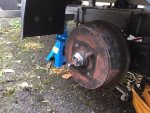
Upon removing the wheel on the old axel on the side that did not get hot. I repeat on the side that did not get hot two of the wheel studs snapped of with the minimum of pressure on the wheel wrench. Upon putting the bolt in the vice the nuts would turn very easily. I had greased them.


Although I still had 2 good studs I think that on the journey home I would have very likely lost the wheel on a major road (M25 for example)


This does not bear thinking about and I am at a loss as to why they broke with such little force

The axel was bought from Trailertek and made by Peak
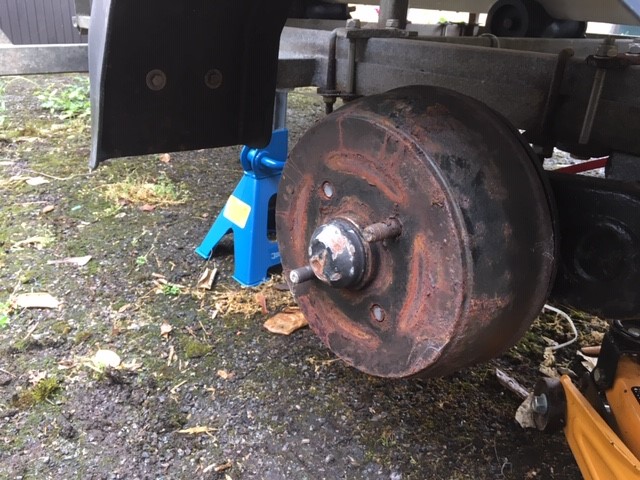

Broken-Studs.jpg
 

Attachments

  • Broken-Studs.jpg
    Broken-Studs.jpg
    107.4 KB · Views: 0
Last edited:
As a general rule Dennis, one should not grease wheel studs as this can result in overtightening resulting in premature failure...
 
Don’t know the size of your studs but typically torque would be about 80 ft lbs.With your 2 ft bar you could easily exceed that by 4 or 5 times.

Just bought myself a torque wrench...…… Looks like most trailers for 12 mm dia studs would be 80 - 88 nm

Dennis
 
Trailer wheels can suffer from kerb strikes, which put significant load through the studs. An extreme example is when truck trailer wheels shear off, usually as a result of kerb strikes.
 
Trailer wheels can suffer from kerb strikes, which put significant load through the studs. An extreme example is when truck trailer wheels shear off, usually as a result of kerb strikes.

Interesting but this was the right hand (Offside) side so don't think it would be that
 
Crikey, where to begin.

I am assuming you have studs pressed into the flange and you use nuts to hold your wheels on, just to be clear.

Overtightening and not tightening in the correct sequence will stretch the studs, so clean the wheels and nuts before a dry assembly.
Are you using the correct nuts for the rims? many people are unaware that there are different nuts for different wheel types.
Thermal shock, are you dropping your trailer into the water with hot wheels? these are all induction hardened now and can be brittle if heated and rapidly cooled.
Has your trailer got a towing limit on it as many axles (its axle and not axel) have a maximum distance they can tow at specific speeds before a break to allow them to cool, strange but true.
Are you using the correct grease and keeping your hub bearings adjusted as either raises the temperature of the entire stub axle and the hub.

British roads are full of pot holes and if car wheels are being split on them then a trailer will also get huge shock loads with sufficient force to crack a wheel stud or two and remember that on a 4 stud axle with one broken stud the remaining studs will have to take the extra 25% of the load, and the loss of clamping force will allow the wheel to flex for 180 degrees.
 
I

Design issue or lack of !

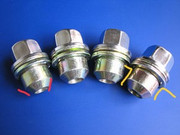
You need a ferrule effect like the yellow and tip taper like the red lines on theses LR discovery lug nuts mates to a suitable designed wheel .

If you have that somewhere one or preferably both features then over tightening is a none issue and the also slight under tightening because the ferrules and tip taper keep the hole centred .The lug covers the hub bolt and cones to a stop exactly due it’s internal machined L matching the wheel stud and the red taper .So no “ stretching “

The yellow ferrule stops it rotating , rocking and resists a bending moment on the hub bolt .

It’s really design basic stuff all this used in biomechanics to stop fractures and loosening of implants in surgery .


Need to see the wheel and lugs but I bet they are incompatible from the engineering POV , ferrule and tip taper / centring .
 
Last edited:
Use a little copperslip on the studs so that they don't rust on with being doused in seawater when launching and always use a torque wrench set to the manufacturers recommended settings.
 
O $H1t quality wheel studs.

Standard Triumph supplied-as spare parts only, not factory OE fitment-our stores with a duff batch for Triumph Herald/Vitesse/Spitfire/GT6 models. IIRC, all shared the same wheel studs.

They would easily shear off when tightened with our workshop 'spider' wheel brace. The OE studs were fine. My collegue fitted a couple and both sheared easily when tightened.

As I said, not impossible to get duff studs.

Long before wheel studs had torque settings.........................
 
In May we towed our 17 Foot speed boat to Devon for the Annual speed boat rally we attend. The tow was a good 7 hrs

On the way home I had a bearing failure and had to be relayed home by the AA. The wheel on that side got very hot indeed.

I have now got round to replacing the complete 1300 kg axel which went well. The old Axel was only about 6 year old at most.

Upon removing the wheel on the old axel on the side that did not get hot. I repeat on the side that did not get hot two of the wheel studs snapped of with the minimum of pressure on the wheel wrench. Upon putting the bolt in the vice the nuts would turn very easily. I had greased them.


Although I still had 2 good studs I think that on the journey home I would have very likely lost the wheel on a major road (M25 for example)


This does not bear thinking about and I am at a loss as to why they broke with such little force

The axel was bought from Trailertek and made by Peak


Broken-Studs.jpg

I was driving down the A3 with my 6m rib in tow. Felt a bump and saw a wheel fly by the car. The trailer dragged along on its wheel hub until i could stop. No one hurt but very lucky. Nightmare and no idea but worth having trailers looked at every now and again. certainly feel like a total git on side of road waiting for the AA - who were great incidentally!!
 
The concern is of course what that wheel could have hit. At any speed they will carry some considerable force
 
The concern is of course what that wheel could have hit. At any speed they will carry some considerable force

Yes indeed. Was driving round the Brussels bypass a couple of years ago and came across an accident where a wheel had come off a car, crossed the central reservation and gone straight into a car travelling in the opposite direction. Very nasty.
 
Top