
coppercoat problem

Joined
26 Nov 2009
Messages
13,406
Location
everywhere
Visit site
My boat was coppercoated 3 years ago. Coming out of the water and being pressure washed on Monday, quite a bit of the coppercoat came off the keel leaving bare metal behind - the marking of the lead in some areas suggested that water was travelling between the primer epoxy and the lead with a failure of the bond between them. The edges of the coating are easily lifted with the finger nail. The exposed surface of the lead looks to have been abraded before coating by the yard that did it.
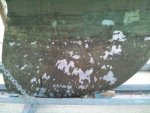
lead keel.jpg

In general I have been quite pleased with the coppercoat and have said so on this forum. When I saw the coating damage and mentioned it to Falmouth boatyard, they said they had had this issue with coppercoat and lead keels before. TBH I took this with a pinch of salt but to my surporise, the tech guy at coppercoat said much the same thing - that the coating would not consistently stick to lead keels. It might adhere, or it might not. I pointed out to him that at no point in their literature did they say this or give any warning of potential problems. So I am not impressed. Incidentally, no problems with adhesion to the grp hull. And no offer of free touch up material to replace the failed coating.

So what do I do now?

1/ has anyone any good experience of priming a lead keel with a two pack primer - needs to be two pack so I can re-apply coppercoat on top.

2/ its wet and its cold and likely to remain so until the boat will be re-launched april 1st. Not ideal for coppercoating. So do I prime the keel as is and coat with normal antifoul waiting until I have the opportunity to lift out mid season , strip off and re coppercoat?
 
A brief online search suggests that lead needs an etch primer, which would presumably be an explanation for the failure of yours. There seems to be plenty of choice for a two-pack epoxy primer but I'm not sure whether a specific one is needed for lead. I did find that lead is attacked by hydroxides, which I believe are the active ingredients in etch primers, so it would seem a conventional etch primer could well be successful.
 
My experience leads me to think an etching primer is essential before applying the copper coat to metal. I would also expect that you will need to shot blast the keel now and start again on the lead area. I have found that you must have a good, sound, surface for coppercoat and apply it on a reasonably warm, dry day, unless you can find a warm shed. I applied coppercoat to my boat seven years ago and it has been fine, but I was advised to ensure the preparation was good and I made sure it was.
 
I'm sorry to say that my professionally applied Coppercoat came off the GRP in a very similar manner after a year or so. I really loved the fact that I didn't have to do any serious clean down after lifting out, but I became concerned about the risks of it falling off. The new boat is just done with some standard International stuff.
 
I'm sorry to say that my professionally applied Coppercoat came off the GRP in a very similar manner after a year or so. I really loved the fact that I didn't have to do any serious clean down after lifting out, but I became concerned about the risks of it falling off. The new boat is just done with some standard International stuff.

get the pro to do it again. No reason for it to fall off GRP.
 
etching might be a good idea but I dont know of a two pack etching primer and two pack is what it needs to be.

I think you can etch and prime as separate operations?
There are plenty of painted lead keels around.
Personally I find if you let it oxidise and then epoxy it normally sticks OK.
I suspect getting back to shiny metal would be the wrong thing to do.
 
I think you can etch and prime as separate operations?
Correct.
When building horsebox for SWMBO the rubbing down process exposed bare ali (plus some new) which had to be primed with an etch first. Just over the exposed ali.
Picture018.jpg


This was then followed up with a two pack primer over the whole thing. Without the etch primer being applied first the two pack primer would not have adhered to the ali (same with the lead keel).
Picture020.jpg


The front bumper also had to be primed with a plastic primer prior to two pack being applied. What you are basically doing is getting the different materials to a point where they will all accept the main primer.

This was then sprayed with the base colour coat which in your case would be the coppercoat.
Picture025.jpg


Just to add in case people thought that was the final finish, no that wasn't the final spray job. Clear coat added after base colour to give this.
Picture038.jpg
 
Last edited:
Yes but does it float_?
Correct.
When building horsebox for SWMBO the rubbing down process exposed bare ali (plus some new) which had to be primed with an etch first. Just over the exposed ali.
Picture018.jpg


This was then followed up with a two pack primer over the whole thing. Without the etch primer being applied first the two pack primer would not have adhered to the ali (same with the lead keel).
Picture020.jpg


The front bumper also had to be primed with a plastic primer prior to two pack being applied. What you are basically doing is getting the different materials to a point where they will all accept the main primer.

This was then sprayed with the base colour coat which in your case would be the coppercoat.
Picture025.jpg


Just to add in case people thought that was the final finish, no that wasn't the final spray job. Clear coat added after base colour to give this.
Picture038.jpg
 
My boat was coppercoated 3 years ago. Coming out of the water and being pressure washed on Monday, quite a bit of the coppercoat came off the keel leaving bare metal behind - the marking of the lead in some areas suggested that water was travelling between the primer epoxy and the lead with a failure of the bond between them. The edges of the coating are easily lifted with the finger nail. The exposed surface of the lead looks to have been abraded before coating by the yard that did it.

So its not a copper coat problem but a primer/preparation problem.

go back to the yard that did it. your expectation is that the paint system should last at least 10 years so make a case.
 
If the job was done professionally, I agree with others that your first port of call is the contractor you employed to do the job - it should be his problem to find out what went wrong and then to put it right!

Applying Coppercoat or two part paints in the UK is not easy, even in summer, due to our weather. Even on a good day, humidity climbs high in the small dark hours of the morning, particularly near the coast. To be confident of curing these materials properly, they should be applied in a temperature and humidity controlled environment, such as those used for GRP lay up work. A good contractor will give you his records of temperature and humidity throughout the job, including the curing time, to show that it was properly done. Take into account present day energy prices, and you will start to understand why a properly done professional job costs so much more than do it yourself with the vessel stood out in the open air!
 
SWMBO hasn't tested that aspect yet.
I'm going for the triple.
That was the land
This is the air
From this (a write off)
Kylierepair.jpg


To this
kylie.jpg


Now on the hunt for a water project.
I did offer my services as a boat buddy but nobody on here took me up on the offer :(

A Dart 17R or is it a 15? I only ever flew the 17 and it was beautiful aircraft to look and to fly but it could bite, both slow turns and landing.
 
Top