Converting old windsurfer mast to a long oar ?

sarabande

Well-Known Member
Joined
6 May 2005
Messages
36,182
Visit site
I want to make a long oar with multiple roles for cruising.

Oar/scull
Long proddy boat hook/depth pole
Leg for help taking the ground
Gin pole


Would a carbon windsurfer mast be capable of such uses, or do you think they are not strong in compression, please ?
 
Windsurfer masts bend quite a lot.
In compression, they are not very strong once they are out of column.
Consider that mast bend is often increased by increasing downhaul tension. With say a 6:1 tackle.
So, not really going to be useful as a leg to hold up your boat.
OTOH, short lengths always do better in column.

A lot of them have a low percentage of carbon in, many are almost entirely glass fibre and black resin.
 
Sarabande,

with a lovely boat like yours I'd not take any chances with drying legs !

A proper big strong spinnaker pole from a fairly large boat might cover your needs - but I know these things are silly prices, even the IYE kit pole for my 22' was around £200, years ago - but you might find someone who bought such a boat and doesn't use the kite so willing to sell the pole on.
 
I used the top half of one as a gin pole to raise our 30 foot mast on our trailable yacht. In compression very strong. No sign of it bending out of column. We also used it as a Genoa Stick! Spinnaker pole was much too heavy and needed uphaul rigging , lightweight surfer mast was so much easier to handle.

I am currently sourcing a pair of old style bottom halves to replace our heavy stainless legs. They are overkill for an occasional dry out in a sheltered drying harbour or as an alongside prop against a wall.
I like the idea of being able to slot the two together insert a rowing spade at one end and start "sweeping". I am not so sure the joint will be up to it!
Link to pics https://www.dropbox.com/sc/cwhbwsctyn3vmf4/AACKc7xAadhS9ZGvKs5dsWx7a.
 
Last edited:
I have what the O.P. Is suggesting in my garage. It came with the boat (24ft).

It consists of a tapered aluminium tube which I was told was a windsurfer mast. It was cut into three sections with each section inserted inside the other. I think it just relies on friction to keep it extended. There is a rope through it to keep it all together especially when contracted.

We have a single rowlock on the back of the boat. I did try to use it as a stern thruster as our boat has an offset outboard and was a challenge in reverse. I also had a brief attempt at sculling with it but it was not very successful. It languishes in the garage because the blade got broken and I haven't found another one.
 
I use a CF windsurfer mast as a spin pole. As said it is quite flexible. Indeed it alarms me sometimes just how far it will bend against the forestay. It is the top part of the wind surfer mast. I have some GRP masts also but they are quite a bit larger in diameter than the CF one. Yes I think the CF pole you have would be very good however I think the problem will lie in the joining together. The CF is quite thin so would need beefing up at the join.
As for use as a Gin pole the loads on a Gin pole depend on the geometry of the set up. I use my CF spin pole as one of 2 Gin poles for mast lowering/raising no problems but it is a light mast. good luck ol'will
 
The problem with some cf masts is that they shatter quite easily of dropped on something hard like a stone. ( as happened to one of mine)
if i was wanting to use a mast for jobs other than ,say holding out a genoa, then i would go for a grp wave mast. Mine are heavier ,i admit, but far stronger. These are designed for the stresses they get when scrunched in a fall in big waves. They would be more suitable for your oars and punting projects i suspect.
if using a cf mast for a spinnaker pole i would keep it off the forestay ( as i would any pole) but one can buy aluminium protectors that are used where the boom is fitted.. One could be reduced in diameter with a little bit of fettling and made to fit the thinner part of the mast and held in place with some tape. That may help prevent shattering at that point. However, if the pole rises up a lot then the position of the rubbing point may change too much to make the protector effective. But worth considering
 
If using a windsurfer mast that has been languishing in the weeds make sure you use gloves and sand the surface and either epoxy or several coats of paint as the splinters are horrible and do not under spec as carbon poles when fractured can do serious damage and can fracture with a sudden sharp blow such as two boats passing.
 
I'm very much with those saying beware of carbon fibre - it's a nasty material !

I was a technical photographer for BAe when the Harrier II GR5 aircraft was introduced; the wing was at the time the largest C/F structure in the world, and various other bits like the horizontal stabilisers were C/F too.

Everyone was terrified of the C/F taking a knock, say dropping a heavy tool on the hollow structure wing; it could look perfectly fine on the outside, but be shattered like rotten plywood inside.

I did a lot of travelling to RAF bases to find GR5's with technicians all over the wing with ultrasound; as the idea of the Harrier was to disperse into hides in woods if the Cold War went hot, the idea of an aeroplane which couldn't take knocks and scrapes instantly struck me as unrealistic...

I was not the only one, the late Harrier ace Chief Test Pilot John Farley - a gifted engineer too - proposed a more battle-worthy Harrier 3 with a more suitable lithium alloy wing, but being a better bet at actually doing the job couldn't compete with company politics.

On the marine side, when carbon fibre rudders first appeared on racing boats there were a series of catastrophic failures after hitting quite light FOD - foreign object debris.

I would NEVER have any important part of a boat of mine in carbon fibre; a racing dinghy mast / all the bits inc hull fine if that#s what turns you on - I've been regular crew on such boats, but anything life critical without a safety boat nearby - like on a yot which may go long distances offshore, no thanks.
 
I have to speak against Seajet's condemnation of CF. MY CF spin pole has taken a terrible treatment and can bend remarkably without damage. I have sailed a bit on an old Farr 30 built for the 1987 Admiral's cup series (shipped and returned to UK) built entirely of CF. Certainly no problems with the CF since. I too have been involved with manufacture of almost entirely CF aeroplane. No concerns with easily damaged. It had a thin layer of kevlar over outside surfaces. Yes I have seen it fail in ultimate stress tests and it goes off with a bang. I have a boom made of a broken CF mast. Yes it did break for unknown reasons but I love it as a boom. (half the weight of ali so more gentle in a gybe. I love CF. ol'will
 
ol'will,

we have privately chatted re mutual aviation experiences which I respect hugely, but I saw what effect was of introduction of Carbon Fibre on military aircraft and offshore yachts; in both cases it 's good for a pose and to rip off Congress* or the keen yottie, but this material is not fit for purpose.

* In a real world if the Russians or Chinese were a real threat, we would not be mincing about with a few things like the F-35, we'd have a LOT more F-22's on our side; I have personally been all over and in the cockpits of the Mig -29 and SU -27 ( I was hoping for guages showing Alpha and ETPL among other things, but they keep all that on the Hud, very few head down instruments even compared to the Sea Harrier which RN Test Pilots critized for.

In a real war the Russians would marmalise us, hundreds of big fighters carrying lots of weapons, compared to a pitiful few fancy few ' silver bullet ' ultra-expensive jobs.

When John Farley - first Western Test Pilot to fly the Mig -29 Fulcrum -he said " forget the Euro Fighter Typhoon, get loads of these and fit Rolls Royce engines ! "

His book is ' A View From The Hover ' - as John himself said ' go for the second edition it's much better '.

He was talking as a pure research analytical pilot, he didn't give a toss about politics or money - just aircraft performance.

Carbon Fibre is not a safe material to rely on, certainly not for legs on a She 36, and sod all use as a crane/ gin pole, unless over'spec'd or supported midway it would break in half.

I certainly wouldn't have a carbon fibre rudder let alone rig or keel, unless it was someone elses' expendable boat with a Rib alongside if I pushed my luck, ready to collect me when it all went tits up ! :)
 
I can only RE iterate.

I have successfully without any risk of sudden failure used a carbon fibre windsurfer mast for two functions for a number of years.

As a gin pole and a whisker pole.

Nearly all competitive rowing boats and scullers use carbon fibre oars.

I suspect even the Russian crews have adopted this technology instead of using hollowed out logs��

Understanding how to use it's incredible strength for its relative weight within its limitations is the key engineering principle that needs to be applied.

Whilst aviation antiques used aluminium and rivets the key players are now using this material for passenger plane wings.

I rest my case and like other engineers have a less jaundiced view for uses of this material.
Steve.
 
I'm a bit of a ( qualified ) engineer myself and apart from your traditional YBW style wish to have a go at me as we disagree re lift keel boat designs, I expect you'd think twice about using a carbon fibre ex-windsurfer mast as a drying leg for a She 36; if you think that's spiffing you're just confirming what I always thought.

Re aviation I too RE-ITERATE talented world famous Test Pilots like John Farley ( who had a degree in engineering picked up casually along the way ) preferred a ' tin wing ' of lithium alloy; among the many panics I was asked to photograph on the GR5 wing were not just military knocks and link strikes from the ( dismal failure ) 25mm cannon, also lightning strikes on two flying loosely together - I'm sure the RyanAir approach will love C/F as it confers slightly cheaper operating costs - and in theory one can 'train ' C/F to oppose divergent forces on forward swept wings, but in real life something which will take the odd ding without becoming cordoned off unservicable then a long inspection / rebuild - the Russian approach - will always win.

You can have a C/F keel and rudder if you like.
 
Carbon fibre is a great material, but it has to be used properly.
You can make something that breaks out of any material, by not designing around the properties of the material.
For sure, there were a lot of cock ups in the early days. People made mistakes as they learned to use metal too.
https://en.wikipedia.org/wiki/List_of_aircraft_structural_failures
Looks like wood and plastic have a better crash record than aluminium?


I've seen plenty of it broken, for instance dingy tiller extensions. If you miss the toe straps tacking, and don't let go, a carbon extension will often shatter where it hits the gunwhale.
Whereas I've done this with an ali extension and put a 90 degree bend in it, straightened it over my knee and finished the race.

Some carbon structures bend through very big angles without harm, others will shatter before distorting much. A 49er mast is a very different design to a bicycle frame.

I wouldn't prop up a yacht with a bit of tube designed to bend but of unknown specification. A yacht leg carries no load when the boat's vertical, but a rapidly increasing load if the boat leans on it. So it needs to be beyond reproach, ample for the job and well undestood.
Using a carbon sweep made from a springy mast might feel a bit weird if you're used to a heavy wooden sweep, but it's unlikely to actually break unless you go mad at it.
And if you do break it, it won't kill you or do £££ of damage. You might take some knocks if you fall in the cockpit though.
For a gin pole, you can test it at progressive loads and satisfy yourself it's up to the job.

Anyone got any novel uses for broken ali dinghy spars? Since Lasers have adopted a 'carbon composite' (ie theres 'some' carbon in it) top mast, they've taken to breaking lower masts, which are pretty chunky bits of metal. Must be good for something?
 
I don't think I have ever posted or suggested that a windsurfer mast could be possibly be used as legs for a deep draft high freeboard yacht. I have posted my experience of actually using such material in three of the ops considerations and hope this positive information is of use to Sarabande

I have no idea why you should suggest I should wish for a carbon Fibre Keel. I have lead and a lot of it!

I think Jefa the largest specialist rudder supllier to the boating industry made my balanced rudder which is a composite structure of aluminium or stainless and glass fibre. https://www.jefa.com/rudder.htm

I don't know if they used carbon fibre in its production probably not when mine was made. I suspect if you wanted a really stiff one you could have it specified!

I and quite a few others on this post disagree with your preference to not use CF in this modern age. Your view is your own and is formed from your experience for which I am sure the forum is better off and is welcomed.

Your grumpiness and attitude towards anyone who has an alternative view does you no service.

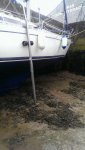
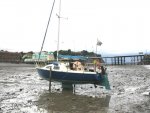
Our legs are only 2.1M Long a perfect length for bottom half of a windsurfer mast. 301 Leg.jpgA 2 meter long CF tube is very strong in compression and will take a massive compression load before bending out of column. Legs should never be under massive load otherwise the boat will fall over anyhow as the feet will probably sink into soft ground unless they have a massive foot print.

Our dried out draft is only slightly more than your favoured craft which could really benefit from a pair of light weight legs for beaching.VEGALEGS.jpg I am pretty sure these were made of solid heavy wood........

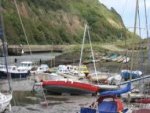
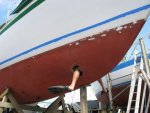
The standard option otherwise is not so goodA22 Fell Over.jpg:encouragement:

This is a perfect example of where a set of lightweight legs could be used and would open up to us a lot more short term visits to drying harbours and sheltered coves in our area or even further abroad.

We miss the ability to beach in places that we took our TS240 . Then we had no need to carry any legs to stay upright.....:encouragement:


Sarabande. Now I understand you have a SHE.
You might consider the human alternative to CF legs. Perhaps a blonde in the fore cabin with very very long legs is needed!SHE LEGS.jpg
 
Last edited:
TSB 240,

It is not I who is grumpy, it's you who pounce on anything I say re lift keelers - or anything else - since I disagree with you on that subject; and you have chosen two extreme examples for photo's, both in situations I or most Anderson owners wouldn't go near; I'm flattered you went to such trouble, I expect if I could be bothered I'd find pics of Evolutions and E-Boats sunk or damaged by settling the full hull on a nasty pointy seabed, and the E-Boat website is very honest, ' these things sink if driven hard without modification '.

A friend of mine, a better sailor than I suspect you and me merged, had an E-Boat for a short while, I sailed with him and it was way faster in light winds; but he he is a delivery skipper with more transats under his belt than I've had hot dinners, and remarked ' now the A22 can really take it, this thing won't '.

Same goes for Carbon Fibre; spiffing on say a Formula 1 car where weight and performance is everything, doesn't matter if it shatters; same with airliners, economy is everything and it's low stressed so crashes are usually due to C-FIT ( controlled flight into terrain ) or a bomb - on the 777 I'd be much more concerned about the lithium battery fire hazard.

The fact remains, during a boats' life she will take knocks, and carbon fibre does not respond kindly to knocks - probably fine for the first owner, it's down the line I'm interested in.
 
Anyone got any novel uses for broken ali dinghy spars? Since Lasers have adopted a 'carbon composite' (ie theres 'some' carbon in it) top mast, they've taken to breaking lower masts, which are pretty chunky bits of metal. Must be good for something?


Thanks for the tip off. I didn't know the bottom halves were breaking. Seen plenty of the old aluminium tops fold!

How/ where do they usually fail, at the gooseneck or at deck height?
 
Top