Confused about alternator/duel battery selector switch. - Jeanneau Sundream 28(1988)

that might explain why i had to have the head inlet/outlet through hulls / cocks replaced when i had all the seacocks checked when i bought the boat. rest have been check and deemed good.

 
Best thing is to ditch the 1-2-B-O switch and fit a Volt Sensing Relay put starter only on battery 1, everything else on battery 2. Wire up as VSR instructions.
Modern practice is not to connect sea cocks etc to zinc anode but DO check they are DZR or bronze not plain brass.
 
how is the inverter/starter motor wired up? Assume i can just connect the sola panel via its regulator with duel battery connector as normal
 
went to the boat tonight to get pics of my seacocks. the ones behind the toilet are new the rest original. but i believe they are DZR. not blakes either :'(

Galley Sink-

TTS10H8.jpg


Head sink-

btbAr5C.jpg


New Toilet seacocks(they were also installed with new skin fittings)

v0v6P3L.jpg


Engine Seacock

OH1et2c.jpg
 
unclear if to remove the earth cabling still
Unfortunately it won't make any difference. To quote Viv Cox from a previous thread "Skin fittings have only been available in DZR for the past two or three years and all are marked CR, although I believe other markings are used in Australia. If the fitting is old and not marked there is every likelihood that it is brass."
To be safe you should examine them all for CR markings. If none are found I'd replace them. The cost is not huge.
 
unclear if to remove the earth cabling still

Difficult to advise without knowing what materials the skin fittings and valves are. It is not possible to do a chemical analysis from a photograph and the photographs do not show the markings

I think remove it from any that you know to be bronze or DZR. Leave it in place on any you are unsure about or believe to be ordinary brass. The plated ones are almost certainly ordinary brass.

Make sure that the earthing cables are well insulated, preferably also well separated, from your DC system wiring. The DC system is the potential source of any catastrophic electrolysis .

Over time any replacements should be bronze, DZR or plastic. The earthing should not be connected to the replacements.
 
excellent advise again, appreciated. i think ill leave the cables on the seacocks in situ for now and looking into it further. i really want to test the boat out before the years over and it will come out again in early jan till the season starts again.

im still unclear how the alternator is connected though, how do i tell how the alternator is connected. im sure the panels are separate now except the battery tester. but would these devices be good to use if i want to separate the batteries. and what type cabling should i use. thanks

http://www.cactusnav.com/bluesea-mi...dYEIiAEZfp00-sOYip3gUcCfS24ZA9vRoCWGQQAvD_BwE

and

https://www.cclcomponents.com/victr...BdHIrvL1QoFgON06q6LniTJc8qSKGg3BoCE7wQAvD_BwE

edit: here is a post, could i do the same with the alternator charging and solar panel too connected to the batteries via crocodile clips

https://www.pbo.co.uk/expert-advice/installing-a-automatic-charging-relay-acr-26108
 
Last edited:
excellent advise again, appreciated. i think ill leave the cables on the seacocks in situ for now and looking into it further. i really want to test the boat out before the years over and it will come out again in early jan till the season starts again.

im still unclear how the alternator is connected though, how do i tell how the alternator is connected. im sure the panels are separate now except the battery tester. but would these devices be good to use if i want to separate the batteries. and what type cabling should i use. thanks

http://www.cactusnav.com/bluesea-mi...dYEIiAEZfp00-sOYip3gUcCfS24ZA9vRoCWGQQAvD_BwE

and

https://www.cclcomponents.com/victr...BdHIrvL1QoFgON06q6LniTJc8qSKGg3BoCE7wQAvD_BwE

The Blu sea kit contains a Dual circuit switch .... basically two isolator switches in one module . Switch to ON and the engine circuits are connected to the engine battery and the domestic circuits are connected to the domestic battery. This one also has the facility to combine both batteries in an emergency
It appears to be this one
https://www.bluesea.com/products/6011/m-Series_Mini_Dual_Circuit_Plus_Battery_Switch_-_Red
You can read all the detals by following that link.

The kit also contains an automatic charging relay ( ACR) what we normally call a voltage sensitive relay (VSR) It appears to,be this one;;

https://www.bluesea.com/products/7601/m-Series__Automatic_Charging_Relay_-_12_24V_DC_65A


The kit is described here https://www.bluesea.com/products/7649003/Mini_Add-A-Battery_Kit_-_65A_[Boxed].


The Victron Cyrix CT is also an ACR / VSR. It also incorporates a facility to combine both batteries for emergency starting for a limited time ( 30 seconds) by adding a simple push button
You will need to supply your own battery isolator switches.

If using a VSR (or ACR) type of charge splitting connect you alternator output to the engine main battery connection on the starter solenoid in the usual way and as is probably shown in the engine wiring diagram in your owners and workshop manuals


The down side to both the Blue sea DualPlus switch and the Cyrix VSR is that when used to "combine" they parallel the batteries. Ideally you want to be able to isolate a duff battery and parallel engine and domestic circuits onto the good battery. You can do this with separate isolators and an appropriately wired combining switch.
 
Last edited:
next year i will want to add another house battery, how would that work along side those kits?

The kit with the switch is not the best way, separate switches and the Victron Cyrix is the better solution, as mentioned by Vic.

As for the PBO article, i'd ignore that. The whole job is messy and untidy. Black cables for the positives, insulation tape wrapped around the terminals (will not stay put for very long) and a nasty mess of wires.

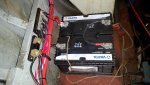
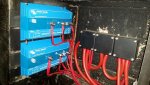
This is what it should look like in the battery box after getting rid of the 1-2-B switch and fitting separate switches, this installation uses Victron ArgoFETs on a twin engine installation, seen in the second picture, which also shows the rear of the isolator switches. :
 

Attachments

  • 20180531_151438.jpg
    20180531_151438.jpg
    507.3 KB · Views: 1
  • 20180531_151455.jpg
    20180531_151455.jpg
    526.2 KB · Views: 1
boll*cks, sorry i just ordered the add another battery kit as it seemed the simplest to wire up. its already shipped.
 
Last edited:
boll*cks, sorry i just ordered the add another battery kit as it seemed the simplest to wire up. its already shipped.

It's not a bad system, just that there are a couple of failures that can be better handled by separate switches, so i wouldn't lose too much sleep, it's a million times better than a 1-2-B switch.

Just try to make a better job of the wiring than in the PBO article :encouragement:

EDIT, when you add a 2nd domestic battery next year, all of this will work just fine with it. You'll jest need a couple of additional cables and to move either the positive or negative cable to the new battery (you don't have both cables coming from the same battery in a two battery installation), so if you're making new battery cables now you might want to allow for that.
 
Last edited:
Top