Condensation?

If you boil potatoes or pasta for 10 minutes every day then you will have an uphill battle,particularly if the hob is not under the hatch.
 
Condensation occurs when the air outside of the yacht is colder than the inside, and the air inside is humid. The air outside cools the hull and outer parts of the yacht, and the humid air on the inside cools where it comes into contact, particularly thin parts like the windows. Then it dumps dew.

So there are a number of solutions.

1. Insulate the boat, so the cold outside doesn't penetrate the inside (but you can't insulate the windows).
2. Lower the humidity inside by not living aboard and/or by using a dehumidifier.
3. Keep the internal temperature the same as outside, by having lots of ventilation.
4. Keep the internal temperature sufficiently high so that no matter how cold outside, the inside of the hull etc does not fall below the dew point.

Generally it helps to combine methods.

That's a comprehensive collection of half-truths on the subject!
 
Our Sadler 34 is foam filled, as with the Starlights. In winters in the Netherlands we never had condensation on the topside and hull walls but we did on the windows. Some owners have made perspex secondary glazing that cuts it down but perhaps condensation would then deposit somewhere else.
 
Plus the desiccant ones are quiet and don’t have a habit of catching fire.
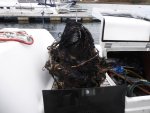
Unfortunately (for me) not true. This was my dessicant dehumidifier yesterday, and the inside of my boat after it had done its worst.P1000823.jpgP1000824.jpg
I await the insurance company's decision.
 
Thanks, not the best news to get when the marina phones you in the morning. I had used the same dehumidifier for the past few years with no problem.
Obviously quite a hot fire, but fortunately it burned itself out due to lack of oxygen, and no other boats were damaged, and most importantly no-one was hurt.
 
Sorry to see that and hope it's sorted in time for next season. Did you ever clean the dehumidifier's air filter? Only that seems to have been the cause in many of these cases. A lot of folk don't read the manual so don't realise they even have a filter that needs regular cleaning.
 
Did you ever clean the dehumidifier's air filter? Only that seems to have been the cause in many of these cases. .
I pulled out the filter and checked it three days before the fire, and it seemed quite clean and clear.
 
I once used a cheap dehumidifier in an empty house I owned and it ran 24/7 for a year and half, until one day when I entered the house I could smell a burning smell throughout the house. Traced it to the dehumidifier. It's tank was empty so hadn't been working best part of a week and you could barely keep your hand on it's plastic case. When I dismantled the unit there was a copper tank inside (looked like a miniature hot water tank but someone here will explain what it does hopefully) This copper tank quickly got scalding hot when switched on. So nothing to do with a blocked air filter. Can anyone explain what caused this? I have paid extra for a more expensive dehumidifier and it has given years of trouble free use. Would never buy the cheapest again.
 
Top