Condensation / diesel bug over winter

My understanding is that things have changed with the advent of biodiesel. Nowadays diesel contains up to 5% biodiesel. Biodiesel has a shelf life of 6 months. So apparently it is better to run down the tank by the end of the season and then fill at the start of the next, so most of the fuel is fresh.

Am I wrong?

TudorSailor
 
Excellent, thank you. I bet some will say its all wrong though in the true spirit of the forum! ;)

I reckon that the world of boats is easily divided into those that have had the problem and those that havent. Im in the first group and we will do everything in our power to prevent it coming back! Good luck to th doubters and I hope you never have one of the worst boat jobs thrust upon you, especially if you are becalmed off St Lucia........

I changed fuel filter in St Lucia. The Ozzie who helped me said "Good call." There was about half a litre of gunge that came out with the filter!
 
Unless you have the QE II as your yacht, I'd say you have about 200 x as much water in your tank as could have come from anything other than a gross leak or abysmal fuel. Get rid of that water as soon as you can, and find the leak (or change supplier) and fix it!

Even the PBO article - of no scientific merit whatsoever - admits that without free water there'll be no 'bug'. Free water is not inevitable: I've never found free water in my tanks, and I keep the tank empty all winter. I do check in the spring via the inspection hatch.
A litre of water is a lot, but not uncommon. A lot of tanks draw from well above the bottom and the water can build up year after year.
Then when you get diesel bug, some of those organisms are using oxygen and generating water as a byproduct.
 
I only have an interior filler.

Just taken 1 litre of water and about 4 more of dirty fuel from the drain on the bottom of the tank.

Whether dirty fuel or condensation or both?

If you have a drain from the bottom of the tank, why did you let it get so bad? I check mine probably about monthly, and almost never get any water or measureable dirt, but at least I know that there's nothing nasty festering in there.
 
Drain it about twice a year and always before a big trip.
I have a water separater too which was clean.

Probably some dodgy fuel in Brittany somewhere!
 
I have never had any water that I can detect in my tank or separator trap and I've never used a diesel additive. I've never seen a trace of bug.
Each time I fill up, (rarely - it's a sailing boat) then I ensure the filler cap is clean and dry before I open it and then that no liquid water enters during the fill. The boat stays in the water most of the year, and with the plastic 100L tank at around water level I doubt the temperature changes much throughout the winter so I suppose condensation is unlikely (I can't see how much water can condense from the tiny amount of air in the tank anyway). I've nothing against additives, but if I had bug problems, I'd want to work out how to prevent water ingress into the tank rather than treat the sympton.
 
I've nothing against additives, but if I had bug problems, I'd want to work out how to prevent water ingress into the tank rather than treat the sympton.

I use additives because I am worried about contaminated fuel, and the aggravating effect of bioidiesel. Not a great deal I can do about that.
 
I use additives because I am worried about contaminated fuel, and the aggravating effect of bioidiesel. Not a great deal I can do about that.

It depends on where you get your fuel. My supplier has good old fashioned high sulfur non- bio marine diesel. I've never felt, or seen, the need for fuel treatment additives.
 
It depends on where you get your fuel. My supplier has good old fashioned high sulfur non- bio marine diesel. I've never felt, or seen, the need for fuel treatment additives.
Where are you based and what is the current cost of the non-bio marine diesel, red I assume.

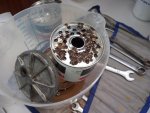
I changed both the fuel filters last weekend, if ever I get my hands on the design engineer there will be bloodshed. The first job this winter is to move the primary filter to the front of the engine bay where access is simple and I don't feel like I've gone a round with Mike Tyson.

The primary filter had been clearly doing its job and I use Soltron

IMG_20170924_130047.jpg

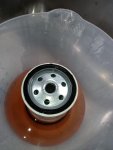
The secondary filter clean as a whistle, but the fuel still pink; I'm changing to white diesel and the tank is being emptied and cleaned this winter.

IMG_20170924_132639.jpg
 
Last edited:
It depends on where you get your fuel.

Of course.

My supplier has good old fashioned high sulfur non- bio marine diesel. I've never felt, or seen, the need for fuel treatment additives.

I generally don't have the luxury of choosing supplier. On the Clyde I get it at Largs Marina if I am over that way, as they guarantee non bio-diesel, but up the West Coast one takes what one can get.
 
Where are you based and what is the current cost of the non-bio marine diesel, red I assume.

I changed both the fuel filters last weekend, if ever I get my hands on the design engineer there will be bloodshed. The first job this winter is to move the primary filter to the front of the engine bay where access is simple and I don't feel like I've gone a round with Mike Tyson.

The primary filter had been clearly doing its job and I use Soltron

View attachment 66452

The secondary filter clean as a whistle, but the fuel still pink; I'm changing to white diesel and the tank is being emptied and cleaned this winter.

Reply:-
I generally get my fuel from Oban. Tommy Barbour, the oil supplier, also supplies the Calmac ferries. They briefly tried biodiesel and found that it gave them problems (unspecified). Using tons per day, they have clout!

I
 
Top