Compass mystery

2nd_apprentice

Well-Known Member
Joined
18 Mar 2007
Messages
2,480
Location
Berlin
Visit site
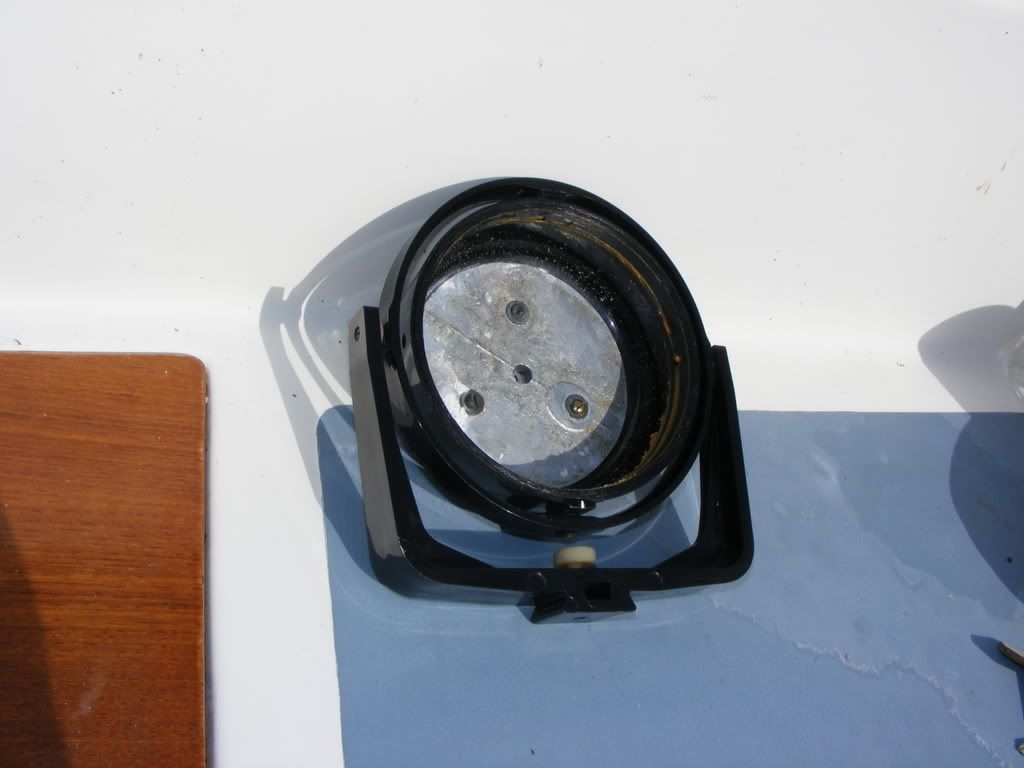
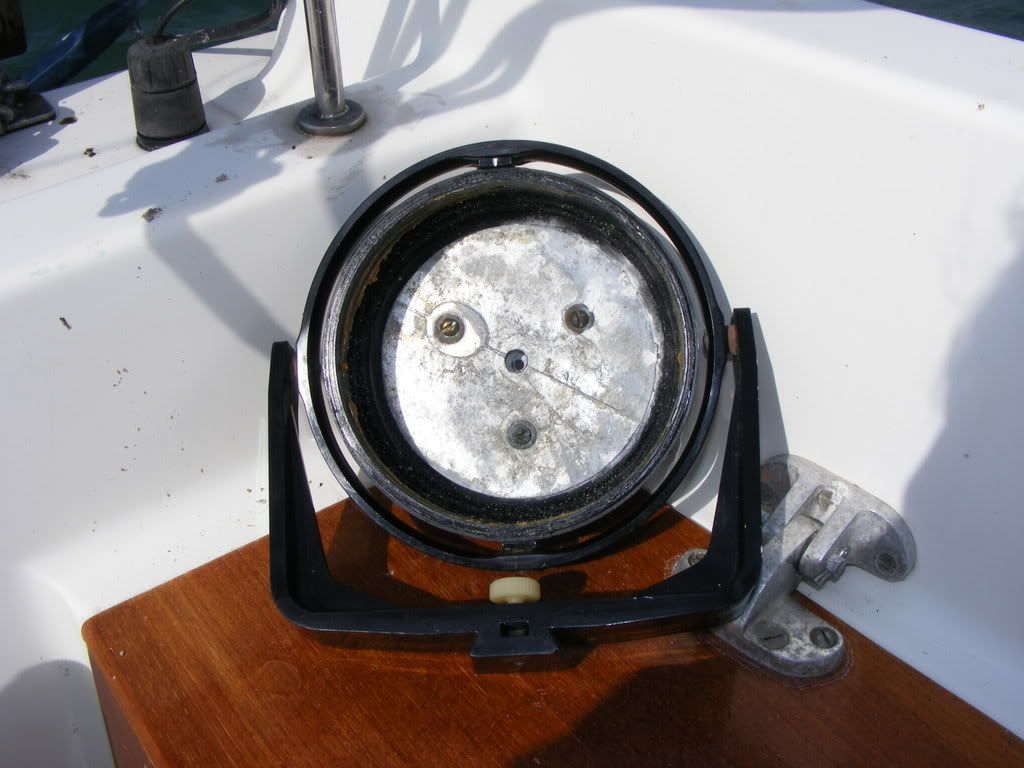
Thought I'd fix my compass, well have a look inside at least. It's a grid compass made by Heath Marine, similar to the "Sowester Bosun". Mine seemes to have some sort of illumination though which the Sowester lack as I understand it.
Anyway, I've been puzzled by the four wires (green white red and blue) that go in so I decided to take the housing apart. Not that difficult.
To my surprise not only did I find a small light bulb as expected but also that it's wired to a tiny circuit board. The electronics are in a well sealed plastic case filled with a clear liquid.
Even more disturbing was that since the compass card isn't transparent the light doesn't seem to make a lot of sense. Actually I tried a torch in place of the light bulb assembly but couldn't see any light getting through.
Perhaps it isn't a light bulb after all, could well be a glass fuse?

2830836956_5441de12f2.jpg


the compass

2830839174_6089afecfd.jpg


gimbals

2830838490_4bd5cba2eb.jpg


underneath the compass unit

2830837444_e825682670.jpg


the clever bit

2830003455_dcaa97c974.jpg


hmm?

2830003909_7774b697df.jpg


so, what issit?

/forums/images/graemlins/confused.gif
 
It's a TMC
Transmiting Magnetic Compass
Most commonly used as an off course alarm and as a back-up to a gyro.
 
I had one of the Heath compasses until it was stolen. It never had anything like that in it. Like wise the replacement Sowester one.

Sharp made autopilots. My guess is that its a modification for a Sharp autopilot to use it as its compass unit. How it would work though i don't have a clue. Well.......

It has some vague similarities to the compass unit in the very old (big) Seacourse autopilots (the insides of one of which i know only too well) Any sign of card rotating in there? The Seacourse units had a card with cut outs in it through which light from an under-run festoon bulb shone onto a couple of LDRs. They were independent of the steering compass though but I can picture a system in which a small card follows the movement of the large card in the steering compass.

No good to you though unless you find an old Sharp autopilot tucked away somewhere.
 
Cheers for the hints! The TCM stuff sounds convincing. Since I obviously don't have a Sharp autopilot I'll just get rid of the electronics and reassemble the compass. Filling the hole with epoxy and giving it a coat of paint would be a sensible idea I assume. The housing for the electronics is quite heavy (1 lb or more) do I need to counter ballast the compass with something?
 
Interesting, checked the heavy lump against my hand bearing compass and it's magnetic. Don't think it's for adjusting the compass deviation though.
 
[ QUOTE ]
do I need to counter ballast the compass with something?


[/ QUOTE ] Almost certainly yes. I have never taken mine apart to see what's inside it but I reckon there must be a weight of some description in there but I would not think it is quite as heavy as a pound.
 
i don't imagine that the lack of weight in the bottom of the compass bowl will matter much. Assuming there is enough weight to make the gimbals work correctly. I think your 1 lb electronics is mounted in the bottom of the bowl. Any magnetic effect may have to be compensated for though.

Compass balance is where weights are put on one end of the magnets on the card depending on the latitude the compass is uised in.

This is because a compass follows the earths magnetic lines of force. At the magnetic poles the lines of force are actually going vertically into the earth. And at places near the M poles the lines have a vertical component in their direction as well as the horizontal (north seeking component) So in high latitudes the needle actually wants to point towards N and also down. To make the card usable the card has weights fitted to balance the down ward dip. For most latitudes where there is habitation this balance is quite small but it is noticeable on compasses in the southern hemisphere where they have been balanced for northern hemisphere.

The standby magnetic compass on an international aircraft here in Oz always looks like it is broken as it is balanced for UK type N latitudes. Likewise always be careful buying a compass by mail order from another hemisphere. (here endeth the lesson) olewill
 
[ QUOTE ]
i don't imagine that the lack of weight in the bottom of the compass bowl will matter much

[/ QUOTE ] I still have one of these compasses and I am pretty sure there is a weight in the bottom. I dont think I'll be going near the boat this weeknd othewise I would offer to check
 
Snap, The gimbals work best the lower the center of gravity is below the pivot points. My grid compass has a lead plug in the bottom of the bowl. If I was removing 1lb of electronic package from the bottom of mine I would be looking at replacing it with 1lb of lead to keep the CoG as low as possible. Maybe gimbals work differently in the antipodes..... /forums/images/graemlins/grin.gif
---------------------
hammer.gif
Artificial Intelligence is no match for Natural Stupidity
 
Right, I'll just reassemble the whole thing as it was minus the electronics under the compass card. That should do just fine.
Any ideas what to use to help the the bevel ring sliding? Thought of using vaseline or something like that. Perhaps silicone spray?
 
I would have thought that vaseline would not be suitable due to its tendency to thicken. There is something at the back of my mind but I can't quite recall what it is. If it comes back to me I shall PM you.

Mal
 
I had a look in my compass yesterday. A substantial weight in there but I would not like to guess exactly how much.. I reckon it must be zinc. Too bright and shiny to be lead and I would not have though it was galvanised soft iron.

The grease is just an ordinary light grease I think!

Click the pics to enlarge

<span style="color:white"> .............. </span> <span style="color:white"> ..................... </span>
 
Confirmation!

I have one of these compasses on a boat I bought last year. It is indeed part of an autopilot system.

Having spent last weekend following hydraulic pipes in the stern I have since discovered that I have most of the system, it just isn't working at the moment.

The gimble is bolted to a control box which in turn has a socked for the compass input. When I get the chance I'll take some more pictures so you can see what it originally looked like.
 
I have one of these compasses on a boat I bought last year. It is indeed part of an autopilot system.

Having spent last weekend following hydraulic pipes in the stern I have since discovered that I have most of the system, it just isn't working at the moment.

The gimble is bolted to a control box which in turn has a socked for the compass input. When I get the chance I'll take some more pictures so you can see what it originally looked like.

Welcome to the forum TGB, although that is a 4 year old thread I'm afraid, so I guess that the issue will have been resolved by now.

Richard
 
OK, a bit late but it may be that the weight that VicS has could well be Bismuth. It's unusual to find Bismuth around, but it melts at a very low temperature and is easy to cast. I used to see it used at work to fill components which were to be machined to a thin wall, then the bismuth was boiled out, so as to not crumple the wall during machining.

Rob.
 
Well, some thing take a bit longer I reckon ;-)
Don't have the control box or anything apart from the compass itself, so no use for a/p cleverness.
Probably made its way onboard via boat jumble, lol

Welcome to the forum, Rob!
 
Top