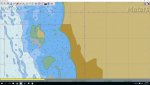
Cockpit instrumentation on a 40ft cruising yacht?

"with a screen (or perhaps multiple screens) where you need them."


Yes, that makes real sense. What about mounting them on the Whitlock steering pedestal? I had intended mounting a compass there but maybe I should go the way Roger has with an electronic compass?

Clive

But I still have a normal compass on my outside steering station under the blue cover including 2 black balls that you don't need

IMGP2633_zps697c2f7e.jpg


My outside display is a car DVD video display the I put into a stainless sealed box and mounted on the tube going vertical behind the switch box.

My computer is a 12VDC car/truck computer mounted inside a cupboard next to my nav station with a 17" TV/video/computer screen at the nav desk the outside screen is a video signal from q VGA to video converter I got from E-Bay

My electronic compass is really for my autopilot but I added a display inside for bad weather sailing and the outside one I am thinking of replacing with a GPS repeater.
 
Last edited by a moderator:
"with a screen (or perhaps multiple screens) where you need them."


Yes, that makes real sense. What about mounting them on the Whitlock steering pedestal?

Certainly no technical reason why not, but it wouldn't be my choice. I suspect you're still thinking like a car, with a driver behind the wheel, not like a yacht at sea.

I'm assuming your cockpit layout is more or less conventional, with the steering pedestal towards the aft end. Now consider the cockpit as a whole, a living and working space which you enter (from the cabin or foredeck) at the forward end. Ignore the wheel - as an offshore cruiser you don't use that at sea, the autopilot or windvane does the steering. Now if you put the navigation screen on the pedestal, what you've effectively done is mounted it at the far end of your space, facing away from you. How is that ergonomic?

Pete
 
"Even in somewhere as first-world as the Channel Islands it shows practically no maritime data - no depths, no rocks, just a handful of the larger buoys. Surely in your intended cruising areas it's just going to be blank as there's nobody to collect the data?"

That was my impressions too. I was trying to find the depth of water around the UK but couldn't. I thought that was because I wasn't using it properly ( I did find the 100m contour off the West Australia coast). However I did find it quite informative for Durban and Capetown though.

A lot of the coast off Northern Australia hasn't been surveyed. On the marine charts it is not uncommon to see notes like "Apparently very shoal" on top of a shaded area. An intrepid single-hander was telling me a depth-sounder is not much use as you could be in 50 meters of water one moment and just about aground moments later. I'll give that a miss.

https://www.google.com.au/search?q=...AQ_AUIBygB#tbm=isch&q=sailing+kimberley+coast

Clive
 
Last edited:
Thanks Roger. That looks identical to the paper chart I have. Why would you have a chart of Lancelin Western Australia? I imagined you would only buy charts of the area you intended to sail e.g. West Africa, SE Asia

I thought C-map is now the dominant player for digital charts but I can't find anything on the Internet to back up that notion.

Do you have a back-up system of any sort.?
 
Last edited:
Thanks Roger. That looks identical to the paper chart I have. Why would you have a chart of Lancelin Western Australia? I imagined you would only buy charts of the area you intended to sail e.g. West Africa, SE Asia

I thought C-map is now the dominant player for digital charts but I can't find anything on the Internet to back up that notion.

Do you have a back-up system of any sort.?

I have C-map charts for the whole world (don't ask) The may not be fully up to date but OK for main use between ports.

I also have on old Simrad plotter with C-map cards for the South African coast plus paper charts for the whole South African coast so yes I do have several backups.

I tend to update up still keep the current stuff that works as a backup. I also have all my Nav software on my laptop and my home PC so if my main nav PC does down I can use my laptop.

The only backup I don't have is my Simrad instruments central computer.

I think the point about C-Map being "the dominant player" is more to the fact that there are a lot of "non legal" copies around not the fact that is it the most legally used.
 
Certainly no technical reason why not, but it wouldn't be my choice. I suspect you're still thinking like a car, with a driver behind the wheel, not like a yacht at sea.

I'm assuming your cockpit layout is more or less conventional, with the steering pedestal towards the aft end. Now consider the cockpit as a whole, a living and working space which you enter (from the cabin or foredeck) at the forward end. Ignore the wheel - as an offshore cruiser you don't use that at sea, the autopilot or windvane does the steering. Now if you put the navigation screen on the pedestal, what you've effectively done is mounted it at the far end of your space, facing away from you. How is that ergonomic?

Pete

Yes, OK I've got it now. Thanks.

I'm going to use OpenPNC (or similar) and will therefore need a display in the cockpit beside the main hatchway - I'll make up a weatherproof binnacle for that if it is not waterproof already.

I tried to download OpenPNC last night but my software didn't recognise the file type (presumably it is zipped) but I'll overcome that problem. The cable at the rear of my LCD display of this computer is quite heavy (5mm?) and I'm wondering if I need more than one display or does OpenPNC have the software option of embedding additional data on the screen such as speed, wind measurements etc. I presume you switch "windows" for nautical charts, radar images and depth information. What I'm asking is how many display units would I need?

On a completely different matter what do you use for a fuel tank pick-up. I have plenty of SS tube as well as through fuel tank fitting (I am drawing from the top) but they are not cheap (I think the two of them cost $100). Is there a cheap , seaworthy way for the fuel return hoses to enter the tanks?

How would one of these go with narrow nuts?

View attachment 57622
 
Last edited:
Yes, OK I've got it now. Thanks.

I'm going to use OpenPNC (or similar) and will therefore need a display in the cockpit beside the main hatchway - I'll make up a weatherproof binnacle for that if it is not waterproof already.

I tried to download OpenPNC last night but my software didn't recognise the file type (presumably it is zipped) but I'll overcome that problem. The cable at the rear of my LCD display of this computer is quite heavy (5mm?) and I'm wondering if I need more than one display or does OpenPNC have the software option of embedding additional data on the screen such as speed, wind measurements etc. I presume you switch "windows" for nautical charts, radar images and depth information. What I'm asking is how many display units would I need?

On a completely different matter what do you use for a fuel tank pick-up. I have plenty of SS tube as well as through fuel tank fitting (I am drawing from the top) but they are not cheap (I think the two of them cost $100). Is there a cheap , seaworthy way for the fuel return hoses to enter the tanks?

How would one of these go with narrow nuts?

OpenCPN does have an instrument display window built in and the instruments are configurable in what you select to display and the format of those displays. It also had an AIS radar type diaplay but also displays AIS targets in the main chart. This is the way I use the AIS in OpenCPN.

I prefer the instrument display in NavmonPC (also a free download) and I also use NavmonPC to combine all the input signals which then gets feed to OpenCPN using a virtual port. NavmonPC also allows input data to be copied to real or virtual ports for sending to an autopilot if need be.

Did you download from here

http://opencpn.org/ocpn/download

Also look here for a range of plugins

http://opencpn.org/ocpn/downloadplugins

The windows download gives you a setup EXE file that you just run and should do all the things needed. You then need charts and C-Map can be found on the net but be careful as some chart download sites can be very destructive to your computer system.

As far as displays I have a combined TV which has inputs for TV aerial, VGA computer input and Video inputs for Satellite TV and video cameras. This is at the Nav station and in the saloon.

I the cockpit I gave a car DVD screen in a stainless steel waterproof box that clamps to any of the tubular support in my cockpit so can be positioned to be viewed from different positions either looking fed of astern, in front of the wheel or next to the companionway. So I have total flexibility for viewing the cockpit display which is the same as on the nav station display.


My fuel tanks also have a top draw off and I fitted a threaded socket in the top of the tank directly above the deepest point. I then got a fitting as below of the size of the stainless tube I was using for the draw off pipe. This fitting has an olive under the nut to clamp and seal the draw off pipe but also has a ridge inside to prevent the pipe going too far through. I drilled out this ridge so the draw pipe can do all the way through and can then be adjusted to draw off a little distance above the bottom of the tank. In my case I welded an elbow to the top of the pipe so I could fit a shut off ball valve then a straight version of the fitting like you posted.

715ZQHK8RvL.jpg


This is a pic of the top of my keel tank.

IMGP2651_zpsqzp8xnfu.jpg


The yellow pipes are bilge pump discharge pipes so nothing to do with fuel tank.

The small black pip in the centre is the fuel draw off pipe and that attaches to the shut off valve screwed to the draw off pipe.

The black roung item with 5 screws is a capacitive fuel level sender.

Then there is a vent and fuel return elbows. The fuel filler is 38mm BSP pipe fittings with a Y strainer to prevent large debris getting into the tank and also prevents anyone syphoning fuel at it is above the level of the fuel in the tank.

I also fitted a float switch with an alarm so when filling and alarm goes off when the tank is nearing full to prevent fuel overflowing into the deck and possibly overboard.

The black rod just by the red cross member is the top of a dip stick in case the electric gauge fails.
 
Last edited by a moderator:
On a completely different matter what do you use for a fuel tank pick-up.

My stainless tank was installed by the builder; the pickup and return lines are welded or possibly brazed into it. The supply and return for the engine are both dip tubes, apparently identical. On the top of the tank they appear as female threaded bosses, which take a banjo bolt. When we bought the boat this was followed by a bit of a lashup of ball valves soldered onto cut-down banjos; not sure if this was original or added by the previous owner. The valves were knackered so I had to fit new ones; it was quite difficult finding anything that would go on a banjo and fit directly to a valve, so I went for short lengths of hose instead.

The supply for the heater is different; it's just a length of thin pipe welded/brazed through the top of the tank, then a valve with a compression fitting is attached to it. The filler and breather connections are fabricated elbows (welded from short lengths of pipe cut diagonally) welded to the top of the tank.

Here are a couple of not-very-good photos of the engine and heater connections:

92B9B12A-518A-4479-947B-5716883CBDC9_zpsoslvpfuq.jpg


9acfb790-71ce-4284-a6c5-43a6f00c66bc_zpsbp1sonyr.jpg


You can also see the primer bulb that makes replacing filters and bleeding the system really easy. It will happily push fuel right round the low pressure side of the system, from the tank through both filters, the lift pump, the low-pressure side of the injector pump, and back down the return line.

The shiny stainless plate on top of the tank is an inspection hatch that I added last year to finally sort out the fuel contamination we inherited.

Pete
 
Last edited:
Thanks Pete and Roger. There a lot of good ideas there.

I'll probably go for a dipstick to get a rough idea of the amount of fuel I have in the tanks. I was going to have a sight "glass" on the fuel tanks until I found a lot (most?) marinas will ban boats from the marina if you are using them. I'll certainly will have priming bulb though to prime the LP system..

I'll try again to download OpenCPN later this evening but I'm always wary where I down load any free software from because, as you say a lot of downloads include malware as part of the deal. Thanks for the safe link Roger.

Clive
 
Last edited:
Top