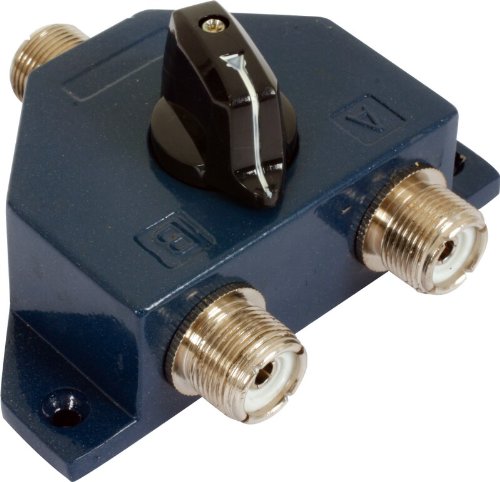
Coax switch

Graham_Wright

Well-Known Member
Joined
30 Dec 2002
Messages
8,207
Location
Gloucestershire
www.mastaclimba.com
I have a NASA "radar" AIS receiver and have recently bought a Matsutec transponder which also receives.

The NASA draws significantly less current than the Matsutec and I wish to have the option of selecting either in the interest of power economy.

I have two vhf aerials at the masthead (with 1 metre separation) one for the vhf radio the other for AIS.

It would be useful to able to select either of the two AIS devices through a mechanical coax switch.

Do such things (still) exist?
 
Not aware of manual switchess, but I bought some coaxial relays from Radiall a while back. They were quite expensive, but good to several GHz.
There are manual switches about used by hams.
There are aerial switches good for high frequencies intended for sat TV reception, might not cope with 5W Tx and will probably be 75ohm...
 
Thanks. I had a look. No mention of impedance matching. I can't remember if marine vhf tx/rx i 75 ohms or something different.
Marine VHF is 50 ohms.

From my knowlege of physics I can't see that the difference between 50 and 75 ohms would be significant for a component like a connector or switch, I would love an expert to explain if that is not the case.
 
Apologies if causing thread drift but I think you have got useful answers. Can I ask what the current draws are, I have NASA AIS and am thinking of buying the matsutec!
 
Apologies if causing thread drift but I think you have got useful answers. Can I ask what the current draws are, I have NASA AIS and am thinking of buying the matsutec!

There is a description here;-
https://www.foreign-trade.com/wholesale/Matsutec-HA-102-CLASS-B-AIS_222203.html

It has no display so needs to drive a plotter which is where the majority of the current draw would be.

The cheapest offer I found was;-
https://www.ebay.co.uk/itm/143052044901?ul_noapp=true

Despite informing the seller, the picture remains the same!
 
Apologies if causing thread drift but I think you have got useful answers. Can I ask what the current draws are, I have NASA AIS and am thinking of buying the matsutec!

The Nasa draws 50 to 100mA depending on screen on or off. It is only a receiver. The Matsutec that I have is rated at 250 to 300mA but it is a transponder and a gps and has a radar display just like the Nasa! The Matsutec could possibly be switched to receive only and dark screen if you wanted to get down to similar current draw as the Nasa unit. This would be a lot easier than introducing another switch. I think a Nasa unit needs a gps input to be of any use so you need to add the GPS power requirement to your calculation.

To be frank. I would be seriously worried about your power bank if you are worried about this level of current draw even a small solar panel will give enough output to keep them going in day light hours.
 
Last edited:
I have a NASA "radar" AIS receiver and have recently bought a Matsutec transponder which also receives.

The NASA draws significantly less current than the Matsutec and I wish to have the option of selecting either in the interest of power economy.

I have two vhf aerials at the masthead (with 1 metre separation) one for the vhf radio the other for AIS.

It would be useful to able to select either of the two AIS devices through a mechanical coax switch.

Do such things (still) exist?

I looked into this in some considerable detail when I bought my HP-33A, because I thought it would be useful to be able to swap the VHF and AIS between masthead and pushpit antennae.

The answer is that there are lots of switches which will handle these frequencies, but if you have a transmitter you have to make sure that the transmitter is attached to something while transmitting, whether that's an antenna or a dummy load of the same impedance. Eventually I discovered that the device needed is a "coaxial transfer switch" or, more to the point, a "manual coaxial transfer switch" since most of them are solenoid operated.

Unfortunately, I couldn't find one at a sensible price. Solenoid ones are not too hard to find or too expensive, but I didn't want to mess around with an actuating circuit.

If you can make sure that Matsutec won't try to transmit when unconnected, Amazon can sell you a switch for under thirty quid:

51hvjVtN8oL.jpg


Be sure to check the frequencies on anything you're thinking of buying: I found quite a promising transfer switch which was only good up to 10MHz, and AIS runs at ~160MHz
 
Marine VHF is 50 ohms.

From my knowlege of physics I can't see that the difference between 50 and 75 ohms would be significant for a component like a connector or switch, I would love an expert to explain if that is not the case.

If the switch looks like a short section of 75ohm line in a 50ohm system, that's unlikely to make much difference, but these small effects can stack up in odd ways.
Biggest problem is that connectors will probably be different, beware of 75ohm BNC for example.
 
Biggest problem is that connectors will probably be different, beware of 75ohm BNC for example.

I defy you to detect the difference between a 50 ohm BNC and a 75 ohm BNC at anything below 1.5 GHz, I looked into this when looking at digital signals in broadcast, as we tend to use 50 ohm plugs and 75 ohm sockets in 75 ohm broadcast systems ... at the time I had access to a decent time domain reflectometer and was unable to detect a difference between the two.

I would add that there is no such thing as a 75 / 50 ohm PL259 ... they are all the same.

The trick with BNCs is to use 50 ohm plugs and 75 ohm sockets, the broadcast industry has done this for years, even on digital systems up to 270mbits ...
 
Top