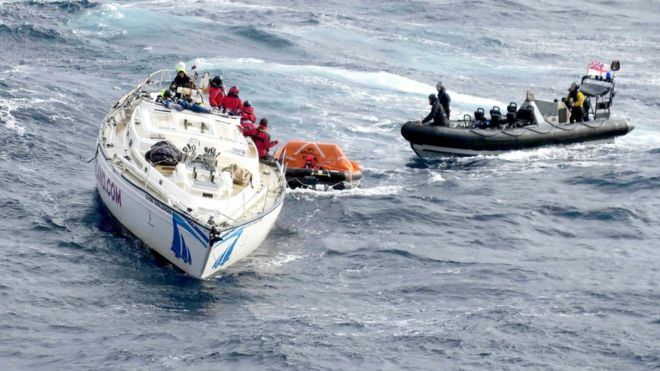
Clyde Challenger no more.

Covert

New Member
Joined
22 Jun 2012
Messages
3
Location
Bridge of Earn
Visit site
Clyde Challenger one of the original clipper 60s has been scuttled after sustaining damage.

From their Facebook page...

Ultimate Atlantic Shore Team Update 11 Feb 2017 18:15

Following assessment of the damage caused to Clyde Challenger during the evening of 9th February 2017 and transfer of all crew from the vessel it is with a heavy heart that we have to announce the Clipper 60 Ocean racing yacht Clyde Challenger (ex. Chrysolite Clipper) has been Scuttled with the assistance of the UK Navy. She went down at 45^ 13.42N 017^07.5W at approximately 17:30 UTC.

Many recovery options were investigated with the co-operation of the coastguard, salvage agents and insurers. Due to her current position, 7-10 day forecast, risk to other vessels and considering the damage sustained it was concluded that the only safe option was to ensure the vessel posed no further risk to person or marine traffic.

Commenting on the recent events owner Glenn Porter stated “Despite sustaining significant damage in the evening of Thursday 9th February Clyde Challenger continued to provide safe refuge for her crew until they could be transferred with minimal risk off the yacht by the UK Navy. It is sad to see the loss of Scotland’s Clipper 60, she will be sorely missed by many.”

Our immediate task now is to get the crew back home and provide all co-operation necessary to the authorities investigating the incident. The team at Clyde Challenger will also be working on options to move forward with our aim to “make the ocean racing experience available to all” and will keep our many followers and supporters updated through our social media channels.
 
It's a hard to find out what happened; sounds like severe weather damage but the yacht still floating to provide shelter. As for scuttling it "with help from the Royal Navy" ??? A passing submarine ?

Getting the crew off in grim conditions must have been a feat of seamanship. Well done to the rescuers.
 
It's a hard to find out what happened; sounds like severe weather damage but the yacht still floating to provide shelter.

A bit more detail has appeared at http://www.bbc.co.uk/news/uk-38944629

_94273183_hi037826759.jpg


A Royal Navy warship has rescued 14 sailors who were stranded for two days in the Atlantic Ocean. The HMS Dragon diverted 500 miles to reach the 13 Britons and one American after the mast and rudder had broken off their racing yacht. The 60ft (18m) Clyde Challenger yacht had been travelling to the UK from the Azores when it was damaged in stormy conditions on Thursday. ...
 
These yachts are designed for Ocean Sailing so they should be able to take a hard knock down without losing the mast and rudder. It is easy to blame the quoted rogue wave but that just raises other questions: fitness to remain in classification for Ocean sailing, experience of crew to handle the boat, contingency measures, fair wear and tare and the level of refit to maintain specification.

The Challenger's skipper, Roy Graham, said problems had begun five days after leaving the Azores when a large wave hit the yacht."We got hit with a rogue wave coming in the opposite direction," the 66-year-old Scot said.
"It hit us and knocked us over and dragged the crosstrees into the water, which dragged the mast into the water and snapped it at deck level."

Probably bad luck that they happened to be in the path of a 'rogue wave coming in the opposite direction'. I guess with the boat moving one way, the wave moving the other way, with the mast in the water it is a pretty tall order to expect the mast to survive that sort of combination of loads.
 
These yachts are designed for Ocean Sailing so they should be able to take a hard knock down without losing the mast and rudder. It is easy to blame the quoted rogue wave but that just raises other questions: fitness to remain in classification for Ocean sailing, experience of crew to handle the boat, contingency measures, fair wear and tare and the level of refit to maintain specification.

+1. Specially rudder loss.
 
These yachts are designed for Ocean Sailing so they should be able to take a hard knock down without losing the mast and rudder. It is easy to blame the quoted rogue wave but that just raises other questions: fitness to remain in classification for Ocean sailing, experience of crew to handle the boat, contingency measures, fair wear and tare and the level of refit to maintain specification.


Probably bad luck that they happened to be in the path of a 'rogue wave coming in the opposite direction'. I guess with the boat moving one way, the wave moving the other way, with the mast in the water it is a pretty tall order to expect the mast to survive that sort of combination of loads.

It's easy to think of the water in a wave moving in the direction of the wave, but that is not what happens. The water movement is roughly circular. But I have not been in a violent knock-down... (But have been flung across the cabin and "seen stars"!)

Mike.
 
The conversations with the insurers must have been 'interesting' with 13 souls on board. Doubtless we shall hear what the damage was in due course.


David Lewis, solo, in a 32ft boat, was dismasted with hull damage near Antarctica nearly 45 years ago. He made a jury rig, and then sailed 2500 miles further South down to Palmer Station, where he spent the winter, refurbishing his boat.

On the way back to Cape Town, he was dismasted again, but this time it was a small voyage of 800 miles.

Autres temps, autres moeures
 
It's the breaking waves that have more force as that part of the wave is falling down into the trough. Having spent most of my life surfing the white water or breaking wave is what to be aware of. Whilst sailing I've also had a breaking wave knock down to past 90deg in Biscay in a November storm in a 40' yacht, the rudder gets a huge sideways load as the boat rolls and then tries to slide sideways down the wave but I am surprised that this design of boat broke. The rig loads will be decided by how much sail was up, our knock down had no main and only a storm jib on an inner forestay. Good to see they are all safe, that can't have been very nice out there.
 
Grumpybear,

I was waiting for someone to say something like that ! :)

It strikes me, even the best steel boats and ships have a distinctly finite life, which may possibly explain losing the rudder - maybe she had done her bit ( and more ) and her time was sadly up.
 
Grumpybear,

I was waiting for someone to say something like that ! :)

It strikes me, even the best steel boats and ships have a distinctly finite life, which may possibly explain losing the rudder - maybe she had done her bit ( and more ) and her time was sadly up.

I presume you are referring to HMS Dragon. The Clipper 60s are/were all plastic.
 
Well done to all all those who responded to the rescue mission, and glad everyone safe at the end of the day no matter what the reason for the loss of the mast. A happy ending albeit the loss of the boat which can be replaced. I'm sure there's 14 families very grateful to the RN.
 
Can I be the second? The last report we got from jonjo was that they were all unseaworthy and tied up in Pompey.

Last year, HMS Defender spent over 100 days protecting US and French carrier groups in the Middle East without losing a single day of tasking to machinery defects.

Meanwhile, following attacks on coalition vessels by Houthi rebels, HMS Daring was quietly deployed to the coast of Yemen.

Her ship’s company spent 39 days in Defence Watches and over 97 hours at Action Stations as they accompanied 650,000 tonnes of coalition shipping through the Bab-el-Mandeb strait at the height of the threat.


Newspapers, eh? ;)
 
What would others who post on this forum have done if their own cruising yacht was dismasted in that location? Attempt to construct a jury rig or ask for assistance?
 
+The other factor is the number of crew with deadlines for an end to the voyage. Clearly, from the pic, they have got rid of the mast (and some rigging ?), and she seems to be riding quite high. Loss of the mast will make her rather 'frisky'. But what about the sails stored down below , and the stump of the mast between deck and keel ?
 
Top