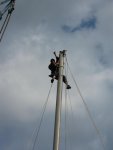
Climbing the mast, why? How?

Yes, the subject has come up several times on PBO. There are some made using a plywood board and a couple of fairleads and cam cleats. My Mastclimb is quite simple and could be made easily by anyone with reasonable engineering skills.
April044.jpg
Like this?
mastClimber-2.jpg
 
Does anyone know what is the minimum rope thickness for safe mast climbing?

Gitane
Depends on the rope, for hoisting personell a safety factor of 10 seems to be the the norm.
Dyneema has higher breaking strenght than polyester.

The condition of the rope is equally important, if in doubt pull the halyard for inspection (using a messenger line).
My son worked for a rigger - they refused to go up a mast bacause they deemed the halyards insecure - the owner didn't understand why, but would not klimb himself...

Always use two ropes, preferably internal halyards if available.
 
To make it up easily and feeling safe - alpinist way is the answer. Possible to go up on halyard made fast, using just Prussik knots at feet, or those devices for climbing on rope (whatever English name they have) I use Gibb kind from old times, similar to this http://www.copquest.com/35-2130.jpg
8 mm diameter halyard is perfectly safe for going up.

And good idea is safety harness line put around the mast. Also when on bosun's chair harness and line around mast prevents falling backwards; it also can be attached stiffly to another halyard. Such line, from chest, helps to have both hands free. Hallo down there :) j3.jpg
 
Last edited:
Yeah, actually I would also prefer a bosun's chair, and to be hauled up, and generally not to be a singlehander aboard, not only when going aloft :cool:
 
whilst I like the principal of the Topclimber, I am concerned that there appear to be no shoulder harness arrangements.

What happens is th eclimber leans abck and inverts ?
 
whilst I like the principal of the Topclimber, I am concerned that there appear to be no shoulder harness arrangements.

What happens is th eclimber leans abck and inverts ?
A good question, don't know, they probably plunge to a nasty and bloody death.
As I use a chest harness for my safety line I think I've eliminated that risk!
 
That is why better to look what profs, alpinists, cavers and others who climb ropes, normally do. This may be done by just tying couple of knots, sailor might know some knots, perhaps even have some rope... ;)
No dedicated device is necessary. No reason to pay for "special marine systems" either. http://en.wikipedia.org/wiki/Single_Rope_Technique

You strap one 'ascender' to the chest belt, another to the leg (foot). Better to have third, for other leg, this one on longer strap so to move it up by hand (not so easy to go up just on one leg, but may be done). http://www.globalsecurity.org/military/library/policy/army/fm/3-97-61/fig10-26.gif
 
Last edited:
whilst I like the principal of the Topclimber, I am concerned that there appear to be no shoulder harness arrangements.

What happens is th eclimber leans abck and inverts ?

As long as you have legs then your bottom half is likely to be heavier than your top half. Inverting is rather difficult, especially accidentally.
 
Like another post I always go beyond having an extra line to the bosuns chair by putting the extra line to a chest harness (well actually a life jacket). That way even less single points of failure.
 
It's not weight but moment that counts. Usually your legs will be bent, so your balance point will move up your trunk.

Mike.

First impulse on unexpectedly finding yourself tipping backwards is to kick your legs out. As said, to invert involuntarily is very difficult. Hence why most bosuns chairs and climbing harnesses don't have shoulder straps.
 
Like another post I always go beyond having an extra line to the bosuns chair by putting the extra line to a chest harness (well actually a life jacket). That way even less single points of failure.

Very wise. It worries me if I see someone attach both hauling halyard and safety line to the ring on the bosun's chair, even more so if they use snap shackles for either or both. My spinnaker halyard has a snap schackle on it, so I double the rope and pass it through the ring on my harness, then tie a bowline on the doubled line, finishing the job off and preventing the shackle from catching on anything by clipping the shackle round the tree of the line.
 
All the reasons stated above, but whynot try one of these have used a similar ladder for years.

www.flexiclimb.com
But you would still have to use two halyards attached to a harness of some kind for security?

We had a nasty death accident around here some years ago.
Man and wife where anchored in harbor, wife below deck, man decided to climb mast using fixed mast steps.
He fell down and died....
 
But you would still have to use two halyards attached to a harness of some kind for security?

We had a nasty death accident around here some years ago.
Man and wife where anchored in harbor, wife below deck, man decided to climb mast using fixed mast steps.
He fell down and died....

I use the topping lift with an accender attached to a climbing harness so I am always attached. There are various ways of securing oneself but I find that the best for going up and coming down. Once at the work spot I use a mast strap and can then sit comfortably to work.
 
Top