Cleat fail: when sweating by hand

Jamesuk

Well-Known Member
Joined
7 Apr 2007
Messages
2,522
Visit site


file and image uploader

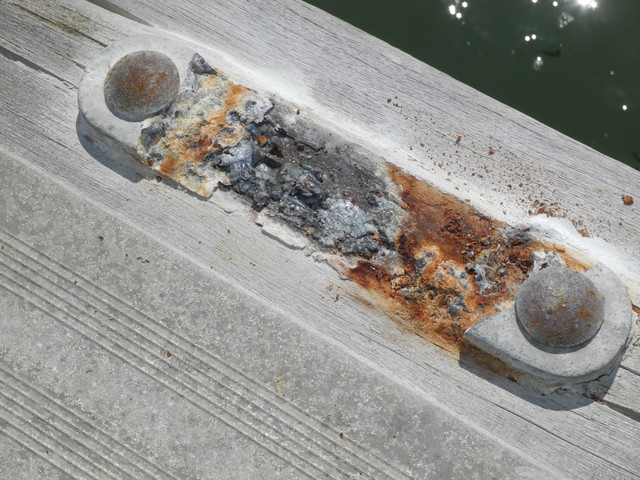
A line between two cleats is being sweated by hand to bring a boat alongside. The cleat that has the 3rd man taking up the slack allowed by those sweating; parts-from-itself.

What would cause this type of internal degradation to the cleat (3 tonnes in line and 1 tonne lateral pull) to fail?

One for the metallurgical engineering department?

The Cleat is suggested to be 20 years old (earlier version to MH4 I think)
"The twin-posted cast aluminium deck cleat can be fitted to all standard units with a simple through- bolt connection. The assembly has been load-tested to 3 tonnes in line and 1 tonne laterally."

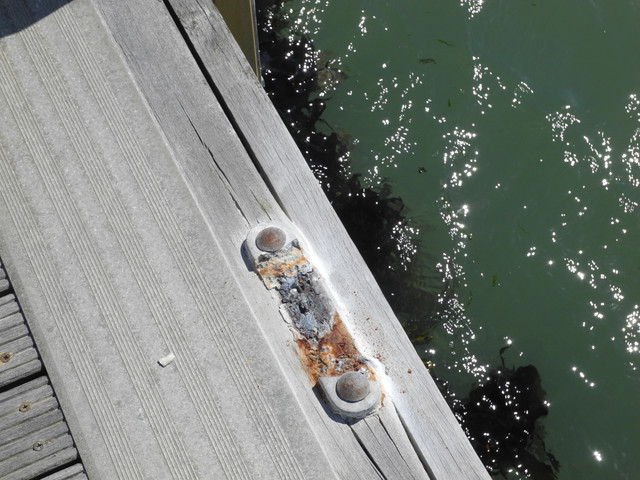
In the below photo it shows the next available cleat to use after the first one failed which was opposite the large wet patch.
2wfttf9.jpg


http://bollardloadtest.com
 
Looks like an electrolytic reaction between the steel bolts and the alloy cleat. Vyv Cox is the man to ask I reckon.

Exactly what I would expect with 20 year old aluminium.

Note you call these deck cleats i.e. to be fixed to a boat, suggest using something better for mooring cleats or bollards.
 
I suspect that over the years that cleat has been hit a few times which could well have led to it being cracked and subsequent penetration of salt water leading to the corrosion.
 
I experienced similar corrosion with the cleats mounted on the teak toerails of my old HR, at around 20 years old. Corrosion underneath forced the cleats upwards, eventually cracking them. I replaced them but mounted the new ones on thin nitrile sheet, which seemed to work.
 
I experienced similar corrosion with the cleats mounted on the teak toerails of my old HR, at around 20 years old. Corrosion underneath forced the cleats upwards, eventually cracking them. I replaced them but mounted the new ones on thin nitrile sheet, which seemed to work.

This was in a marina and an accident happened after and they are denying all responsibility.

So when you tie up your boat do you need to install your own cleats to be safe?
 
A quick visual check of whatever you're tying to would be a good start. If you're not happy with anything then report it.

Usually a quick visual check is the moment you wrap the cleat around with a rope, I've never once got a hammer out to tap it or applied a load on it.

The brand was walcom and I have had years of successful use, so should the RYA put into its training a method of testing cleats because at £70-100 per night you would have hoped the marina would have taken that risk out of the equation.

Stand by for little Yellow signs appearing on all marina's 'use cleats at your own risk' they may fail at the tug of a line
 
Usually a quick visual check is the moment you wrap the cleat around with a rope, I've never once got a hammer out to tap it or applied a load on it.

The brand was walcom and I have had years of successful use, so should the RYA put into its training a method of testing cleats because at £70-100 per night you would have hoped the marina would have taken that risk out of the equation.

Stand by for little Yellow signs appearing on all marina's 'use cleats at your own risk' they may fail at the tug of a line

I wouldn't assume anything. Can't see the whole structure in your photos, but those cleats are fixed very close to the edge of the timber. I'm ignoring what looks like a rubbing strip to the outer side.
 
Usually a quick visual check is the moment you wrap the cleat around with a rope, I've never once got a hammer out to tap it or applied a load on it.

The brand was walcom and I have had years of successful use, so should the RYA put into its training a method of testing cleats because at £70-100 per night you would have hoped the marina would have taken that risk out of the equation.

Stand by for little Yellow signs appearing on all marina's 'use cleats at your own risk' they may fail at the tug of a line

Exactly. I doubt the marina could waiver away their responsibility to provide safe, secure mooring arrangements.
 
I wouldn't assume anything. Can't see the whole structure in your photos, but those cleats are fixed very close to the edge of the timber. I'm ignoring what looks like a rubbing strip to the outer side.

Looks like a standard Walcon pontoon. Cleats fixed to a galvanised steel edge channel section.
 
I would say three things.

1 it looks like a pontoon that gets sea spray over it and when it dries off a lot of strong salt solution.

2 it looks like there is a chemical reaction going on between the bolts which are galv steel and the Aluminium cleat.

3 I would say corrosion of the bolts has caused the Aluminium cleat to weaken and fracture around the bolts due to the expansion of the steel.

Today most cleat bolts are stainless steel which wile retaining the corrosion issue with Aluminium do not expand in diameter with rust.

I have also recently seen cases where Aluminium cleats, stainless bolts and stainless backing plates within Aluminium pontoon tracking have caused the pontoon track to fail, admittedly over 30 years.
 
I would say three things.

1 it looks like a pontoon that gets sea spray over it and when it dries off a lot of strong salt solution.

2 it looks like there is a chemical reaction going on between the bolts which are galv steel and the Aluminium cleat.

3 I would say corrosion of the bolts has caused the Aluminium cleat to weaken and fracture around the bolts due to the expansion of the steel.

Today most cleat bolts are stainless steel which wile retaining the corrosion issue with Aluminium do not expand in diameter with rust.

I have also recently seen cases where Aluminium cleats, stainless bolts and stainless backing plates within Aluminium pontoon tracking have caused the pontoon track to fail, admittedly over 30 years.

Thanks great reply, do you work in the field?

The suggestion is that it was mis-use of the cleat. By using a winch to haul in the boat, this is NOT the case that happened after so why didn't the other cleat fail when a winch was used.

On the subject of cleats, I often see yachts dock using a 'blood' line which is a midship or stern line (with bow thruster) bring a vessel alongside applying huge loads to the cleat not to
Mention the surge in a storm.

Old, and corroded is why it failed and not mis-use
 
sorry for dragging up an old thread, but I'm looking for walcom cleats and came across this thread. At first glance that looked like the visitor pontoon at Haslar Marina.
during a particularly vicious storm a couple of years ago several cleats parted in exactly the same way along the visitor pontoon there. The corrosion and break pattern was identical.
I wonder if there is an issue with stray currents/galvanic corrosion on certain pontoons in certain conditions?
As we're in storm season, having already had Storm Brian a few weeks ago, I wonder if there's any "at risk" cleats in our own respective marinas that could be checked to avoid costly breakages this winter.
Pertinent for those of us who remain in the water all year round.
 
Top