Cleaning heads pipes with brick cleaner

lumphammer

Well-Known Member
Joined
21 Aug 2003
Messages
471
Location
Chichester
Visit site
I'm sure I've read on the forum that you can use brick cleaner (hydrochloric acid) to remove scale from waste pipes on boat heads. Before I pour a whole load down the toilet I thought I had better get some advice.
What concentration is best?
Will the acid affect the stainless ball valve in my Marelon stop cocks.
What about the environmental impact of dilute acid going into the sea?
Does it work????

TIA
 
If you have reached the point where you are having difficulty flushing stuff out, there is probably a thick layer of scale, which might not be removable without industrial strengths and quantities.

On my previous Moody I bought it at 11 years old, (2006), and started having problems the following year. Tried flushing a variety of stuff down without success and removed the forwards heads pipe - not easy!!

Despite loads of stuff having been flushed through, the diameter remaining was probably about 10-15mm of a 38mm pipe. Bashing it on the quay loosened it and it came out but, to get it out I'd chopped it in several places, so it wasn't going back.

Having replaced the hose, I regularly flushed it with a vinegar solution in the hope of discouraging the build up again.

I replaced the rear heads hose later in 2007, but sold the boat in 2010, so don't know how the vinegar regime worked.

How long is your hose, (ooh err Missus :) )? If relatively short, and easy'ish to remove and refit, bashing on the quay might be the best option.
 
I agree with Richard. I tried vinegar and concentrated hydrochloric acid but the problem is that whilst I did dissolve some of it (going off the gurgling and bubbling noises) there is no way that I am aware of of holding an acidic solution throughout the length of the pipe for a long enough time to clear it.

i reluctantly decided to remove the pipe which involved cutting inspection panels etc, but it was worth it because I can now maintain that area of the boat. Once committed to that, it was no big deal - in fact I spent more time trying to avoid it with flushing than it actually took to fix

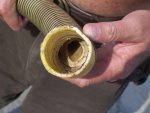
The only way is to remove the pipe and bash it on the quayside to break away the blockage that forms. You would need an awful lot of acid and flushing to dissolve this lot (see photo).

100_4501.JPG
 
That's what mine looked like!

Similarly, once committed, it gets done - although I recall it as being a big deal that needed a lot of thought and a bit of inventiveness. You have to be not afraid to cut holes in your boat where necessary. These pipes are generally fitted, then the boat built over them :(
 
I agree with all the above having had similar experiences.

In the end, rather than bash out the old hose I just replaced it, job done.

The most important lesson I learned when initially trying to clear it and flush it through was how many pumps it took to get from the bowl to clear the boat.
In my case it was 9.

The standard rule now is, after using the toilet, pump 10 times on flush, then switch over and pump until the bowl is left empty.
No problems since.
 
I have to agree. HCl used regularly can help to keep the Joker valve and hoses free of carbonate scale but as an unblocking treatment it is a non-starter. The volumes of acid needed are considerable and, as has been said, there are some parts of the hose system that cannot be treated.

Answering the questions:
Use it as it comes. Brick cleaner is fairly dilute, the stuff sold in European supermarkets is usually rather stronger and is reasonably effective.
HCl will not attack anything in the toilet and hoses, including stainless steel parts, brass/bronze seacocks, nitrile rubber
Once the acid has done its work and stopped fizzing the result will be calcium chloride, water and CO2. No environmental concerns.
It does work but not on scale half an inch thick, unless you buy your acid by the drum-full.
 
I'm going through the same process.
I put a small amount of high strength hydrochloric acid down the pipe to the joker valve but I reckon it will need quite a bit. It isn't nice to work with!
Process is on hold at the moment due to recent knee op, but for my next line of attack I have made a reamer from a 1 1/2 inch square of copper with the ends bent over to make teeth. I'm going to attach it to the end of a flexible spiral drain rod and put that on an electric drill.
It might work!
 
I have to agree. HCl used regularly can help to keep the Joker valve and hoses free of carbonate scale but as an unblocking treatment it is a non-starter. The volumes of acid needed are considerable and, as has been said, there are some parts of the hose system that cannot be treated.

Answering the questions:
Use it as it comes. Brick cleaner is fairly dilute, the stuff sold in European supermarkets is usually rather stronger and is reasonably effective.
HCl will not attack anything in the toilet and hoses, including stainless steel parts, brass/bronze seacocks, nitrile rubber
Once the acid has done its work and stopped fizzing the result will be calcium chloride, water and CO2. No environmental concerns.
It does work but not on scale half an inch thick, unless you buy your acid by the drum-full.

Brick cleaner we have been using specifically states it will affect stainless steel.
 
Brick cleaner we have been using specifically states it will affect stainless steel.

Some brick cleaners are not hydrochloric acid, which was the chemical I spoke of. Stainless steels are not particularly good in chlorides and can suffer stress-corrosion cracking after prolonged contact with them. In the case of dissolving toilet carbonate deposits we are talking about dilute acids for very brief periods, a few minutes only, which would not affect any stainless steel parts, or the others I mention.
 
HCl will not attack anything in the toilet and hoses, including stainless steel parts, brass/bronze seacocks, nitrile rubber
Once the acid has done its work and stopped fizzing the result will be calcium chloride, water and CO2. No environmental concerns.

I used to think that, until the plunger seal began to leak on my Jabsco a few months ago: the tension spring had completely corroded. (And, yes, it was an official Jabsco part). Obviously I can't be certain, but I put that down to HCl incompletely flushed-through.

As to nitrile in general, I quite agree that HCl seems to do no harm (although I've observed nitrile hardening after cleaning with white vinegar).

+1 on the environmental bit.
 
I use Hydrochloric acid, a high concentration, bought in corfu, every month down my heads, I use a bunch
close the inlet seacock, pump dry, pour it into bowl about 5 litres and pump it through, a bit at a time, once it stops fizzing outside, pump somemore, until its all flushed through, then pump through about 10 litres of fresh water and finish off with opening inlet seacock and flushing again. This regiome shifts a bunch of stuff out and touch wood I havent needed to replace any pipes on my three heads in 5 years, have replaced impellors in onbe heads and a motor in another, nothing to do with the acid treatment, these heads are used everyday, as we liveaboard. The acid is nuetralised before it gets out of the boat and it sure shifts va lot of gunge.
 
I use Hydrochloric acid, a high concentration, bought in corfu, every month down my heads, I use a bunch
close the inlet seacock, pump dry, pour it into bowl about 5 litres and pump it through, a bit at a time, once it stops fizzing outside, pump somemore, until its all flushed through, then pump through about 10 litres of fresh water and finish off with opening inlet seacock and flushing again. This regiome shifts a bunch of stuff out and touch wood I havent needed to replace any pipes on my three heads in 5 years, have replaced impellors in onbe heads and a motor in another, nothing to do with the acid treatment, these heads are used everyday, as we liveaboard. The acid is nuetralised before it gets out of the boat and it sure shifts va lot of gunge.
 
I use sulphamic acid, take out and clean the hose very 2nd year. If done regularly a good bashing gets rid of the scale, once its built up to 50% of the tube diameter, forget and replace.
Vinegar, HCl etc are , IMHO, useless as the pipe beyond the gooseneck is what blocks.
 
I'm sure I've read on the forum that you can use brick cleaner (hydrochloric acid) to remove scale from waste pipes on boat heads. Before I pour a whole load down the toilet I thought I had better get some advice.
What concentration is best?
Will the acid affect the stainless ball valve in my Marelon stop cocks.
What about the environmental impact of dilute acid going into the sea?
Does it work????

TIA

Depends on the grade of stainless used in the balls. And as for acid into the sea, your pi55 is acid. Dont worry - theres lots of sea to dilute it to nothing.

Maybe the next herring you catch will already be soused!
 
I use sulphamic acid, take out and clean the hose very 2nd year. If done regularly a good bashing gets rid of the scale, once its built up to 50% of the tube diameter, forget and replace.
Vinegar, HCl etc are , IMHO, useless as the pipe beyond the gooseneck is what blocks.

Also proper pumping of the heads will get rid of the problem altogether - but its' bloody difficult to persuade the crew to pump 30 times!
I replaced the pipes this year (smell issues) and there was zero calcium build up.
 
Also proper pumping of the heads will get rid of the problem altogether - but its' bloody difficult to persuade the crew to pump 30 times!
I replaced the pipes this year (smell issues) and there was zero calcium build up.


Chemists out there speak up!

Are these deposits a function more of sea water than pee? Phosphates or carbonates. Does it depend on where you sail or temperature or how thoroughly you pump out? I've never had any bother ? Mind you I try to pump out 10+ pump strokes every time?

Graeme
 
Just to be a little controversial, has anybody compared the price of new pipe against the chemicals being considered?

Butyl hose in 1.5 inch bore can be as much as £10 per metre. Brick acid is about £5 per 5 litres, which would last for years. The HCl we buy in the Med is roughly £0.40 per 500 ml.

The deposits are largely carbonates, mostly magnesium, some calcium plus several others. Seawater is quite a complex mixture of salts.
 
Top