Cleaning fuel tank in situ

eddystone

Well-Known Member
Joined
18 Aug 2013
Messages
1,936
Location
North West Devon
Visit site
Before I fill up the (steel) diesel tank for winter lay up I wondered whether there is a way of cleaning the tank in situ? There is no inspection hatch and I wouldn't risk trying the drain nut underneath in case it fell out. Access would have to be via the filler tube.
 
I hate to be the bearer of bad news, but you may have a problem.

I was faced with the same issue some years ago after a particularly bad infestation of the dreaded diesel bug. The tank obviously needed cleaning and I investigated getting one of these fuel cleaning companies to do it, but they would have needed two access points to the tank. In the end I had to bite the bullet and get the tank removed and have an inspection hatch fitted.

Unless you have an obvious problem with crud in the tank, an interim solution might be to fit a Racor type filter, which is probably worth doing anyway.
 
Poke the hose from a Pela-type oil extractor down the filler pipe and check you find clean diesel at the bottom of the tank.
If there is any crud, it will block the thin pela tube, I replaced mine with bit of 8mm bore plastic with a few inches of ali tube on the end as a weight. Suck out all the water and dirty diesel.
I let the diesel I took out settle and put the clean stuff back via a filter.

Get rid of any significant water and you are unlikely to have a problem.

I am not a fan of storing diesel over the winter, it goes off, but as you have a mild steel tank you may have to compromise.
If I was going to spend your cash for you, I'd consider changing the tank.
 
Poke the hose from a Pela-type oil extractor down the filler pipe and check you find clean diesel at the bottom of the tank.
I am not a fan of storing diesel over the winter, it goes off, but as you have a mild steel tank you may have to compromise.
If I was going to spend your cash for you, I'd consider changing the tank.
I think the tank is stainless, not mild steel. What I don't know is whether it has baffles inside which make it more difficult to clean out and what is the state of the drain nut. Unless the boatyard has a clever solution I will probably do what you describe which is what I have done before and keep taking the Marine 16.
 
Since you are not confident about the state of the drain "nut", If it was mine, I would investigate it before doing anything else, and definitely before filling the tank. If you are in the fortunate position of having a fuel tank with a drain, you can use it periodically to drain out any accumulated water or dirt.
 
What's the issue with the drain plug? If it's corroded very badly, it might dump a tank of diesel in the bilges at sea! I would warm it up and get the stilsons on it, if stuck. It's a valuable resource (which I don't have on my boat:disgust:) and worth sorting.
Good advice above anyway.
 
Before I fill up the (steel) diesel tank for winter lay up I wondered whether there is a way of cleaning the tank in situ? There is no inspection hatch and I wouldn't risk trying the drain nut underneath in case it fell out. Access would have to be via the filler tube.
You don't say what type of boat you have.

I remove my tank every three years and steam clean it after picking up a dose of the fuel bug from somewhere.
 
Since you and I lead parallel lives with Sadler 32s, I imagine I have the same tank - no inspection possibilities and such an absolute pain to remove and clean that it would be easier to buy another boat. I had a big bug problem when I first bought the boat.

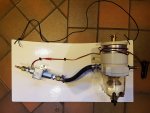
I made a portable fuel polisher (below) which stays in the forepeak locker in case of a dodgy batch of fuel but which I use at this time of year to do a winter clean. It has an 8mm ID hose which reaches the bottom of the tank through the filler hose and I can see the crud being removed. The return hose also fits into the filler so recirculates the clean fuel. I run this for about an hour and move the sucking hose around the bottom of the tank until there are no more cruddy bits to suck up. (I don't think there are baffles.) I also dose with Marine 16 on every fill and always seal the filler cap with grease to avoid water ingress. I've had zero problems for four years and do not intend to either clean the tank any other way or sell the boat.

20170114_122920.jpeg
 
Last edited:
I have 2 tanks in my boat, motor sailer and previous owner only ever use stb tank so port one needs cleaned out. I discovered it had over 100 litres of fuel in it,(no gauge), and so am presently setting up system same as Poey 50 has done and will polish fuel until filters are clean, which hopefully means tank will be too.
 
Since you and I lead parallel lives with Sadler 32s, I imagine I have the same tank - no inspection possibilities and such an absolute pain to remove and clean that it would be easier to buy another boat. I had a big bug problem when I first bought the boat.

I made a portable fuel polisher (below) which stays in the forepeak locker in case of a dodgy batch of fuel but which I use at this time of year to do a winter clean. It has an 8mm ID hose which reaches the bottom of the tank through the filler hose and I can see the crud being removed. The return hose also fits into the filler so recirculates the clean fuel. I run this for about an hour and move the sucking hose around the bottom of the tank until there are no more cruddy bits to suck up. (I don't think there are baffles.) I also dose with Marine 16 on every fill and always seal the filler cap with grease to avoid water ingress. I've had zero problems for four years and do not intend to either clean the tank any other way or sell the boat.

View attachment 81401

I also dose with Marine 16; I do have a Racor water removing funnel but it's so slow it's only viable for using on a jerrycan. I haven't had a fuel bug problem yet but....
BTW the other problem with the drain bolt is it's (non) accessibility on the underside of the tank.
I'd be very interested in replicating your fuel polisher if you had a parts list!
 
Eddystone, I've never had our 1985 Sadler 32 tank out since she was new. It is metal like yours. The fuel take off is at the bottom and has a lever operated cock.

I'm not sure whether there's a separate drain plug.

That's maybe because I find the cock very difficult to get at, or to be more precise, I find it hard to get out of the locker again once I've got into it far enough to grasp it.

I'm wondering whether this drain plug you see is in fact a redundant fuel outlet, which has been replaced by a top mounted draw off. If that's the case the 'drain' won't be much use to you anyway because it's probably got a small upstand inside it.

Anyway, do keep us posted on what you discover and do.
 
I also dose with Marine 16; I do have a Racor water removing funnel but it's so slow it's only viable for using on a jerrycan. I haven't had a fuel bug problem yet but....
BTW the other problem with the drain bolt is it's (non) accessibility on the underside of the tank.
I'd be very interested in replicating your fuel polisher if you had a parts list!
Cruder version:
https://theboatgalley.com/diy-fuel-polishing/
 
Is there not a fuel gauge fitting that you could remove and use as a access point?
Re is there a baffle in the stainless tank; if there is you should be able to see discolouration marks ( in a straight line) where the weld spots show .
I too have made a polisher and have a selection of hoses including some that have rigid pipe at the tank end so you can direct the pick up to the corners a low spots.
 
After various unsuccessful attempts at cleaning through small openings, I ended up taking an angle grinder to the top of my stainless tank to open up a 10" square hole. Through this I was able to scrub off copious quantities of black goop clinging to the walls, and get all the interior surfaces sparkling clean and dry, before bolting a new stainless plate and nitrile gasket over the hole.

Obviously this isn't something you'd do on a "maybe", though ;)

Pete
 
Eddystone, I've never had our 1985 Sadler 32 tank out since she was new. It is metal like yours. The fuel take off is at the bottom and has a lever operated cock.

I'm not sure whether there's a separate drain plug.

That's maybe because I find the cock very difficult to get at, or to be more precise, I find it hard to get out of the locker again once I've got into it far enough to grasp it.

I'm wondering whether this drain plug you see is in fact a redundant fuel outlet, which has been replaced by a top mounted draw off. If that's the case the 'drain' won't be much use to you anyway because it's probably got a small upstand inside it.

Anyway, do keep us posted on what you discover and do.

I don’t think so. The fuel cut off is on the underside of the tank and is quite accessible if I empty the cockpit locker and stand on my head. The nut which I think may be a drain I found with a mirror on a stick - it’s not in a position where I could gently unscrew to see if water comes out and I might end up swimming in diesel.
Fuel level indicator ? It’s a sight gauge
 
If your fuel is drawn from the bottom of the tank, it's possible the tank is very clean, as any water will have gone straight to the filter, rather than festering in the bottom of the tank.
My advice would be to sample the bottom of the tank with a pela or something, then you know if you have a problem or not.
There are plenty of fairly old cars which have never had the tanks cleaned and have not had bug problems.

Another idea is to look at your fuel filter when you change it. Cut it open. Is there much crud in there?
 
... I'd be very interested in replicating your fuel polisher if you had a parts list!

Yes, a parts list would be helpful if Poey50 has one to hand. I’ve occasionally wondered about the bottom of our tank (GRP, in a 1994 S32 not built by Sadler) ever since reading on the Sadler forum that some S34s (IIRC) had a filter built in to the outlet at the base of the tank. But I get essentially no water, nor evident detritus, in the primary filter (though I’ve not cut one open) and have therefore not investigated further.

I haven’t looked very closely at the fixings of our tank, having only renewed its filler and vent hoses, and I admit that I’ve always thought its removal looked potentially tricky. But - a genuine question - would tank removal actually be that difficult a job? I apologise for seeming to doubt you and Poey50 - but sometimes experience provides a knack, and I notice that Vyv Cox referred (on another thread by you on this subject in 2015 http://www.ybw.com/forums/showthread.php?432532-Drain-Sadler-32-fuel-tank-or-not) to having removed his (admittedly, S34) tank to fit a new level sensor.
 
Last edited:
Last edited:
Top