
Clamp water feed to stern glad when leaving boat?

Tim Good

Well-Known Member
Joined
26 Feb 2010
Messages
2,888
Location
Bristol
Visit site
When I leave my boat I always close the main engine seacock inlet. Obviously.

However, when changing my impeller recently it dawned on me that seawater was still linked to the engine via the small tube I have feeding my PSS stern gland.

If something in the raw circuit decided to come undone then technically the boat would fill.

Does anyone bother putting valve on the PSS feed or clamp it with a mole grip when laying the boat up afloat?
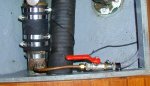
 
Yes, I have. I had the same realisation when changing the impeller so I added a ball valve just before the stern tube.
 

Attachments

  • Capture.JPG
    Capture.JPG
    78 KB · Views: 1
I only have a vent pipe on my PSS and that goes above the water level. Of course, if the stern gland fails then the boat floods but if the raw water inlet is shut then the only water in the boat is that in the cooling system - not enough to sink the boat surely? Do you have a pressurised water feed to the PSS?
 
I've not had a boat with a water-fed stern gland, but if I did then I might well fit a valve on it so that it can be closed for maintenance while afloat. However, I wouldn't close it between trips, as I don't with any other seacocks, because I don't believe there's any significant risk of hoses spontaneously jumping off of properly-secured fittings. If I was worried about a particular hose disintegrating in situ then I'd replace the hose FFS, not just seal it off so at least the boat only floods while I'm on board (and possibly mid-Channel in poor weather).

Repeatedly crushing the tube with mole grips seems like a good way to induce failure.

Pete
 
I've not had a boat with a water-fed stern gland, but if I did then I might well fit a valve on it so that it can be closed for maintenance while afloat. However, I wouldn't close it between trips, as I don't with any other seacocks, because I don't believe there's any significant risk of hoses spontaneously jumping off of properly-secured fittings. If I was worried about a particular hose disintegrating in situ then I'd replace the hose FFS, not just seal it off so at least the boat only floods while I'm on board (and possibly mid-Channel in poor weather).

Repeatedly crushing the tube with mole grips seems like a good way to induce failure.

Pete

+1

never close any seacock, boat still afloat. All hoses 4yo with new ss double hose clamps.
Regarding the stern gland Q, I wonder how much water will get in with the pipe removed (and shaft not turning), isn't the packing in between?

V.
 
I'd worry about vibration on the short copper pipe to the ball valve in your photo.... I could be wrong though.
 
I only have a vent pipe on my PSS and that goes above the water level. Of course, if the stern gland fails then the boat floods but if the raw water inlet is shut then the only water in the boat is that in the cooling system - not enough to sink the boat surely? Do you have a pressurised water feed to the PSS?

Not sure it's a vent pipe. Mine is attached to my raw water circuit and water it pushed through it. Presume it prevents fouling up inside the stern tube and aids lubrication.
 
Yes, I have. I had the same realisation when changing the impeller so I added a ball valve just before the stern tube.

That vent pipe is fitted to the stern tube. The PSS vent pipe is fitted to the carbon part of the seal so you must have a flexible pipe on a PSS at it could cause the seal not to run true and thus leak.
 
Presume it prevents fouling up inside the stern tube and aids lubrication.

I thought the water injection was to slightly pressurize the PSS to ensure the lip seal sits firmly on the shaft. Is that correct?

I am bleeding off water from the raw water system which is a point well above the waterline. I suppose the injection tube could rupture close to the PSS then I would be in trouble.

I've been doing a little research to see if I can get a better understanding of PSS and came across this article which I believe is a "must read"

https://www.passagemaker.com/technical/dripless-shaft-seals

OK OK! I got it.

The lip seal cannot run dry or it will be quickly damaged. If you have this seal and need to be towed, you must prevent the shaft from freewheeling if the engine will not be running.

https://www.passagemaker.com/technical/troubleshooter-understanding-shaft-seals

I have a Tides Marine Sure seal and I don't think I'd have a problem if the injection tube ruptured as sea-water could not flow up the propeller tube and out the ruptured tube.

View attachment 70773

If water can flow to a second Tides Marine Sure Seal (in the case of two motors) then I can block off the "crossover barb"
 
Last edited:
I thought the water injection was to slightly pressurize the PSS to ensure the lip seal sits firmly on the shaft. Is that correct?

I am bleeding off water from the raw water system which is a point well above the waterline. I suppose the injection tube could rupture close to the PSS then I would be in trouble.

I've been doing a little research to see if I can get a better understanding of PSS and came across this article which I believe is a "must read"

https://www.passagemaker.com/technical/dripless-shaft-seals

OK OK! I got it.

The lip seal cannot run dry or it will be quickly damaged. If you have this seal and need to be towed, you must prevent the shaft from freewheeling if the engine will not be running.

https://www.passagemaker.com/technical/troubleshooter-understanding-shaft-seals

I have a Tides Marine Sure seal and I don't think I'd have a problem if the injection tube ruptured as sea-water could not flow up the propeller tube and out the ruptured tube.

View attachment 70773

If water can flow to a second Tides Marine Sure Seal (in the case of two motors) then I can block off the "crossover barb"

The PSS and dripless are different types of seals.

The PSS has a carbon stator attached to the stern tube and its face runs on a stainless steel collar attached to the prop shaft. The seal is a very thin film of water between the carbon stator and the stainless collar. This must not run dry hence the vent to ensure water is inside the carbon stator and collar.

https://www.youtube.com/watch?v=a5SlEfpiaJ4
 
The purpose of the water feed is to ensure that the stern tube is always full of water when the engine is running as the seal requires water to seal and run cool. normally only required on higher powered installations and/or long stern tubes. On most sailboat installations the vent is sufficient to ensure that water fills the tube from the rear.
 
I once had a Tides Seal that depended on a pressurised water feed. A failed impeller means a failed water feed. I once ran the engine without opening the seacock but just for a few minutes. It caused the Tides to overheat and crack. Got rid of that sharpish. The PSS replaced it and the instructions only refer to a vent for low powered craft as Tranona says.
 
Check that ball valve regularly! The handle will almost certainly be pressed mild steel and will rust away quickly if there is a hint of saltwater around. If I ever have to install one of these I make a new handle from Stainless (316) or bronze. IMHO these are barely fit for marine use!! Sorry, I have seen too many of them fail at the handle.
 
Check that ball valve regularly! The handle will almost certainly be pressed mild steel and will rust away quickly if there is a hint of saltwater around. If I ever have to install one of these I make a new handle from Stainless (316) or bronze. IMHO these are barely fit for marine use!! Sorry, I have seen too many of them fail at the handle.

I buy my DZR ballvalves from ASAP (asap-supplies.com) and they come with stainless handles. Very good quality and very fit for marine use. Recommended.

Www.solocoastalsailing.co.uk
 
Check that ball valve regularly! The handle will almost certainly be pressed mild steel and will rust away quickly if there is a hint of saltwater around. If I ever have to install one of these I make a new handle from Stainless (316) or bronze. IMHO these are barely fit for marine use!! Sorry, I have seen too many of them fail at the handle.

I'm not sure if you're referring to my picture but, yes, I do check it regularly and it's now 10 years old , working just fine and seemingly in pristine condition.

By the way, I prefer frequent checks rather than regular ones at an unspecified interval.
 
Last edited:
When I leave my boat I always close the main engine seacock inlet. Obviously.

However, when changing my impeller recently it dawned on me that seawater was still linked to the engine via the small tube I have feeding my PSS stern gland.

If something in the raw circuit decided to come undone then technically the boat would fill.

Does anyone bother putting valve on the PSS feed or clamp it with a mole grip when laying the boat up afloat?

Do you shut those cockpit drain seacocks or rely on the flexi hoses & jubilee clips, whilst you are away
 
Yes, our new boat spent it's life in marinas and rivers so a swinging mooring on the west coast of Scotland showed that if the boat pitches enough it pumps water back up the pipe, even though it comes up to waist height in the cockpit before the t and dropping to the elbow, filled my exhaust (closed valve at transom) and filled the engine with seawater ?
 
The PSS and dripless are different types of seals.

The PSS has a carbon stator attached to the stern tube and its face runs on a stainless steel collar attached to the prop shaft. The seal is a very thin film of water between the carbon stator and the stainless collar. This must not run dry hence the vent to ensure water is inside the carbon stator and collar.

https://www.youtube.com/watch?v=a5SlEfpiaJ4

Roger

Thanks for that. Is it any wonder I was confused as I thought they were the same thing.

Actually I initially wanted to install a stuffing box but apparently they don't sell the off the shelf anymore in Australia.

I have to laugh, a long time ago I was parked in the street waiting for my wife. I noticed a Chandler over the road so to kill time I thought I'd look around. When I walked in a young woman asked "Can I help you?" so I told her I wanted to look at a 4 inch stuffing box. She gave me a filthy look, spun on her heels and went out the back. After a couple of minutes she returned with the boss and he said " What's your problem sport?" So I said "I want to look at a 4 inch stuffing bo...... " Then I thought OMG I see what her problem is so I said "4 inch stern gland". That eased tensions immediately!

Clive
 
Last edited:
Top