Circuit Breakers

TiggerToo

Well-Known Member
Joined
23 Aug 2005
Messages
8,409
Location
UK
Visit site
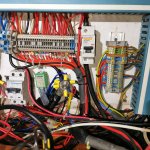
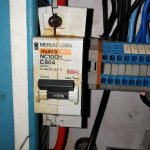
Last weekend I noticed this, behind my electrical panel. It looks like it is time to get a new one. This is a circuit breaker on the the main 12V system. I cannot seem to find a "direct replacement" of a new unit.

I am starting to try and educate myself about some of the bewildering varieties of CBs available out there. Can anyone here comment on whether these characteristics are likely to be critical/useful/recommended for this use (i.e. BOG standard AWB stuff.... )

NC100H (what does these actually mean?)
C80A (I presume this means a characteristics C CB, rated at 80A)
10kA
 

Attachments

  • IMG_20211029_205514.jpg
    IMG_20211029_205514.jpg
    933.2 KB · Views: 90
It's an AC breaker, probably not guaranteed to do anything particular with 12V DC.
I'd replace it with something properly specified at 12V, or to be more exact, DC.
DC is harder to break than AC.
I'd also do the maths and work out whether 80A was necessary, and think whether the supply could usefully be split in two, so a fault in something high current need not wipe out the depth sounder or the 'essential' autopilot.
 
Merlin Gerin are quite happy to work on DC, they are used in telephone exchanges. Probably the best MCBs available, now Schneider branded.
You are right, in as much as those particular breakers are also rated for DC.
Many are not.
Best to check the spec of the exact model one is buying.
 
Last weekend I noticed this, behind my electrical panel. It looks like it is time to get a new one. This is a circuit breaker on the the main 12V system. I cannot seem to find a "direct replacement" of a new unit.

I am starting to try and educate myself about some of the bewildering varieties of CBs available out there. Can anyone here comment on whether these characteristics are likely to be critical/useful/recommended for this use (i.e. BOG standard AWB stuff.... )

NC100H (what does these actually mean?)
C80A (I presume this means a characteristics C CB, rated at 80A)
10kA

Can you post a picture showing more of the installation please?

From what i can see, it looks very much like the breaker is a waste of time, but i'd like to see that picture to be sure.
 
It's an AC breaker, probably not guaranteed to do anything particular with 12V DC.
I'd replace it with something properly specified at 12V, or to be more exact, DC.
DC is harder to break than AC.
I'd also do the maths and work out whether 80A was necessary, and think whether the supply could usefully be split in two, so a fault in something high current need not wipe out the depth sounder or the 'essential' autopilot.

What do you think the 80a breaker is protecting ?
What do you think will cause it to trip and lose all power?

DC is harder to break ? A DC breaker will open when it's overloaded, just the same as an AC one will. The difference between an AC and DC breaker is the air gap between the contacts. When a high current DC load is disconnected there is a greater arc than there would be wit an AC current. The arc can jump the gap between the contacts and weld them together, so the breaker does not actually disconnect the load. With low current circuits this is less of an issue.
 
What do you think the 80a breaker is protecting ?
What do you think will cause it to trip and lose all power?

DC is harder to break ? A DC breaker will open when it's overloaded, just the same as an AC one will. The difference between an AC and DC breaker is the air gap between the contacts. When a high current DC load is disconnected there is a greater arc than there would be wit an AC current. The arc can jump the gap between the contacts and weld them together, so the breaker does not actually disconnect the load. With low current circuits this is less of an issue.
I suspect the breaker fulfils a box ticking requirement and is maybe a convenient way to switch off everything down stream of it?
 
I suspect the breaker fulfils a box ticking requirement and is maybe a convenient way to switch off everything down stream of it?

You might be right. Hopefully the OP will post a pic of the installation. I suspect that other than being a convenient switch, it's a waste of time.
 
You might be right. Hopefully the OP will post a pic of the installation. I suspect that other than being a convenient switch, it's a waste of time.
Hi Paul, thanks for your comments so far. I have another pic (here) but it may be inadequate. I will need to get some more, next time you get to the boat.

I think you may be right about the "waste of time" (space) bit, and that it was probably something, someone installed simply as a switch. All the DC feeds go through their own circuit breakers on the panel anyhow. The one seen here on the top right , is on the feed to the windlass (see the "chunky" cables) and is not on the "offending" line of in the OP.

I hope this makes sense to you.

If the corroded one of the OP is a "waste of time" (space), what do you recommend putting in its place, as a convenient switch for all DCs behind the panel?
 

Attachments

  • IMG_20211029_215637.jpg
    IMG_20211029_215637.jpg
    897.7 KB · Views: 67
Hi Paul, thanks for your comments so far. I have another pic (here) but it may be inadequate. I will need to get some more, next time you get to the boat.

I think you may be right about the "waste of time" (space) bit, and that it was probably something, someone installed simply as a switch. All the DC feeds go through their own circuit breakers on the panel anyhow. The one seen here on the top right , is on the feed to the windlass (see the "chunky" cables) and is not on the "offending" line of in the OP.

I hope this makes sense to you.

If the corroded one of the OP is a "waste of time" (space), what do you recommend putting in its place, as a convenient switch for all DCs behind the panel?
Surely, two different Circuit breakers shown, looks like the first pic. is of a breaker in the +ve line and the second of a similar breaker in the -ve line? Both are single pole devices. Much better sourcing a Double pole DC breaker.
Chint Double Pole MCB Circuit Breaker 80A to 125A, 10kA
 
Hi Paul, thanks for your comments so far. I have another pic (here) but it may be inadequate. I will need to get some more, next time you get to the boat.

I think you may be right about the "waste of time" (space) bit, and that it was probably something, someone installed simply as a switch. All the DC feeds go through their own circuit breakers on the panel anyhow. The one seen here on the top right , is on the feed to the windlass (see the "chunky" cables) and is not on the "offending" line of in the OP.

I hope this makes sense to you.

If the corroded one of the OP is a "waste of time" (space), what do you recommend putting in its place, as a convenient switch for all DCs behind the panel?

Hard to see much of what's going on from that picture. Basically, every circuit should have its own fuse/breaker, which you say they do. The cable that supplies the electrical panel should be fused at the source end, not the panel end. It cannot possibly be doing any good as a breaker where it is situated, if there is a fault in a circuit, that circuits own fuse/breaker should trip, if it doesn't have a fuse/breaker, the 1.5mm-2.5mm wires there would melt and possibly catch fire before the 80a breaker tripped.

So, make sure each one is fused, the 80a breaker serves no purpose where it is, regardless, unless you need a switch there, which should not be the case. You should have a main isolator, which isolates the battery from all loads for that purpose. If there is a risk of the main supply cable shorting, it needs to be fused at source, purely to protect the cable. Personally, i'd get rid of it. But, if you want a switch there, you could just fit a bog standard domestic breaker there of any type, because it should never acting as a protection device, remember, if each circuit has an appropriate fuse it will blow and protect its own wiring, the 80a can never trip. In this application it doesn't matter that its rated AC as it will never be switching anything close to 80a.

The 80a breaker being used for the windlass is incorrect and should be changed. It's rated for AC and the windlass is a high current load, if there were to be a short or a fault with the windlass arcing within the breaker could render it inoperative. In addition, the windlass should be protected by a thermal breaker, to protect it from overload in the even of a snagged anchor or clumsy use of the windlass, etc Fit a proper thermal breaker here and you can use the 80a breaker to replace the rusty looking one.
 
Surely, two different Circuit breakers shown, looks like the first pic. is of a breaker in the +ve line and the second of a similar breaker in the -ve line? Both are single pole devices. Much better sourcing a Double pole DC breaker.
Chint Double Pole MCB Circuit Breaker 80A to 125A, 10kA

He does say that it's a different breaker Alex, it's for the windlass. It is incorrect for that job, needs to be a DC rated thermal breaker.

No need for a double pole breaker for the windlass and as the rusty breaker cannot act as a circuit protection device, only a switch, no need there either.
 
He does say that it's a different breaker Alex, it's for the windlass. It is incorrect for that job, needs to be a DC rated thermal breaker.

No need for a double pole breaker for the windlass and as the rusty breaker cannot act as a circuit protection device, only a switch, no need there either.
Paul, yes my mistake.
 
Thanks all... I am learning lots, here. It seems that whoever set these circuits up either did not know what they were doing, or just bodged it with what they had available.

Summarising, I will

1) remove the rusty breaker (it is serving no purpose). I have a very nice "domestic" isolator for everything emanating from the batteries. Simply splicing the two wires together properly should do the job

2) install a thermal breaker for the windlass (it is a Cayman 88 / 1000w): what rating should I use for that? Is it OK to have the breaker installed there, behind the panel? The solenoid relay is near the forepeak.

Did I get this right?
 
Din rail circuit breakers, such as the one pictured, are a great choice for marine systems. Check that the breaker is DC rated, but most AC circuit breakers are OK to around 32v DC, but always check the DC rating before installing. The specialist DC-only breakers are typically suitable for much higher DC voltages, but these are usually only needed for solar panel input.

The pictured circuit breaker is in bad condition and should certainly be replaced. One of the advantages of these Din rail breakers is that they are easily replaced. They just click in and out of place.
 
Thanks all... I am learning lots, here. It seems that whoever set these circuits up either did not know what they were doing, or just bodged it with what they had available.

Summarising, I will

1) remove the rusty breaker (it is serving no purpose). I have a very nice "domestic" isolator for everything emanating from the batteries. Simply splicing the two wires together properly should do the job

2) install a thermal breaker for the windlass (it is a Cayman 88 / 1000w): what rating should I use for that? Is it OK to have the breaker installed there, behind the panel? The solenoid relay is near the forepeak.

Did I get this right?

That is all correct, the windlass breaker needs to be as close to it's supply source as practical, it is there to a) protect the cable and b) protect the windlass. It should be 100A
 
Din rail circuit breakers, such as the one pictured, are a great choice for marine systems. Check that the breaker is DC rated, but most AC circuit breakers are OK to around 32v DC, but always check the DC rating before installing. The specialist DC-only breakers are typically suitable for much higher DC voltages, but these are usually only needed for solar panel input.

The pictured circuit breaker is in bad condition and should certainly be replaced. One of the advantages of these Din rail breakers is that they are easily replaced. They just click in and out of place.

Why, what is it's purpose ?
 
2) install a thermal breaker for the windlass (it is a Cayman 88 / 1000w): what rating should I use for that? Is it OK to have the breaker installed there, behind the panel? The solenoid relay is near the forepeak.

The pictured circuit breaker is a magnetic/ thermal circuit breaker. This is superior to a thermal circuit breaker, so called because it only has thermal protection.

Basically the magnetic system provides more rapid protection in a short circuit situation where a very high current can flow, and the thermal system provides better protection for a lower, but longer duration current.

The pictured circuit breaker has both systems. Thermal circuit breakers are less expensive and while often adequate, they provide lower levels of protection. To switch would be a backwards step.
 
Top