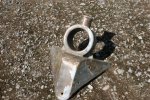
Chrome on Bronze

I was intrigued, since I didn't know the answer, either. This post might help: http://ratrodsrule.com/forum/archive/index.php/t-12881.html (after all, who has more chrome than a custom car nut?)
Removing chrome by dipping is a a more involved process than you might imagine, since each of several metals in the 'chrome' plate requires its own specific treatment. A word of caution if you go this route: there's no such thing as naval bronze. There's naval brass (which is, er, brass) and admiralty bronze (which is also brass). The de-plating plant would need to know this.
 
I have asked the same question several times in several places as I have a whole load of chromed (circa 1963) deck fittings which I would like to return to an original bronze and allow to verdigris naturally.

Nobody, as yet, has come up with any sort of answer based on experience.

I wait in expectation!
 
Chromium is extremely hard, somewhere around 2000 Vickers, which is considerably harder than almost any abrasive other than tungsten carbide and diamond. Abrasive papers or wire brushing are almost certainly not going to be effective, or at best extremely slow. If much of it has already flaked off, as seems to be the case from your photo, you may be able to get a blade under it and flake it off. Otherwise, you could try an angle grinder.
 
Before having my fittings dechromed professionally, I looked into doing it myself but was put off by the nasties involved.

If I remember correctly, an acid bath was required into which item was placed then attached to + of 12v battery and the - being attached to earth. This then bubbled away merrily and removed the chrome.

Can't remember what acid but was concerned about disposal and splash risk so paid £70 to have about 20 pieces done and £40 to have have them polished.
 
If much of it has already flaked off, as seems to be the case from your photo, you may be able to get a blade under it and flake it off. Otherwise, you could try an angle grinder.
That was my thinking. It looks as though it is ready to come off. The twisted wire brushes are much kinder to the substrate than grinding discs, but great care and patience could see a clean job done.
 
Top