Choosing outboard propeller pitch

................................the assertion that more rev's = just more noise ..............................

I don't believe Roger said that and its is not what i actually said either. ................ You have taken a small snippet from one of my posts and misquoted it.
 
Nothing will go wrong.
The engine will run somewhat faster than previously at all speeds below max hull speed. Because it is running faster it will be a little noisier, will use more fuel and potentially develop more power but once you reach the hull speed any extra power will be wasted in trying, but failing, to push the boat faster. You might just be able to get a very light boat up on the plane, and be able to utilise the potentially available extra power.

Is what I'm thinking about.

You grudgingly admit there may be extra power if the engine is allowed to rev properly, but you basically poo -pooh the idea without reason or suggesting a better alternative.

Sure, I'd like a custom made fuel cell / electric hybrid with a prop designed specifically for my boat, battery incorporated into my keel bulb, please Mr Tesla !

As Santa seemed to miss this off his waypoints I had to file the prop blades.
 
Rogershaw,

I have to disagree with one small point, the assertion that more rev's = just more noise was never right.

I don't think I say anything like that but for the record more rev's do mean more noise but it also gives more power /thrust and thus possibly more speed.

Just before you nip off to the Dispensary / ( Sea ) Witch Doctor / Merlin...
Sandoma

https://en.wikipedia.org/wiki/Traditional_healers_of_South_Africa

I was never talking about filing the tips off the prop' blade diameter wise; I must not have explained it properly, what I mean is a small amount - say 1mm at a time - off the trailing edge of each blade.

If one wanted to be fancy about it one could make it more off at the root and less off towards the tip, but a simple bit off all the way along is fine for a crude thing like a small outboard, as long as the reduction is balanced among the - usually 3 - blades.

I have heard of that technique being used to stop/reduce a prop from "singing" but not to increase the rev's of an engine thus producing more power.

I think it can also be used to reduce cavitation. but never done either myself.

My smallest outboard is 4hp but I seldom use it my very small one is electric made from a battery drill which is fixed speed so not relevant.

Now back to the cricket sob sob
 
Is what I'm thinking about.

Which was a direct answer to the ops question "what can go wrong (apart from possible money wasting) if I fit the 7 1/4" x 5" Yamaha propeller?"
Read more at http://www.ybw.com/forums/showthrea...-outboard-propeller-pitch#LTWB8mPcRoswzcZY.99

Basically, nothing

I am coming to the conclusion that fundamentally, even if surprisingly, that if the OP's rpm readings are correct the 3hp engine is too powerful for the boat. After all it appears to get the boat up to max hull speed at an rpm that means it must be developing significantly less than its full 3hp. I wonder just how far he can close the throttle before the boat speed drops significantly below max
Also worth noting that Drascombe suggest that a 2.5 hp engine is quite suitable. They also suggest fitting a Sailpower/Saildrive/high thrust prop rather than the standard prop more suited to being put on the back of a small RIB whizzing around at 75% throttle (or even more!). Unfortunately a high thrust prop is not available for the little Yamahas
 
Vic,

I suggest you sleep on that one.

When I tried my Mariner 2hp in the well of my A22 as an experiment it could barely move her, so there's a lot more than ' half a 4 hp ' going on.

If we and our boats are all fit next season I'd be happy and intrigued to carry out some comparisons; we'd bring Mariner 2 & 5 2-strokes, in the well of an A22 or if required a rigid dinghy alongside.

No agro, I'd be pleased to meet you all..

How exactly we measure and calibrate results is another matter, and I can already see a good Christmas 2017 thread or book coming ! :)
 
Last edited:
Basically, nothing

I am coming to the conclusion that fundamentally, even if surprisingly, that if the OP's rpm readings are correct the 3hp engine is too powerful for the boat. After all it appears to get the boat up to max hull speed at an rpm that means it must be developing significantly less than its full 3hp. I wonder just how far he can close the throttle before the boat speed drops significantly below max
Also worth noting that Drascombe suggest that a 2.5 hp engine is quite suitable. They also suggest fitting a Sailpower/Saildrive/high thrust prop rather than the standard prop more suited to being put on the back of a small RIB whizzing around at 75% throttle (or even more!). Unfortunately a high thrust prop is not available for the little Yamahas

Thank you VicS.
First time I used the Malta I had the illogical impression that it was more powerful than the previous Johnson 4 twin.
On the Dabber the Seagull 40 plus was enough on flat water, but slightly underpowered in adverse conditions. I changed it mainly to get the practicality of a clutch.
Evidently these modern little motors are geared and propelled with quick planing tenders in mind as the average user.
It's a pity that there is not room for a larger diameter propeller.

I am sorry for having involuntaryly caused friction in the forum and shall stay quite until I'll have factual news.

Fair winds

Sandro
 
Sandro,

please rest assured you have not been the cause of any friction.

The little engines you speak of ( I'm thinking 2-4hp ) are not really intended for planing tenders, more like an easy alternative to rowing !

There is no way the Malta engine would be too much for your Drascombe, if punching into big waves and winds in a narrow harbour entrance for example, you'd very quickly want much more power than that.

Beware the Malta had a very bad reputation re reliability when it was first out; sorry but I can't remember what the problem was...

Hopefully it will come to me, or more likely someone here will know.

Andy
 
5kt out of a relatively heavy, fairly short, displacement hull form sounds to be pretty much max hull speed.
Assuming a waterline length of 4.2m, 5kts => Fn=0.4
You'll not get it to go much faster even if you put a 5hp on it.
I would have thought that your 3hp Malta is pretty much ideal.
Where you might be able to get an improvement is if you went for a finer pitch prop, 4blades if available ( though I doubt it for your engine). That would mean that that you can maintain your 5kt against a bit of headwind and/or chop.
 
Updating my work (or play) on Yamaha Malta propeller improving.

I checked again the rpm tachometer, this way:

A 12 V car battery
An old 4 cylinder car distributor - 4 breaker points openings per revolution
A car ignition coil
A mock-up spark plug
The tacho to be tested - set for 1 spark per revolution (2 stroke)
All are connected as they would in a real motor.

The distributor shaft in the chuck of a lathe. The body just prevented from turning.
The lathe has 6 fixed speeds and theese speeds are certain, being the lathe motor a 3phase asyncron.

Results :

distributor (lathe) speed____r p m_____________85_____160_____300_____560_____1060_____2000
x4__________________________sparks p m______340_____640____1200____1240____ 4240______8000
tacho reading______________r p m____________345_____720____1265____1335_____4370_____8035
error_______________________%___________________1_______12________5_______ 4_________3_________0.5


The tacho, set for 2 stroke, is dependable for our purpose.
The previous measures should be about correct. Only possible remaining mistake: the then setting of the tacho - 2 or 4 stroke.

As soon as the weather will be suitable I'll launch the boat and go again through the rpm/boat-speed measurements, possibly with an assistant.
I'll also perform a bollard pull test with a spring dynamometer.

I shall report.

Fair winds

Sandro
 
Last edited:
Reckons begin balancing.
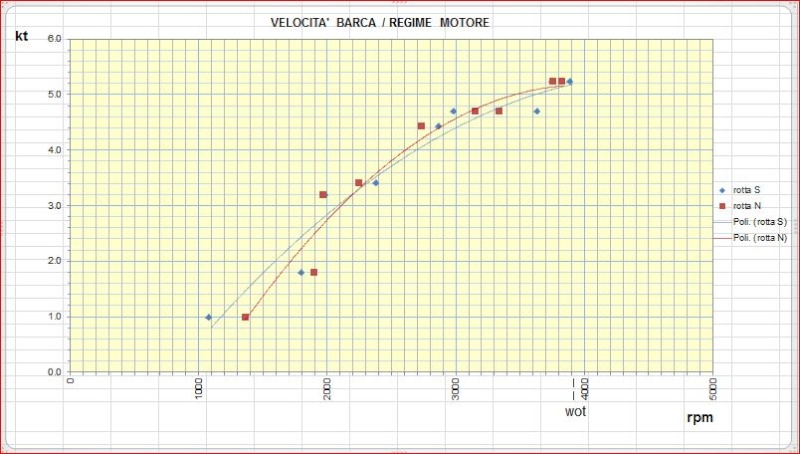
Yesterday I measured again boat speed versus motor rpm. This time I am sure of the correct setting up of the tacho - for two stroke.
There was just a little wind but no waves. I made two ways, against and following the wind. No big difference.
Here is the result:


The bollard pull test gave 22 kg (48 lbs) at 3100 rpm, not very much IMO. Is it suitable?
I was moored to a big tree root and I had to explain to a curious onlooker that my purpose was not to uproot the tree.

The WOT rpm is almost 4000, i. e. 20% less than maximum rated. The motor is still overpropped but not as much as it appeared to be.
Also the considerations made about boat size and motor power are better fulfilled.

The Yamaha available propeller, 17% lesser in pitch, should be suitable. I think I'll buy it. Moreover in case of hitting an obstacle there is no breakable pin, the plastic bond between alu propeller and shaft breaks and one has to replace the propeller, so a spare one is a good thing to have aboard.

Thanks to all that helped me with advise.
I'll do tests with the new propeller and report.

Sandro
 
Top