Chinese circumnavigator lost off Hawaii

How about you stop and think about it; if you were singlehanded and went over the side, knowing there was a trailing line which meant life or death, would you sit static like said bucket & fender* - or maybe have a go at grabbing the line ?

* I did say it's not perfect, if you were knocked unconscious by the boom you've probably had it anyway, and getting back aboard is a huge problem - when showing a novice chum the usual MOB manouvres ( reach tack reach or gybe immediately ) - I commented how sailing schools using a bucket & fender is a bit of a fobb off; once you get back to the casualty, now your real problems start, and that's with a crewed boat.

So I also have a Mastep folding plastic ladder secured in the cockpit at the transom with a line hanging down so as to pull it down from the water.

These things are a real pain to use, far from ideal - but it's a start and having been in an accidental overboard situation myself I can appreciate what's involved.

People sometimes say I'm too anxious about safety; my answer is that there's plenty of experience to read up on, and it would be insulting those who have paid in blood before me not to act on it; once I feel I have taken reasonable steps, then I can get on with enjoying sailing.

The suggestions I make are absolutely full of problems, which I've freely admitted - but they're a helluva a lot better than doing nothing except whine on a forum about others trying to help.
 
I knew him. Not well, but I did meet him couple of time when we both did the mini transat in 2011.

As for getting the boat to stop and get back on board -
- I think anything is better than nothing. My boat had a system in which I wore a remote control for the autopilot. If the autopilot was engaged and lost contact with the remote (maybe after 100 meters) , the boat would auto-tack, record the GPS coordinates and range/bearing to where contact was lost. It would do all of this except auto-tack even if the electronic system was powered up without the autopilot engaged. I didn't really think this was going to be much use in getting back on board, but it would help SAR find the body.
- I had a line from quarter to quarter - actually a piece of webbing with a bungee sewed into it. When sailing the bungee held it out of the water. If needed you could reach up and grab it down into the water. It was not easy to use, even when I was just getting out of the water after scrubbing the hull at the dock.
- my guiding principle (particularly since one of the entrants to the race was lost overboard a couple of weeks before the start, while sailing to the start port - and he was wearing a survival suit but still drowned) was to stay on board.
- I had only one life jacket but really thought of it as a harness. I also had a spare very light harness that I used when it was hot. Spare cylinder for the LJ but no spare LJ.
- tethers for the harness: one always fixed to a hard point in the cockpit and another shorter one on the high-side jackstay. I switched from tether to tether as I moved around the boat. Clipped on to the cockpit one before I left the cabin, and when I switched from one tether to the other, I was clipped on to the new one before unclipping from the old.
 
I don't like jackstays either - the wire ones roll underfoot, and the webbings ones are susceptible to salt crystals & sunlight - which is why I mentioned the mastfoot harness eyes I've found useful, I just leave lines clipped to them when necessary - and have strong points beside the main hatch & in the cockpit too.

However some boats seem to require jackstays which is why I mentioned the Latchway system.

I also find a 3-point harness line very handy, with this one can work along in really bad weather, never being unclipped; it does mean in good weather I usually have the spare unclipped line loose around my neck, but it's a comforting bit of kit to have when the chips are down.
 
Torp,

Little Grebe has taken lately to automatically having a go at me, without reading what I've said.

If one dislodges the autohelm from any normal sailing boat, she will luff up; normally staying stalled just off head to wind - if she tacks the headsail will be aback, so hove to.

I have indeed tried swimming after boats - I used to tow people around, and them tow me, from my Scorpion and Osprey dinghies - and every experienced dinghy racer I know has had the experience, on windy days, where after the odd capsize the halliard tails go through the self bailers; more than once I have grabbed this halliard as it went past, stopping the boat via my drag turning it into wind - whether via a gybe doesn't really matter, and with a dinghy a capsize stops it.

I have swum after a lot of boats in my time, not always for fun; I rate my Dart 18 cat' as the worst to try to catch, as it managed a fair rate even on its side in a strong breeze, due to the windage of the trampoline and uphill hull.

This trailing halliards thing is probably what gave me the idea.

I said it wasn't perfect, but offered it as an aid for people to consider - anything is better than taking no precautions and waving your boat goodbye as she departs the scene with a fully functioning autopilot.

Some tethers include loops to act as steps to getting back on board. I saw a video of somebody doing that at 5knts and the inventor says he has done it at 7 knots.
 
If one dislodges the autohelm from any normal sailing boat, she will luff up; normally staying stalled just off head to wind - if she tacks the headsail will be aback, so hove to.
Depends how well you balance the boat. I always try to get boat sailing hands off before attaching tiller pilot. My girl will sail for miles holding course without me doing a thing.
Here is proof


As I sail a lot single handed, watching her sail away is one of my main concerns. I have a 3 hook lifeline to allow me to move around without being unattached to a hard point. Seems to have worked so far.
 
Sandy, in answer to your questions:
A few questions are raised about this that I would like to explore:

Do you single hand? Yes, I've gone singlehanding more than 1,000 times over the past decade, including more than 300 races against crewed boats. In fact I actually wrote a book about it.

How many times has the jack line saved you from going over the side? For me, never. But in my book I have a long interview with a fellow who did fall off of his Mini off the coast of France. He has absolutely no doubt that his tether save his life - even though he was dragged beside his boat for 10 minutes.

Is there a risk of a repeat of the Lion1 fatality, with slack jack lines of you being dragged along the side of the hull at 5 knots unable to move due to the pressure of water. Two answers to this. First, I have a remote control for my autopilot clipped to my harness, so at worst I can turn the boat head to wind or even heave to while I'm dragging along side. Second, I'd much rather be dragging beside the boat than perish alone in the cold waters of the North Pacific. At least they'll find my body (with shark bits out of the legs).

I know the skipper was only tethered to the boat in this incident, but can foresee extra slack in the system causing the same problem.
The jack lines and tether must be set so that you are never behind the boat. Just beside it.

Are there any improvements can you suggest to a simple jack line running along the side deck?
I think that the tether should have two connection points. One about 5 feet long to allow you to move around the boat with ease, and the second short enough so that you can clip youself in a seated position in the cockpit or to the bow.

With the current set up of crusing boats, where everything is lead back to the cockpit, how much time do we actually need to spend on the foredeck? I go to the foredeck often, to skirt a jib or set up my spinnaker. And my main halyard is at the mast.

Those of us who single hand are aware of the risks of "involuntary stepping off the boat" as I like to call it and take our own decisions about how we reduce, I am well aware of the risks of singlehanding, and I am willing to take those risks. But can you imagine just how stupid you would feel, waiting to die, as your boat sails away just because you tripped on a line and fell overboard? I never want to feel that stupid.
 
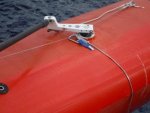
Update on this story. When his shore team boarded the boat recently, they found the broken off end of his tether still clipped to the boat.
Broken Tether.jpg
 
Very sad indeed.

What sort of harness line / ' tether ' is that then ?

Looks like a single line or even wire, ( the broken harness end, not the wire in the shot ) - not the webbing jobs I'm used to ?
 
Foolish Muse thanks for the reply, interesting to read your answers. What is the book called, perhaps something for these long winters nights.
 
Very sad indeed.

What sort of harness line / ' tether ' is that then ?

Looks like a single line or even wire, ( the broken harness end, not the wire in the shot ) - not the webbing jobs I'm used to ?

Looks like the jackstay is wire or possibly dyneema but more likely wire, and the tether is webbing broken off a few inches from the carabiner.
 
Or the tether ran down the boat and came up against a hard point that was sharp enough to shear it.
 
Very sad loss. I was quite surprised when I saw that picture to see his jack lines running all the way out to the ends of the floats.
On my trimaran I run them from the cabin top in front of the cockpit to the foredeck just in front of the forward beam. This allows me to clip on and have free movement to the mast and foredeck, but my tether pulls me up short before I reach either side or the stern, in fact pretty much the only place I could actually go over is between the bows where I end up in the water lee side, or bouncing off it weather side.....

With the speed involved here you would have absolutely no chance whatsoever of catching anything trailing behind the boat or of pulling yourself back out of the water. The speculation seems to be that his tether broke under the strain, some have suggested UV damage may have weakened it. I wouldn't discount the possibility that he cut it himself after he couldn't get back on board. I haven't found any mention of whether he carried a PLB?
 
Cutting seems unlikely, given how close to the jackstay the webbing parted. Possibly it came up against something on deck that either cut it or chafed through it.
 
Foolish Muse thanks for the reply, interesting to read your answers. What is the book called, perhaps something for these long winters nights.

"Thoughts, tips techniques and tactics for single handed sailing" by Andrew Evans. Free download but can't remember where from. Good read, lots of anecdotes and ideas. Thank you Andrew!
 
There's an excellent article by Chris Beeson in I think the Sep issue of YM, on the inadequacy of conventional jackstays and some better ways of arranging them - available online here [ http://www.yachtingmonthly.com/sailing-skills/stay-deck-avoid-mob-51411 ].

From the look of that broken tether webbing remaining on deck in the pic, specific problems may have been
(1) the ability to be swept all the way aft down a long jackstay with no 'stop' points,
(2) no way of softening the shock load when you reach the end of it - particularly at the potential 20 knots' boat speed , and
(3) the sharp edges of the tiller gear, just beside the aft attachment point, to assault a taut and fast-travelling tether.​

I must say I didn't quite get the hang of that pic as you'd expect that carbon tiller bar to run athwartships between the two tillers, whereas it appears at an angle to what I take to be the starboard hull. Perhaps he fell in between the hulls and the tether broke the tiller bar?
 
I must say I didn't quite get the hang of that pic as you'd expect that carbon tiller bar to run athwartships between the two tillers, whereas it appears at an angle to what I take to be the starboard hull. Perhaps he fell in between the hulls and the tether broke the tiller bar?

It runs forward at the angle you see to another bell crank mounted on the aft beam before going to the centre hull.
 
Top