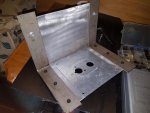
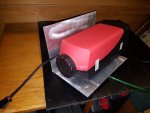
Chinese (5kw )air heater

I've been advised to duct the big fan air intake into the boat to avoid condensation as my install is engine room open to the elements.

Recirculating cabin air will in fact increase condensation; you're better drawing fresh air in.

pvb is correct. Drawing the air in from the engine room is fine, unless the engine steams and snorts :)
 
Recirculating cabin air will in fact increase condensation; you're better drawing fresh air in.

Not disputing that, but having to heat all the air coming through from say 0°C, must use a lot more fuel. Mine is an old installation, prob 1992, and recirculates the air. It's been on for 17 hours each day for the last six days, without any condensation. Clarification: The actual Eber is a lot younger.
 
Not disputing that, but having to heat all the air coming through from say 0°C, must use a lot more fuel. Mine is an old installation, prob 1992, and recirculates the air. It's been on for 17 hours each day for the last six days, without any condensation. Clarification: The actual Eber is a lot younger.

Yes, it may use a bit more fuel, but it will reduce potential condensation and will keep refreshing the air inside the boat.
 
Not sure I'd want a setup where the Eber/Web/China-clone recirculated air. Even 747s mix in a bit of fresh air, and they REALLY try hard to cut energy consumption. And bringing in freshly heated outside air MUST be better for condensation (and probably health) than just warming the moist air you've just breathed out.
 
Not sure I'd want a setup where the Eber/Web/China-clone recirculated air. Even 747s mix in a bit of fresh air, and they REALLY try hard to cut energy consumption. And bringing in freshly heated outside air MUST be better for condensation (and probably health) than just warming the moist air you've just breathed out.

The air being drawn in for combustion is also coming into the saloon, and so there is a constant flow of fresh air coming in. This is unlike the centrally heated room in which I am at present, which has no obvious flow of ventilating air. :confused:
 
Can I ask what fuel consumption per hour are people getting out of these units ?

My friend says 3 hours per litre but their install is in the cabin with an exhaust skin fitting. ?
 
As a rule of thumb, a heater giving 4kW output uses 0.5 litres of diesel per hour.

Thanks that's a lot more than the Chinese say lol.

I was hoping it would be better than my Ebersplutter D4 :ambivalence:

Thanks for your helpful post before.
 
Removed
 

Attachments

  • 1546904397-picsay.jpg
    1546904397-picsay.jpg
    245.2 KB · Views: 1
  • 1546905005-picsay.jpg
    1546905005-picsay.jpg
    425.5 KB · Views: 1
  • 1546960911-picsay.jpg
    1546960911-picsay.jpg
    246.4 KB · Views: 1
Last edited:
I like that post but as it always happens the brand's get greedy and try to hold the market, someone invented a pencil once upon a time, many people now make pencils.

And about time that certain brands have competition.

It was getting ridiculous really, not to mention any brands but parts for those others was ridiculous.

I've bought 2 more Chinese heaters as backup.

It's sad that engineering has come down to this level.
 
The problem with drawing in air from engine compartment is that it will pick up any odour in the compartment ie. diesel-oily- pong from insulation etc etc
Initially only the air being drawn in has the greasy unpleasant odour of diesel etc , this will eventally seep into any saloon fabrics and be impossible to shift.
You can usually instantly tell if boat is drawing in air from a contaminated space as soon as step aboard,even with heater off,especially on older boats.
 
The problem with drawing in air from engine compartment is that it will pick up any odour in the compartment ie. diesel-oily- pong from insulation etc etc
Initially only the air being drawn in has the greasy unpleasant odour of diesel etc , this will eventally seep into any saloon fabrics and be impossible to shift.
You can usually instantly tell if boat is drawing in air from a contaminated space as soon as step aboard, especially on older boats.

Yes, best to duct the incoming air from a safe place.
 
Thanks All, my engine only has 1000hrs, being honest I joined this forum to talk about Chinese heaters. Hidesbehindthesofa !, I live on inland waters pffft a Narrow boat.

Please don't throw stones.:rolleyes:lol

My engine will never be running whilst drawing new air in and it's not a stinky engine bay being a stern cruiser.

Thanks.
 
Thanks All, my engine only has 1000hrs, being honest I joined this forum to talk about Chinese heaters. Hidesbehindthesofa !, I live on inland waters pffft a Narrow boat.

Please don't throw stones.:rolleyes:lol

My engine will never be running whilst drawing new air in and it's not a stinky engine bay being a stern cruiser.

Thanks.

This is Practical boat owner, so a narrow boat should be OK. :encouragement:

My Eberspacher draws its air in from the cockpit locker, which shares its air space with the bilges and engine compartment. The boat and engine are from 1980 and the engine has done over 3000 hours, i don't recognice the smells described earlier :)
 
This is Practical boat owner, so a narrow boat should be OK. :encouragement:

My Eberspacher draws its air in from the cockpit locker, which shares its air space with the bilges and engine compartment. The boat and engine are from 1980 and the engine has done over 3000 hours, i don't recognice the smells described earlier :)

Brilliant Thank you.

I was a bit heads down shush don't tell them I live on a narrowboat but it's all the same I guess.

I am all ready to fasten the mounting plate tomorow but I got a shock my bulkhead us only 3mm steel.

Anyway thanks

Nan Night I am starting to woffle. :p
 
Last edited:
Sika is your friend! Glue board to wherever then screw your plate for the heater to that!:encouragement::encouragement::encouragement:
 
Top