chinaspascher where to fit.

pandos

Well-Known Member
Joined
15 Oct 2004
Messages
3,202
Location
Ireland, (Crosshaven)
Visit site
I have ordered a 5kw heater on Amazon. I really do not want to squeeze it into my engine compartment as working on things in there is difficult at the moment (tendonitis in left shoulder).

I was thinking to fitting in the forward end of the boat, using the supplied fuel tank so that it is totally stand alone, or even squeezing into a cabinet in the aft cabin. I would really like to reduce as far as possible the chance of warming smelly air from the engine area.

boat is a HR 352.

Ill have a better idea when it arrives, but in the mean time suggestions welcomed.
 
I'd fit it in the cockpit locker, this will enable you to have a decent gooseneck in the exhaust pipe and allow you to mount the skin fitting on the blue stripe on the starboard side.

On my old HR352, the Eberspacher was in the engine compartment. Not terribly accessible, but it didn't really need much attention.

I'd still plumb the fuel supply from the main tank - it's too fiddly to keep topping up a dedicated tank.
 
Eber/Webasto suggest a maximum exhaust run of 2m, and the Chinese heaters seem to be near clones of these so it would be sensible to follow this advice. This almost certainly rules out a forward location for the heater, unless you fancy using a mushroom vent on deck perhaps. I don't know if these are compatible with this type of heater, but I had one on an old Wallas in my first boat and it worked well, right up until you turned on the heater without remembering to open the vent...
 
thanks for the replies ... food for thought..

I do fancy the idea of being able to keep a careful eye on it in operation so I'd rather not fit it in the cockpit locker,

just saw that the unit is in Germany on its way to me, ordered it last night so its moving quick....
 
I was thinking to fitting in the forward end of the boat, using the supplied fuel tank so that it is totally stand alone, or even squeezing into a cabinet in the aft cabin. I would really like to reduce as far as possible the chance of warming smelly air from the engine area. a HR 352.

Ours is in the cockpit locker with the exhaust through the coaming. Last place I would want it is inside the boat, particularly up front where the exhaust is likely to be drowned.
 
Can't really advise you on the location, but I do can give you one little tip: you don't have to worry about running the combustion air pipe outside. These heaters are happy to suck it from the inside without any problems. Ebers were very sensitive on any pressure difference between suction and exhaust and mutual position of these port were often critical. Chingspacher doesn't give a damn. I do suspect this is at the cost of combustion quality and efficiency, but don't have any numbers to confirm it.
 
Eber/Webasto suggest a maximum exhaust run of 2m, and the Chinese heaters seem to be near clones of these so it would be sensible to follow this advice. This almost certainly rules out a forward location for the heater, unless you fancy using a mushroom vent on deck perhaps. I don't know if these are compatible with this type of heater, but I had one on an old Wallas in my first boat and it worked well, right up until you turned on the heater without remembering to open the vent...

Agree you need to keep exhaust run short. These things really don't like back pressure. Many of the heaters of any variety that soot up can be put down to restricted exhaust. You will also get a silencer in the kit. Throw it out. Many of them leak and you don't need it. Exhaust straight to an eber skin fitting. Also remember to fit it FORE AND AFT. They will tolerate running at an angle that way. they especially don't like running in a rolling sea fitted thwartship. Don't know your boat but if you have a rear locker and can have a transom exhaust go for it. Also you need to decide if you are going to draw air from inside your boat and recirculate (gets warmer more quickly) or take fresh air from outside. I favour the former but make sure the compartment you fit it in has either a grill to allow air in or trunking to an inlet. If there is a restriction of airflow in it won't like that either and any inlet trunking should be kept short too. Hope this helps!
 
Last edited:
Was wondering why these heaters are configured the way they are. Presumably the layout has been optimised for vehicle rather than marine use. Why is the orientation critical. Anyone mounted one in a non standard orientation.
 
I think it's best if combustion appliances are fitted sealed outside the cabin, I don't want to be breathing any fumes or CO if it's avoidable.
So mounting in a locker vented to the transom would be my preference.
The exhaust needs to be kept short, not just to avoid back-pressure, but also because these things produce a fair amount of water (twice the volume of diesel they consume?) and that can only leave as vapour in most boat installations.
So it's normal to have a lagged exhaust to avoid condensation.
The exahust must run down from the heater, or corrosive condensate will destroy the heater in short time.
 
The exhaust needs to be kept short, not just to avoid back-pressure, but also because these things produce a fair amount of water (twice the volume of diesel they consume?) and that can only leave as vapour in most boat installations.
So it's normal to have a lagged exhaust to avoid condensation.
The exahust must run down from the heater, or corrosive condensate will destroy the heater in short time.

On my HR352, the Eberspacher was in the engine compartment (factory installation) and the lagged exhaust went up through the cockpit locker, round in a gooseneck in the cockpit coaming, then down to the skin fitting on the side of the hull. The pipe must have been around 2.5m long. The installation worked fine for decades - no problems with condensation.
 
Was wondering why these heaters are configured the way they are. Presumably the layout has been optimised for vehicle rather than marine use. Why is the orientation critical. Anyone mounted one in a non standard orientation.

They can be mounted on their side as long as the glowplug is upright.
 
I have ordered a 5kw heater on Amazon. I really do not want to squeeze it into my engine compartment as working on things in there is difficult at the moment (tendonitis in left shoulder).

I was thinking to fitting in the forward end of the boat, using the supplied fuel tank so that it is totally stand alone, or even squeezing into a cabinet in the aft cabin. I would really like to reduce as far as possible the chance of warming smelly air from the engine area.

boat is a HR 352.

Ill have a better idea when it arrives, but in the mean time suggestions welcomed.

Mines in the engine bay and I’m going to have to move it.
When the engine bay is hot they trip out.
2 big engines take ages to cool so is especially a problem for me.
 
I would really like to reduce as far as possible the chance of warming smelly air from the engine area.

boat is a HR 352.

Mine had ducting bringing the process air from the area in the top of the cockpit locker, behind the storage box in the cockpit side. The top surface of that box on mine had a number of large circular holes drilled in it to allow fresh air in.
 
On my HR352, the Eberspacher was in the engine compartment (factory installation) and the lagged exhaust went up through the cockpit locker, round in a gooseneck in the cockpit coaming, then down to the skin fitting on the side of the hull. The pipe must have been around 2.5m long. The installation worked fine for decades - no problems with condensation.

It is often the case that heaters are fitted below the waterline with the skin fitting higher than the heater. If so it is customary to fit a small drain pipe at the lowest point in the exhaust. if the engine compartment is vented well this is not a problem especially if the heater duct for the air input is lead elsewhere. However if the heater is above the WL and it is possible to lead the exhaust downwards a vent is not necessary. What is bad practice is to have an exhaust drain near to the air input as fumes can circulate into the delivery air. It is definitely bad practice to lead the exhaust upwards without a drain.
 
Hmmm, Hallberg-Rassy didn't think so.

If I had a pound for every dodgy installation (not just Eberspachers) that I have seen as original equipment from boat builders I would be rich...... Having said that, yes I have seen many installations such as you describe that work OK but if you talk to Eber themselves they will confirm that where it is not possible to run the exhaust below the heater it is good practice to have a drain. You can get away without one if you always run the heater on high setting where the exhaust remains hot and atomises the water as steam but the problem comes about if the thermostat kicks in and the heater slows right up and the water runs back to the heater itself which is often the lowest point. In fact Eber make an exhaust adaptor which is a right angle solid pipe that bolts directly to the exhaust outlet and has a small pipe exiting from the bottom.... I guess Halberg Rassey determined that it was ridiculously expensive (which it is) and they could do without it.......
 
It is often the case that heaters are fitted below the waterline with the skin fitting higher than the heater. If so it is customary to fit a small drain pipe at the lowest point in the exhaust. if the engine compartment is vented well this is not a problem especially if the heater duct for the air input is lead elsewhere. However if the heater is above the WL and it is possible to lead the exhaust downwards a vent is not necessary. What is bad practice is to have an exhaust drain near to the air input as fumes can circulate into the delivery air. It is definitely bad practice to lead the exhaust upwards without a drain.

The general plan is you do not need a drain as the exhaust is lagged and the water leaves as vapour.
If you have a drain, you need some way of dealing with a litre or two per hour of corrosive smelly condensate.
You also possibly have a leak for fumes into the hull/cabin space.

The other thing is, with a lagged exhaust, the stuff coming out is hot enough to do damage to people, fenders, other boats, etc.
Bear it in mind when mooring the tender astern....
 
The general plan is you do not need a drain as the exhaust is lagged and the water leaves as vapour.

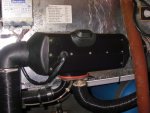
Exactly. The exhaust on the Eberspacher in my HR352 was lagged and then enclosed in 50/60mm flexible ducting, as this rather poor photo shows.

eber.jpg
 
I've recently fitted one to my boat. Deciding where to install it probably took as much time as the install itself. The restricting factor tends to be where you can put the exhaust. Logically, that needs to be on the transom or aft quarter, high up.

My heater ended up in the forward inner corner of the starboard cockpit locker, with just very slightly over 2 metres of exhaust pipe (the proper stainless stuff from Butler Teknik), with fiberglass heat wrap over it, and the whole lot ran inside some leftover 60mm aluminium ducting. It takes the same route as the engine exhaust hose, and exits the transom via a double skinned SS skin fitting from the same supplier, coming out a few inches above the engine exhaust skin fitting.

This locker on my boat is partitioned off by a bulkhead that is just to starboard of the companionway, which allowed me to use a very short run of hot air ducting into the saloon. I didn't want to run lots of ducting throughout the boat.

I tied in to the main fuel tank rather than use the separate tank, using a webasto stand pipe.

Think it through, then think it through again. Measure, measure and measure! Then enjoy that lovely heat...
 
Last edited:
Top