Cherbourg to Alderney Passage

SimonP85

Well-Known Member
Joined
16 Jul 2008
Messages
339
Location
Solent
Visit site
I'm trying to recall the recommended passage notes for the run from Cherbourg to Alderney with a plan to do this on Sunday 17th September.

From memory the suggestion is to leave Cherbourg 3 hours before HW Dover, use the back eddy along the coast to be at Cap de la Hague around HW and then onto Alderney on the first of the west bound tide.

On the 17th HW Dover is 0940 (BST) so would mean leaving Cherbourg around 0700 (BST).

What's the consensus on leaving the departure a little later (maybe 0900 BST) or does this leave too much of a risk of getting sucked down the race or shooting past Alderney down The Swinge on the ebb?

If we can delay departure a little I know the crew would certainly appreciate it! Any advice most welcome.
 
You can leave later, just get yourself about 5 miles offshre at the Cap (which is about a straight line anyway), and you'll be fine.
 
I wouldn't.

http://www.sailingalmanac.com/Almanac/Navigation/tidalclocklarge.html

~25nm => ~5 hours' sailing; rather more if you have to tack a lot into a Westerly breeze

HW Dover = 0950 (all times BST)
HW St Helier = 0450

Original plan = dep Cherbourg 0700 = HWD-3 = HWStH+2. => You're at the top of the Race after ~3 hours, just when the south-going tide is getting strong.

Your revised plan = dep Cherbourg 0900 = HWD-1 = HWStH+4. => that's hitting the Race at its strongest, so worse.

It'll be very very lumpy off Cap de la Hague and there'll be a huge offset pulling you down the Race. I would do it quite a way offshore to avoid the overfalls (which I recall are worst around that cape) and I would not delay the departure from your original plan.

As for the Swinge (your second question), as you're approaching from the East it'd quite hard to get sucked past Braye unless you haven't been closing the land.

In a (typical) SW wind, you will also have wind over tide so there'll be serious overfalls around that lot.

But I may be missing something?
 
You can leave later, just get yourself about 5 miles offshre at the Cap (which is about a straight line anyway), and you'll be fine.

That has been my choice as well, target 5 miles off, then set new course for Braye based on tides at that time. Assuming you don't leave too late and miss the SW going tide altogether.

If Springs then I might investigate crossing the top of the Race and getting into Braye at "slack water", if such an option exists. Because it could avoid the overfalls north of Braye to some extent.
 
From experience there is no effective slack water in the approaches to the Swinge. You can get closer to Alderney than you think in the approach from the north. +1 for Cap + 5 miles. It's my approach on a 26'er and it's not failed me yet. If you don't get pulled South enough to close Alderney, the SW prevailing wind helps crossing the tide as you'll have a broad reach to get you back on the Braye approach line. Do not stray too far west across the Swinge as the tide gets quite fast very rapidly.

Leaving Cherbourg always takes longer than you think, the outer harbour is still tidal and leaving early doesn't mean you won't be punching a tide until you're out at sea.
 
I am mostly with Bobc on this.

The "leave Cherbourg at HW Dover -3" advice is valid if you are actually entering the Alderney race. That is what you are trying to avoid. If you are sufficiently north of Cap de la Hague, then rather than pulling you into the race, the tidal stream is actually pushing you towards Alderney. Just make sure you are in Braye before the tide turns against you at HW Dover +6.

However, Belle Serene's comments do highlight the issue that, depending on the wind direction and strength, it could be very bumpy if you delay the departure. I'm not sure I would want to leave Cherbourg as late as high water Dover if you have fresh or strong Sw'lies.
 
I've done this a few times. Try to arrive at cap de la Hague at skackish water, i.e. Just as the main tide is changing from NE to SW. Can't remember what that equates to in terms of Dover but the tidal atlas will tell you. As others have said it's worth staying 5 miles north if you can. That is how you will get the most comfortable passage. It will still be a bit lumpy off C de la H although suprisingky calm once you are out past that waypoint.
 
Last edited:
Many thanks for the replies, useful information as always.

Given the advice I think I'll stick to leaving earlier than later, gives more of a day in Alderney then too.
 
You can leave later, just get yourself about 5 miles offshre at the Cap (which is about a straight line anyway), and you'll be fine.

Agree, only additional note is don't head towards breakwater too early or you can get into a rocky area off the lighthouse.
Magic 215degrees will get you onto strobe transit lights and the you are home and away!


rps20170906_112100_686-1.jpg
 
Last edited:
Alway allow for the wind off cap le hague to be 1 force stronger than local area forecasts.

Important to get timing right on 1st boat and inexperienced I overestimated motoring speed against a headwind and spent an extra 6hrs just going backwards when doing Guernsey to Cherbourg.

Never figured it out but wind exactly on the nose Guernsey to Cap la Hague turned through some 70 deg to still be exactly on the nose for cap la hague to Cherbourg leg!! Naughty Wind.
 
Last edited:
We did that for the first time this summer and were surprised how long it took to get clear of the foul tide out of Cherbourg and catch the back eddy.
 
Alway allow for the wind off cap le hague to be 1 force stronger than local area forecasts.

Important to get timing right on 1st boat and inexperienced I overestimated motoring speed against a headwind and spent an extra 6hrs just going backwards when doing Guernsey to Cherbourg.

Never figured it out but wind exactly on the nose Guernsey to Cap la Hague turned through some 70 deg to still be exactly on the nose for cap la hague to Cherbourg leg!! Naughty Wind.

The marina staff recommended leaving Guernsey (SPP) at half rising tide.
 
We did that for the first time this summer and were surprised how long it took to get clear of the foul tide out of Cherbourg and catch the back eddy.
You need to keep right in. First time I did this trip following a straight course I noticed boats closer to shore going considerably faster. Second time I stayed further in and did better than boats further north following the straight line course
 
Using some "clever" software and assuming you can average 6 knots between 10 and 12 is the optimium time to pass through the outer harbour entrance. Before and after that window the passage time increases quite significantly. Obvioulsy assuming no wind advantage / disadvantage. I plan at 7 knots and the passage log is rarely more than 10% and usually less which is pretty good. Going Eastbound last week over a 26 hour run the passage was 40 minutes adrift from predicted.

The tidal predictions support the inner passage as Laika suggests and I have always followed that line unless not favoured by the weather. I am 55 foot and would start to think about staying further off shore above a 6 but of course depending on sea state and wind direction.
 
Last edited:
Using some "clever" software and assuming you can average 6 knots between 10 and 12 is the optimium time to pass through the outer harbour entrance. Before and after that window the passage time increases quite significantly. Obvioulsy assuming no wind advantage / disadvantage. I plan at 7 knots and the passage log is rarely more than 10% and usually less which is pretty good. Going Eastbound last week over a 26 hour run the passage was 40 minutes adrift from predicted.

The tidal predictions support the inner passage as Laika suggests and I have always followed that line unless not favoured by the weather. I am 55 foot and would start to think about staying further off shore above a 6 but of course depending on sea state and wind direction.

Thanks very much for this! I assume that's 6 knots through the water not over the ground? We're 34ft so I tend to plan on 5 knots.

What is this clever software?
 
You need to keep right in. First time I did this trip following a straight course I noticed boats closer to shore going considerably faster. Second time I stayed further in and did better than boats further north following the straight line course

We stayed close in to all the headlands. The only way to get closer would be to coast round the bays.
 
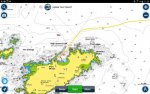
From our passage (data from navionics app) on 21-Aug in a 35ft sailing boat;
24miles
3hours
Left berth at 0930 (HW Dover -2) ish
Went 3nm north of Cap de la Hague - would go further next time as a bit bouncy
Could have left later, as the tides pushing you into bray if you are so far north off Cap de la Hauge. If you check the tidal atlas offshore the tide is more west than SW at this point, so you will only go down the race if you are close to Cap de la Hauge and that would not be recommended.

I would suggest you work out course to steer nearly every hour as the tide changes as you approach CdlH. From Cherbourg keep in for the back eddy, then we pointed to the north west to get us up over CdlH, then north to get 3m off. Then point more or less at the light house so that boat speed+tide carry you close to the entrance. Beware of getting very close, but you don't want to miss the entrance...
 
I've done this a few times. Try to arrive at cap de la Hague at skackish water, i.e. Just as the main tide is changing from NE to SW. Can't remember what that equates to in terms of Dover but the tidal atlas will tell you. As others have said it's worth staying 5 miles north if you can. That is how you will get the most comfortable passage. It will still be a bit lumpy off C de la H although suprisingky calm once you are out past that waypoint.

+1 for crossing the race at slackish water.
 
Top