Checking potential collision course?

FB, the key to understanding the theory is COG .. collisions occur over the ground simultaneously to above it in the water

I think I may have thought how you are visualising this - so let me run it past you ...

You're taking a sighting down a line through the target vessel and to the shore - to visualise it say you're looking down a ruler or pointing an arm at the target (experience will negate this in the end) - you then look for the shoreline disappearing faster against the target vessel if it's going to pass in front or slower if it's going to pass behind. If it is constant (against your line of sight) then there is a collision course.

??
 
FB, the key to understanding the theory is COG .. collisions occur over the ground simultaneously to above it in the water
Your clutching at straws is becoming rather desperate. My proof umpteen posts ago (a hundred or so) referred to the tracks of the vessels, not to their courses, so we scotched this idea that the tide made a difference way back whenever it was.

You method works perfectly if one vessel is stationary.
And it appears to work over very short times and distances, particularly when both vessels are moving slowly. But at higher boat speeds, longer times, or over greater distances, the weaknesses that exist in theory become more and more evident in practice.

As for your offensive comment about my grasp of geometry and trig: it was not I that suggested that the bearing of a fixed object is always constant regardless of where you are. I think it was Winnie the Pooh that came up with the concept of an East Pole and a West Pole -- I presume you must have learned your navigation from him.
 
I think I may have thought how you are visualising this - so let me run it past you ...

You're taking a sighting down a line through the target vessel and to the shore - to visualise it say you're looking down a ruler or pointing an arm at the target (experience will negate this in the end) - you then look for the shoreline disappearing faster against the target vessel if it's going to pass in front or slower if it's going to pass behind. If it is constant (against your line of sight) then there is a collision course.

??

No.

If it appears to be 'eating' shoreline it will pass ahead of you. If it is 'regurgitating' shoreline it will go behind you. If it is not moving against the shoreline then there's a collision risk.

Because, effectively the target is not moving against the shore it is one part of a two-part transit (the other being the beach). You are on that transit and as it is not moving you are moving along it towards the target on a collision course. This, effectively, is the same as being on a steady bearing measured by a hand bearing compass, except that you can do it in an instant as opposed to taking and noting a series of bearings over a time period.
 
Last edited:
Your clutching at straws is becoming rather desperate. My proof umpteen posts ago (a hundred or so) referred to the tracks of the vessels, not to their courses, so we scotched this idea that the tide made a difference way back whenever it was.

You method works perfectly if one vessel is stationary.
And it appears to work over very short times and distances, particularly when both vessels are moving slowly. But at higher boat speeds, longer times, or over greater distances, the weaknesses that exist in theory become more and more evident in practice.

As for your offensive comment about my grasp of geometry and trig: it was not I that suggested that the bearing of a fixed object is always constant regardless of where you are. I think it was Winnie the Pooh that came up with the concept of an East Pole and a West Pole -- I presume you must have learned your navigation from him.

Lets just leave it, Tim my leetle rottweiler, before this degenerates into a real slanging match which will do neither of us credit.

You're talking absolute bollox when you refer to me talking about an east and west pole. I merely said that the magnetic pole was a fixed point on land which compass bearings referred to .


Edit, in fact your rewriting of what I actually said would have done Stalin credit.


The proof of the pudding is in the eating, after all
 
Last edited:
No.

If it appears to be 'eating' shoreline it will pass ahead of you. If it is 'regurgitating' shoreline it will go behind you. If it is not moving against the shoreline then there's a collision risk.

Because, effectively if it is not moving against the shore it is one part of a two-part transit (the other being the beach). Thus, it is on a steady bearing.

ok - I've tried ... but as I've said before - I don't believe this to be an accurate or reliable method of determining collision risk - it may well have worked for you, but I can think of plenty of instances where it doesn't and couldn't work - I've even experienced it not working myself - thus, if you are going to use it then you have to use it knowing the limitations - which (as I've said before) I guess you do - even if it is sub-consciously ..

You and I both know that (especially) when racing you don't think about the theory of determining collision, you glance or look at the target vessel and make split second decisions - our eyes are much better at this sort of thing without the brain's concious input.... perhaps your vision is automatically discounting the method when it doesn't work.

In Jimi's model - the vessels are on a constant bearing to each other - but have progressed equally against the ground - doing a sighting against the shoreline WILL show the shoreline to be eaten up - in a "short moment" it may be only slight - but it will be - yet there is still a collision risk.
 
In Jimi's model - the vessels are on a constant bearing to each other - but have progressed equally against the ground - doing a sighting against the shoreline WILL show the shoreline to be eaten up - in a "short moment" it may be only slight - but it will be - yet there is still a collision risk.


Correct, which is why it is important to look at 3 scenarios
1)Consant bearing
2)Pass close ahead
3)Pass close behind


The DIFFERENCE in the bearing lines scenario v. scenario speaks volumes.
 
You're talking absolute bollox when you refer to me talking about an east and west pole.
Did I really say you talked about an east pole and a west pole? Please show me where.

More to the point, perhaps you could show me how a line that passes through a moving vessel and a fixed point ashore can be on a constant bearing.

I can think of three special cases:
- when the "moving" vessel is actually stationary
- when the track of the moving vessel is directly towards the fixed point
- - when the track of the moving vessel is directly away from the fixed point

in all other cases, I suggest that the bearing of the transit between the vessel and the fixed point must be changing.

If you believe this to be wrong, perhaps you could explain the fallacy. A diagram representing a piece of chart showing the land and the vessel's position at different times would be helpful.
 
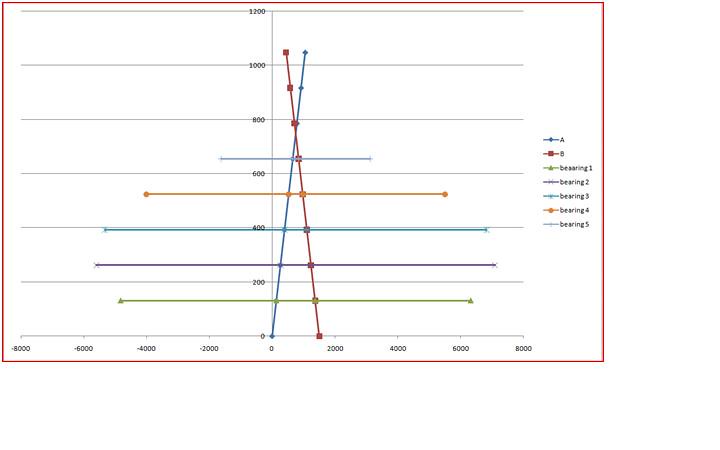
NOTE: courses plotted are COG not water track!! Scales are such to make things other than a small dot visible!

1) OK simple collision course

Bearing constant and “target boat” moves slowly forward against background land distance of land irrelevant although the further away it is the less it will be seen to move.
5418532922_7fa0994d7d_b.jpg


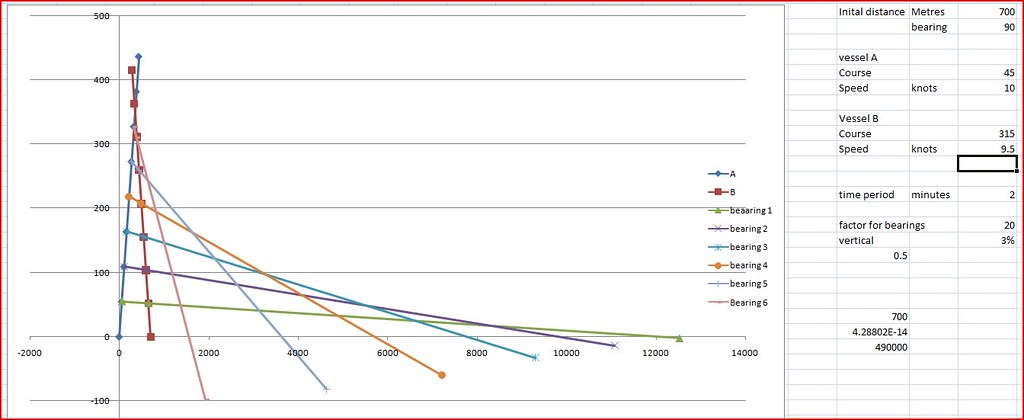
2) A slightly faster than B so will pass marginally ahead.
Now this plot is actually very illuminating
5428949257_8aeb5474bb_b.jpg


Bearing lines (or lines of sight) #1 & #2 intersect at 9000 meters thus if land is > 9000 distant from A then at this point B will start going backwards against the land.
In the same way
#2&3 intersect at 5500 metres etc etc
#3 &4 3500 metres etc etc
#4 &5 2000 metres etc etc
#5 & #6 at 500 metres

So in simple terms the further the land is away then the earlier that this method starts to work because it is past the intersection of the series of the lines of sight and the closer the vessels get then the greater the delta is and thus the faster the ground is eaten up.

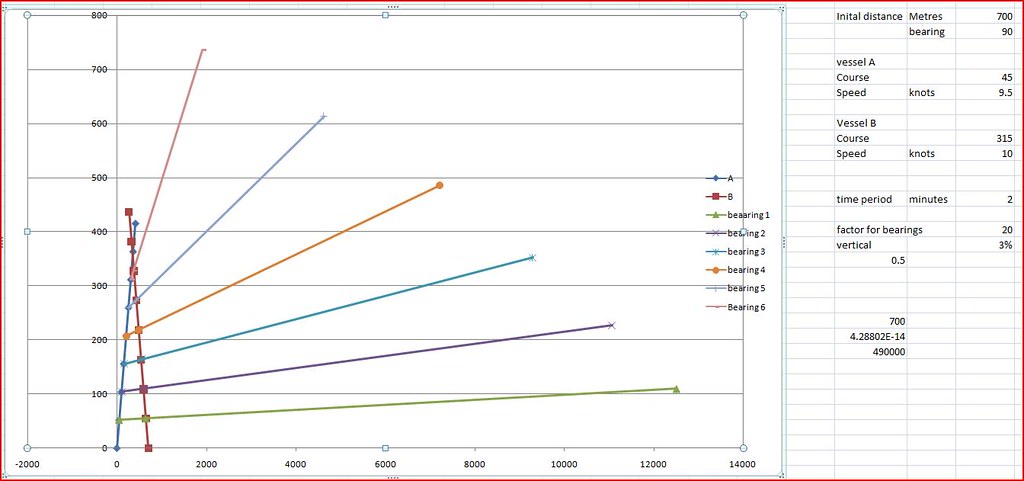
Now looking at the converse view from the vessel passing behind in the same scenario.

5429553514_322fc18092_b.jpg

Here we see that because the lines of sight (and bearings) are widening and thus the vessel passing behind will always see the vessel passing ahead moving forwards against the background land.

So in conclusion,the two areas of weakness are where:

1)Constant bearing shows both vessels to see each other to be moving slowly forward against the land. In reality the movement will be so slow that risk of collision will be assumed by both vessels to exist
2)Where land is close in which case the boat passing behind will see that, but the boat which would pass ahead will think it will pass behind until both boats are really close. This is the area where the greatest care needs to be taken.
 
Thanks for giving consice examples ... Nos 1 and 3 give the same visual effect - just the rate is different and will depend on the SOG as well as the relative speed of the target vessel.
No 2 is clearer - I'd want to play around with it (if I ever get the time!) - but I can't see when it wouldn't work at the moment.
 
Now imagine you are sailing at 2 knots, and the boat you are watching is doing about the same sort of speed, but the river you are in is flowing at say 6 knots. You think you can use the shore line then?
 
Now imagine you are sailing at 2 knots, and the boat you are watching is doing about the same sort of speed, but the river you are in is flowing at say 6 knots. You think you can use the shore line then?

Yes , read the first line on my last post if the land is distant. No (read the last line of my last post) if the land is close. Sigh
 
Last edited:
Ok - downloaded and messing around in Office for Mac - so not sure if it is working correctly ...

Looking at Example No 2 - the target moving backwards against the land... try the following figures:
Initial Distance - 300m
Vessel A - course 10 speed 8.2
Vessel B - course 300 speed 16
Time period 1 minute
factor for bearings 15
vertical 3%
(dunno what the last two are - but that's what it's set too.)
On my screen I think that shows the vessel moving backwards against the land - but after 5 minutes it's pretty close too if not a collision .. ?
 
NOTE: courses plotted are COG not water track!! Scales are such to make things other than a small dot visible!
This discussion (if one can call it that) would be a lot easier to follow if you would use (or at least recognise) conventional navigational terminology. Track is the direction a vessel is actually moving over the surface of the Earth. "Ground Track", "Course Made Good" and "Course over Ground" are all synonyms, but "Track" is the standard term.

Similarly, I understand the concept of scale, thank you. But I can see no reason why the vertical and horizontal scales in your diagrams have to be different: it simply confuses the issue and makes instant appraisal by eye almost impossible because angles areso grossly distorted.

But in spite of all this I note that we are at last getting close to an acceptance of reality when you write:-
1) OK simple collision course

Bearing constant and “target boat” moves slowly forward against background land distance of land irrelevant although the further away it is the less it will be seen to move.
Compare this with
If the vessel concerned is moing forward against the land I'll pass behind, moving backwards I'll pass in front, steady the collision course. This has worked without fail for me.
It seems that what used to tell you "without fail" that you would pass safely behind another vessel is now an indicator of a collision.

I am particularly heartened by the fact that you accept that there are two areas of weakness in your system:-
So in conclusion,the two areas of weakness are where:

1)Constant bearing shows both vessels to see each other to be moving slowly forward against the land. In reality the movement will be so slow that risk of collision will be assumed by both vessels to exist
2)Where land is close in which case the boat passing behind will see that, but the boat which would pass ahead will think it will pass behind until both boats are really close. This is the area where the greatest care needs to be taken.
In other words your system works fine except where :-
1) There is a risk of collision
2) One of the two vessels is likely to pass ahead of the other.

I'm a bit puzzled as to what circumstances it would work under, as these two scenarios between them seem to cover all the options, but please don't bother trying to explain.
 
Last edited:
I'm also leaving this discussion .. everything I and others have said have been consistent and I have nothing else to add to this discussion and I'm fed up reiterating the same points that some people seem incapable of digesting.

Fireball, I'm not referring to you, I'll be pleased to have a pint (or several) at anytime either to discuss this or anything else;-)
 
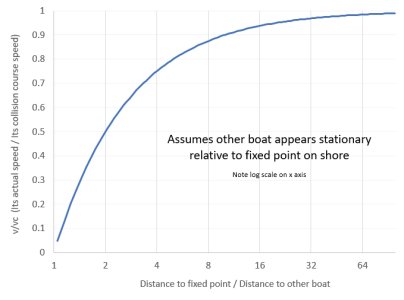
Sorry to resurrect this old thread, but I didn't see a more recent thread on the topic. Just to quantify things: If you and another boat are on intersecting courses, and the other boat appears stationary relative to some distant fixed point, then the ratio of its actual speed (v) to the speed it would need to have to be on a collision course (vc) is given by the formula:

v/vc = 1 - (distance to other boat)/(distance to fixed point)

Everything else—your speed, approach angles, etc.—all drop out.

So, for instance, if the fixed point is 20x further away than the other boat and it appear stationary relative to the fixed point, then v/vc = 1 - 1/20 = 0.95 . That is, its speed is 95% of what it would be if you were going to collide—so caution is warranted and the fixed-point rule is a good approximation.

Or, when the fixed point is even much, much further away and the other boat appears stationary relative to the fixed point, then v/vc approaches 1 (i.e. v≈vc) and this is essentially equivalent to the constant bearing rule.

However, if the other boat is, say, halfway between you and the fixed point and appears stationary relative to the fixed point, then v/vc = 1 - 1/2 = 0.5 . That is, its speed is only 50% of the collision speed and, if everything stays the same, you should pass in front of it (i.e. reach the intersection point first).
[In cases like this—where the fixed-point rule is highly inaccurate—it's when the other boat appears to be overtaking the fixed point that caution may be warranted.]

ScreenHunter 940.jpg
 
Don't you come in here with your clever mathematics!* The only way to settle this fight properly is for its participants to come back into this thread and admit how many collisions they've had in the intervening 14 years.


*actually I found it passably interesting
 
Don't you come in here with your clever mathematics!* The only way to settle this fight properly is for its participants to come back into this thread and admit how many collisions they've had in the intervening 14 years.


*actually I found it passably interesting
The problem is this forum is populated by old farts (self included). The post is almost 16 years old which is about the time it takes from first state pension payment to falling off the perch.

The OP's not been seen here for more than 5 years.
 
Top