
Cheap Chinese AIS Transponder ordering

I repeat, filtering class B is a myth and it does not make sense because the ColRegs apply regardless, so why would a large ship want to be blind to smaller vessels.

I think it was established some time ago that the AIS receivers on commercial vessels can't filter out Class B, but that they sometimes pass the information onto a plotter which can. So the information is always available on the bridge, but not necessarily on the screen being used.
 
I think it was established some time ago that the AIS receivers on commercial vessels can't filter out Class B, but that they sometimes pass the information onto a plotter which can. So the information is always available on the bridge, but not necessarily on the screen being used.

Let's try to be factual: please provide the list of plotters and point to the manual page that illustrates the capability to filter out Class B.
Without such list, it remains a myth.
 
Let's try to be factual: please provide the list of plotters and point to the manual page that illustrates the capability to filter out Class B.
Without such list, it remains a myth.

Sorry, I am only going on what I saw posted here some time ago by someone who claimed to be a commercial OOW. I suspect that the manuals for commercial bridge equipment are not available on line.
 
lauderdale_2-330.jpg


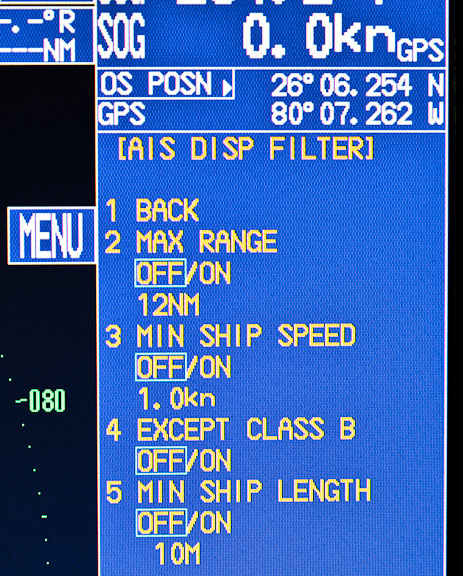
Not totally conclusive, but this is a screen shot of a Furuno 2117 radar showing the AIS display filter menu. Not only does it apparently show the ability to filter out class B, but also all ships under a certain length. Effectively giving the ability of filtering out ?all? leisure vessels.

But deeper investigation may show that this is a method of 'hiding' the targets but not actually stopping them being tracked.... in the event of a potential collision, the alarms will still go off.
 
Last edited:
Facts are chiels that wina ding! ...........
Page 61/62 of http://sportboards.bizland.com/sitebuildercontent/sitebuilderfiles/ce2_reference.pdf

AIS Options
Tools > Options > AIS

Vessels

Show Tracks
causes a track to appear for each vessel picked up by the AIS receiver. The length of the track (in time) can be set with the Track Length option.

Show Predictors causes each vessel to display a predictor line indicating approximately where the vessel will be if it maintains the same course and speed for a period of time. The predictor time used for AIS vessels is the same as the time set for your own boat in the Boat Properties.

Show Vessel Names causes the names of vessels to appear near their symbol on the chart. (Coastal Explorer will attempt to prevent names from overlapping and causing too much clutter, so some vessel names may not appear even when this option is enabled.) When this option is disabled, you can selectively display the names of some vessels by right-clicking on a vessel and selecting the Show Name option.


Show Vessels with Class B Equipment can be used to show or hide vessels that are using Class B AIS Transponders. Normally this option should be enabled, but it can be used to help reduce chart clutter in areas with many smaller vessels.
 
I think that this myth of filtering out Class B has been clarified as a myth in a recent post by a professional in the scuttlebutt forum. No instrument commercially available is able to even tell if a signal is Class A or B. Technically the only way to know is to look at the NMEA raw data.

lauderdale_2-330.jpg


:

Not totally conclusive, but this is a screen shot of a Furuno 2117 radar showing the AIS display filter menu. Not only does it apparently show the ability to filter out class B, but also all ships under a certain length. Effectively giving the ability of filtering out ?all? leisure vessels.

But deeper investigation may show that this is a method of 'hiding' the targets but not actually stopping them being tracked.... in the event of a potential collision, the alarms will still go off.

Facts are chiels that wina ding! ...........
Show Vessels with Class B Equipment can be used to show or hide vessels that are using Class B AIS Transponders. Normally this option should be enabled, but it can be used to help reduce chart clutter in areas with many smaller vessels.
[/COLOR][/SIZE]

There's nothing like peer review is there! One chap says it can't POSSIBLY be done, then along come another two to say well actually... :)
 
You're emailing China, they're about 8 hours ahead of us. I always got near instant replies if I emailed before 8am. After that I had to wait until the next day. Still there may be other reasons. My unit arrives Tuesday, I'll update with photos of it in action.
 
Show Vessels with Class B Equipment can be used to show or hide vessels that are using Class B AIS Transponders. Normally this option should be enabled, but it can be used to help reduce chart clutter in areas with many smaller vessels.

OK I am convinced now. Many thanks to those who have reported the facts.

Frightening however.
 
OK I am convinced now. Many thanks to those who have reported the facts.

Frightening however.

At the risk of raising Guapa's ire, it does further add to the lack of relevance of class B transponders. But I think the unit is more than worth it without the transponder. Tracking shows it arriving tomorrow - so I'll hook it up at the weekend and report back.
 
What is not clear is if by filtering out the class B transponders, at the radar/plotter screen, that disables the collision detection or not. If it doesn't, then happy days, they will still get a bridge alarm if there is a potential collision issue. If not, gulp!
 
Remarakably so. But for it's identical twin, see this http://www.furunousa.com/products/productdetail.aspx?product=GP33 who made which first? Or does one factory make both for two different prices...

Actually when you compare the GP-33 and the Matsutech HP-33 there are very considerable differences in spec.
The Furuno has CANBUS and NMEA2000 outputs - the Matsutech doesn't.
The displays are very similar but not quite the same so at least the driving software is different. Same pixel count.
The Mats claims 50 channel receiver, 32 secs cold start, the Furuno 12 channel, <90 secs cold start.
The case dimensions on drawings are not quite the same, a few mm difference. They certainly look the same.
The Furuno is made in China.

So they aren't the same.
They still may come out of the same factory - who can tell?

The Furuno GP-32 looks identical to one of the ONWA ones (I haven't compared the specs), and ONWA and Matsutech are linked in some way, they both seem to be alter egos of Huayang.

Oh what a tangled web!
 
Top