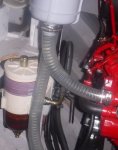
Chasing source of air in diesel

Thee things wrong with Racor. Over here, over priced and over rated. Changed thousands of CAV, Lucas, Denso never had a problem.
There is most peoples problem, they don't change thousands we change one, once a year. And then they are usually tucked away in some vomit inducing corner of the boat (lets not even mention doing it at sea). Why make life difficult? My CAV was neatly tuck under the rear bunk and getting to it was a contortionists nightmare. Having changed to a "top loader" and moved it to somewhere more convenient changing filters is not difficult.
 
Take absolutely nothing for granted! Fit new washers. Don't assume that components are OK, examine each one minutely for defects. ... You will find your air leak!

That!

A cure I once effected to seal a particularly well hidden air leak was to replace the copper washers at the banjo unions with dowty washers; which reminds me that our Yanmar had a dowty washer rather than a copper one (presumably as standard?) to the fine filter housing's bleed screw, is that still there/been changed/damaged?
 
I once had awful problems with a Yanmar 2QN15 engine where the surplus fuel from the injectors was fed straight back into the filter bowl and then back to the injector pump. Re-routing the surplu fuel back to the fuel tank eliminated the problem completely as aeriated fuel had time to lose its bubbles in the tank. A well know problem on old Yanmars. Probably not your problem but woth thinking about this or similar issues.
 
I once had awful problems with a Yanmar 2QN15 engine where the surplus fuel from the injectors was fed straight back into the filter bowl and then back to the injector pump. Re-routing the surplu fuel back to the fuel tank eliminated the problem completely as aeriated fuel had time to lose its bubbles in the tank. A well know problem on old Yanmars. Probably not your problem but woth thinking about this or similar issues.
Interesting
 
I changed my CAV to spin-on. What a difference! I no longer have to leave a bucket underneath to catch the drips. Being bigger, it doesn’t get blocked up as often.
 
I once had awful problems with a Yanmar 2QN15 engine where the surplus fuel from the injectors was fed straight back into the filter bowl and then back to the injector pump. Re-routing the surplu fuel back to the fuel tank eliminated the problem completely as aeriated fuel had time to lose its bubbles in the tank. A well know problem on old Yanmars. Probably not your problem but woth thinking about this or similar issues.
I'm not sure why feeding the return back to the filter was ever thought to be a good idea?
As a bit of an aside, I've just refurbed the fuel system of a fuel injection motor bike, there's a 'degasser' in the return line, a little plastic cylinder with one inlet and two outlets.
 
I suspect some of the above filter problems may be down to too little use.
I used to burn 100lts/day. One inverted cone shaped tarnsparent bowl, where the muck sits right on the drain screw unlike the dastardly CAV glass bowl type, and the two Crosland/Delphi between lift and injector pumps. Very little trouble.
 
Returning to this thread after a while.
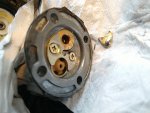
As part of winter maintenance I thought to check the lift pump as I was running out of things to check.

There was actually something wrong there:
IMG_20211212_112224.jpg

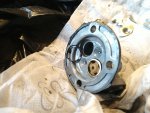
One way valve (the intake side) not held in place because of a broken thinkghy and the extremely thin gasket not fitting correctly and damaged:
IMG_20211212_115414.jpg

This might have been this way forever...

Curious if I will notice the difference.
This is not something i'd expect from Japanese parts.
 
Revisiting...

Last year the engine was slow to react to throttle lever input, which was at an inconvenient moment so startled me a bit. But it picked up shortly after and gave no trouble after this. But this did put a dent my thoughts on reliability again.

I just realized that I might have left out a detail in my reasoning that might actually be crucial.

The breather tube is long. And the lowest part of the path is above the connection to the tank. And there is a coupling at that point where I have drained a bit of diesel, I think twice in owning the boat.

How hard would it be for the engine to lift that diesel far enough for the breather line to burp the tank full of air at normal pressure again?
Is it the lift pump that has to do the heavy lifting?
Is it likely that rpm fluctuations heavily depends on:
- the amount of fuel in the breather line (more fuel leading to stronger drop in rpm)
- the amount of fuel in the tank (more fuel/less air leading to shorter frequency of rpm fluctuations)

I just checked the line and there is no diesel in it, so last years slow throttle response must be different, but the trips with rpm fluctuations that I recall all were on stretches of long motoring. And the ways of fluctuating were different in rhythm and depth of rpm drop.
 
Top