
West Coast
Well-Known Member
Hi all, been considering this question for a few months now, reading threads and consulting manufacturers websites, so think I have a way forward. But before proceeding, would appreciate comments and advice if I have this correct.
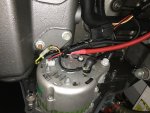
System is 12 volt. Alternator is an Hitachi, 80 amp (fitted to Yanmar 54hp engine). Alternator seems to use an internal regulator, although I have not been able to identify all the wires on the back of the alternator (see piccie), I am wondering what the yellow one is, perhaps sensing battery voltage?
Alternator output is taken to a battery isolator, RCE 100-1E-3IG which is a electronic device of some kind with claimed very low voltage drop. The isolator has 3 outputs, which are used as follows:
A Single Engine battery, lead acid sealed 110Ah
B House batteries, 4 number, each lead acid sealed 110Ah
C Bow thruster batteries, 2 number, each AGM 50Ah (high current rating).
The system runs OK, but my objective is to charge the house batteries more quickly.
I fitted a Mastervolt Battery Monitor system last year so I could monitor what was going on. It has a simple voltage reading on Engine and Bow Thruster batteries (which are normally at rest) and current/voltage measuring on the House Batteries, also giving a % full reading.
If the house batteries start at say at 95%, overnight at anchor they can fall to around 75%. As you would expect, when engine is started, there is healthy current into the house batteries of initially around 30 - 35 amps. However this quickly falls to only around 15 amps (say 80% full) and then around 7 amps (90% full)
I understand the principles here, as the batteries become closer to fully charged, voltage rises and charge current falls. However, to charge the house batteries from say 75% full to 85% full takes around 2 hours and 85% to 95% takes around a further 4 hours.
I considered a smart controller on the alternator, but given I have mixed battery types and 3 battery sets with the isolator, this to me seems the wrong approach. I also considered a larger alternator, but this also seems wrong. I have reached the conclusion that the best approach would be to fit a Battery to Battery charger, with its input connected to the House Battery output of the isolator and output to the house batteries.
Does this seem the best plan? Should I be looking for a Battery to Battery charger, or an Alternator to Battery Charger (given I am not really charging from a battery, but an isolated output from the alternator)?
Cheers
System is 12 volt. Alternator is an Hitachi, 80 amp (fitted to Yanmar 54hp engine). Alternator seems to use an internal regulator, although I have not been able to identify all the wires on the back of the alternator (see piccie), I am wondering what the yellow one is, perhaps sensing battery voltage?
Alternator output is taken to a battery isolator, RCE 100-1E-3IG which is a electronic device of some kind with claimed very low voltage drop. The isolator has 3 outputs, which are used as follows:
A Single Engine battery, lead acid sealed 110Ah
B House batteries, 4 number, each lead acid sealed 110Ah
C Bow thruster batteries, 2 number, each AGM 50Ah (high current rating).
The system runs OK, but my objective is to charge the house batteries more quickly.
I fitted a Mastervolt Battery Monitor system last year so I could monitor what was going on. It has a simple voltage reading on Engine and Bow Thruster batteries (which are normally at rest) and current/voltage measuring on the House Batteries, also giving a % full reading.
If the house batteries start at say at 95%, overnight at anchor they can fall to around 75%. As you would expect, when engine is started, there is healthy current into the house batteries of initially around 30 - 35 amps. However this quickly falls to only around 15 amps (say 80% full) and then around 7 amps (90% full)
I understand the principles here, as the batteries become closer to fully charged, voltage rises and charge current falls. However, to charge the house batteries from say 75% full to 85% full takes around 2 hours and 85% to 95% takes around a further 4 hours.
I considered a smart controller on the alternator, but given I have mixed battery types and 3 battery sets with the isolator, this to me seems the wrong approach. I also considered a larger alternator, but this also seems wrong. I have reached the conclusion that the best approach would be to fit a Battery to Battery charger, with its input connected to the House Battery output of the isolator and output to the house batteries.
Does this seem the best plan? Should I be looking for a Battery to Battery charger, or an Alternator to Battery Charger (given I am not really charging from a battery, but an isolated output from the alternator)?
Cheers


