Changing Cutless Bearings & Shaft seals - what a horrible job !

superheat6k

Well-Known Member
Joined
10 Jan 2012
Messages
6,802
Location
South Coast
Visit site
I recall this was a bloody awful job on my Turbo 36, well I can assure things are no simpler on a Corvette 32 either.

Working hunched up through a small opening at the back of each engine knelt on the floor of the aft cabin and hanging into the bilge, to find most of the coupling assembly bolts (R&D Coupling) rusted and very very tight, the cutless bearings swollen and very stiff on the shaft at both upper and lower, extremely tight props, encrusted Allen bolts on the gator rope cutters, and one rounded cutless grub screw.

So far after ~ 8 hours attention I have: removed the props - 10 tonne hydraulic puller; removed the gland follower studs - locknuts (3), hacksaw blade and handle (1); R&D coupling bolts - impact wrench 14 (30 minutes), Dremel 2 (2 hours); output coupling retaining bolts - 3/4" drive socket with handle extension bars and a Houdini impression inside the engine bay !

To do:

Remove output couplings - puller, possibly hydraulic, to remove the couplings from their tapers (or else a hacksaw and two new shafts !!!).

Pull out shafts - fairy liquid and elbow grease

Pull out cutless bearings - purpose made puller

Remove the stuffing box seals and mount rubber tubes.

Then the simpler task of installing the new cutless bearings and PSS seals can commence. Still should be done by February.
 
Remove output couplings - puller, possibly hydraulic, to remove the couplings from their tapers (or else a hacksaw and two new shafts !!!).
Pull out shafts - fairy liquid and elbow grease
Pull out cutless bearings - purpose made puller
Remove the stuffing box seals and mount rubber tubes.
Then the simpler task of installing the new cutless bearings and PSS seals can commence. Still should be done by February.

Now there's the problem. No, it's nothing to do with dissimilar materials, stuck fastenings or the sheer inconvenience of small compartments on board, you simply aren't swearing enough at the job.

I'm sure if WD40 was relabelled 'profanity' they would sell twice as much and those pig-awful jobs would become easier.

So remember: More swearing = less struggling. I'm sure someone could produce a chart showing the relationships between the two for working at the aft end of all types of boats... :)
 
Having had to replace both shafts, one due to crevice corrosion the other due to a encounter twixt propeller and a hard surface.
You obviously knew about those rinky dinky little grub screws hidden away under the anti-foul.
Can fully appreciate your delight at not having to do it again,hopefully for decade or two.
 
You are lucky you only have to remove your prop shaft when it needs repair.

We have to remove our prop shafts every 4 years for it to be inspected by a surveyor. This means I have to lift my engine to draw the shaft inside the boat.
 
I'm in the process of fitting a PSS seal to replace the old stuffing gland, so I feel your pain!

I can't use any of the edge seals because the shaft is worn just where they need it to be perfect. In an ideal world, I'd change the shaft and use a Radice gland, which would be significantly cheaper, but getting the shaft out is like those jobs in the Haynes manual where you look at it quickly and think, only one page, that's not too bad. Then you realise the first line is "Remove the engine - see section 3"
 
When fitting our bearings they are made as a clearance fit in the carrier so there is no squeeze of the ID dimension. You can have a dry run installation and you can even check P bracket alignment, then coat in epoxy(low temp) and insert by hand.

Heat them to soften epoxy for removal.

Epoxy is also a good under water thread lock as used on our cutters, heat softens it and there is no water to start any corrosion process.
 
If the bearing you are using was made for a press fit it will have a bigger ID to allow for bore closure as it is squeezed in.
 
I'm in the process of fitting a PSS seal to replace the old stuffing gland, so I feel your pain!

I can't use any of the edge seals because the shaft is worn just where they need it to be perfect. In an ideal world, I'd change the shaft and use a Radice gland, which would be significantly cheaper, but getting the shaft out is like those jobs in the Haynes manual where you look at it quickly and think, only one page, that's not too bad. Then you realise the first line is "Remove the engine - see section 3"
If you have a worn shaft have you considered hard metal chroming - we use a firm in Trafford Park, Manchester that does an excellent job. The reason I'm chasing to PSS is I think they are excellent and I am fed up with a wet bilge consequent to a stuffing box seal.
 
The owners of some motorboats might want to be aware that should you have to remove a gearbox with those PSS seals installed , the boat probably will have to come out of the water.
With the basic seals you can drop the shaft back sufficiently to undo and withdraw the various shaft/gearbox bolts, then remove the gearbox and have enough shaft sticking out to pull the shaft back into the boat.
A Princess 330 with the PSS type seals had to come out of the water in order to remove and repair the geabox, in my case with similar engine/gearbox and basic seals it was a simple job to undo all bolts, push shaft back, remove gearbox and then pull back shaft into boat.
Believe there was also a forumite with a Corniche in Dover who had PSS seals fitted, company doing the work insisted that the was boat lifted ashore to work on gearbox.
 
Last edited:
The owners of some motorboats might want to be aware that should you have to remove a gearbox with those PSS seals installed , the boat probably will have to come out of the water.
With the basic seals you can drop the shaft back sufficiently to undo and withdraw the various shaft/gearbox bolts, then remove the gearbox and have enough shaft sticking out to pull the shaft back into the boat.
A Princess 330 with the PSS type seals had to come out of the water in order to remove and repair the geabox, in my case with similar engine/gearbox and basic seals it was a simple job to undo all bolts, push shaft back, remove gearbox and then pull back shaft into boat.
Believe there was also a forumite with a Corniche in Dover who had PSS seals fitted, company doing the work insisted that the was boat lifted ashore to work on gearbox.
If you have a R&D coupling then this removed and the gearbox output coupling half should give enough movement to clear the splines. I certainly managed to get the Twin Disc gearbox off one of my Turbo 36 TAMD60C without pulling the shaft. That required ~ 50mm astern clearance to disengage the splined input shaft from its engagement with the engine.

That said if you are careful it is quite straightforward to move the shaft back say 1/2" at a time because the seal compresses ~ 1" for normal service, but remains leak tight when static until almost all tension has gone from the rubber bellows. A means of holding the shaft back and the seal in tension would be necessary.
 
The boats concerned had the the D 41 coupled to the chocolate teapot MS4 reverse gear.
Just enought room with the standard stuffing box to withdraw flexible coupling/gearbox flange bolts, slide shaft back to remove gearbox and then to grip shaft and pull it back into boat.
Main worry be shaft sliding completely back out of stuffing box and water ingress while waiting for gearbox repair, in my case a couple of hefty hose clips ensured the shaft remained in situ for the few days required.
Shafts should not completely slide out of cutlass simply due to prop hitting rudder stocks ?.
 
Last edited:
I won the battle of the shaft side half couplings this morning !

They tried hard and fought gallantly all the way until they were both off. Just ordered a full set of new coupling unf high tensile bolts and nuts to suit the R&D coupling because the originals were mostly casualties of the battle.

Tomorrow the shafts will be withdrawn, and I am expecting yet another fight !

Then I can draw the Cutless bearings and remove the original stuffing box seal assemblies, so I can finalise sizes for the new PSS Seal and bearings. Hoping the shafts are OK where they pass through the old stuffing boxes, but I fear one may have crevice corrosion.
 
Crevice corrosion.
One of my shafts was constantly weeping no matter how frequently you adjusted it.
When for other reasons :( the shaft was drawn, it revealed a neat little moonscape of pits on the shaft inside the sterngland .The boat had been laying idle for some considerable time in a North Wales marina.
Replacement shaft from one of the usual outfits was eyewatering, demanded old shaft for comparison plus the cost of shipping back new shaft.
Fortunatly was able to source a length of 316 stainless which was cut and machined to size including taper/ thread/key locally.


Corrosion inside cutlass bearing

 
Last edited:
I won the war today, all battles now complete, at least as far as dismantling is concerned !

The starboard shaft has an area of crevice corrosion with some pits 2-3 mm deep where it passed through the stuffing box gland. The port has some minor crevices only which will be away from the new PSS seal or I can reverse the shaft.

However, this will not have unduly affected the strength so I am looking at either welding or hard chroming and re-grinding the affected area.

I will let you know how I get on.

IMG_1262.jpg


IMG_1263.jpg
 
I recall this was a bloody awful job on my Turbo 36, well I can assure things are no simpler on a Corvette 32 either.

Working hunched up through a small opening at the back of each engine knelt on the floor of the aft cabin and hanging into the bilge, to find most of the coupling assembly bolts (R&D Coupling) rusted and very very tight, the cutless bearings swollen and very stiff on the shaft at both upper and lower, extremely tight props, encrusted Allen bolts on the gator rope cutters, and one rounded cutless grub screw.

So far after ~ 8 hours attention I have: removed the props - 10 tonne hydraulic puller; removed the gland follower studs - locknuts (3), hacksaw blade and handle (1); R&D coupling bolts - impact wrench 14 (30 minutes), Dremel 2 (2 hours); output coupling retaining bolts - 3/4" drive socket with handle extension bars and a Houdini impression inside the engine bay !

To do:

Remove output couplings - puller, possibly hydraulic, to remove the couplings from their tapers (or else a hacksaw and two new shafts !!!).

Pull out shafts - fairy liquid and elbow grease

Pull out cutless bearings - purpose made puller

Remove the stuffing box seals and mount rubber tubes.

Then the simpler task of installing the new cutless bearings and PSS seals can commence. Still should be done by February.

This can't be right at all............Shafts are simple, with little or no maintenance required and no expense spent. You must be doing something wrong. I suggest you go back to shaft school and have extra lessons with the head, Mr Oldgit :D
 
Replacement shaft from one of the usual outfits was eyewatering, demanded old shaft for comparison plus the cost of shipping back new shaft.

Blimey, shafts and eye wateringly expensive in the same sentence, and from the man himself. What is happening with the world? It's gone mad I tell ya. ;)
 
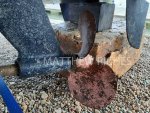
Had this job to do during the summer. A very sick shaft with numerous "rotten" parts but even more odd was the opposing propellor had gone slightly pink. Propellor cleaned up ok and still rings nicely but the shaft was ruined.

To save messing around I cut it into 3 pieces, all 10 foot of it. That enabled it to come away easily. Unbolted the inner coupling and then pressed it out with the big workshop press. Cutlass pulled out nicely once I'd dug out all the grub screws that had a good few years of antifoul in them.

I had a new double taper shaft machined and put back together although I kept the stuffing glands instead of deep sea seals.

20190624_175051-1024x768.jpg

20190624_175131-1024x768.jpg
 
Top