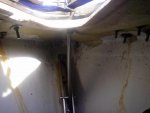
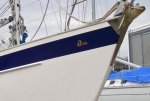
"Chainplate" for an inner forestay...

Kukri

Well-Known Member
Joined
23 Jul 2008
Messages
15,562
Location
East coast UK. Mostly. Sometimes the Philippines
Visit site
There is a U bolt just aft of the windlass for a storm jib but it goes to a bulkhead with an access hatch cut in it. I mistrust this and want to fit a stainless rod nutted over a plate buried in the stem and glassed over, with an eye on deck, or something similar (perhaps a very long stainless steel U bolt or "staple") The under deck section will be in the chain locker.

Has anyone else done this? Am I thinking straight?
 
on my previous boat I used the U bolt ends protruding under the deck to bolt in place a piece of angled stainless (similar to a large backing plate but with an attachment point under the deck).
Then made up a short wire strop with a bottle screw running from this down to the stem in line with the pull direction from the inner forestay.
Adjusted to a moderate tension on the basis that didn't want to pull the deck down and once the moveable stay was attached above it would be in tension anyway.
To be honest it was never tested to it's limit but I felt happy enough !
Martin
 
Thanks, Martin and Graham.

It seems I am on the right track. I will use a Highfield lever, and I am also adding a pair of runners from the upper cross trees, where the inner forestay will land, to Highfield levers in way of the cockpit, with another pair of extra chain plates for the turning blocks.

( I think that, before the mast is unstepped,I should remember to make a plywood template for the angle of the proposed new inner forestay...)
 
Last edited:
You might also want to consider a double folding padeye, like in this photo. That will give you a separate anchor point for the sail tack. This is from Wichard, who also make a matching saddle fitting that takes the fore and aft bolts under the deck.
padeye.jpg
 
My advice is do not load the deck, take the load down to the hull either directly via a rod or via an existing bulkhead that has good contact with the hull and deck, especially where the hull meets the deck.

Whilst its true that the forestay due to the angle is generally under less static tension than the caps or lowers, its also the case that the forestay (inner and outer) is more subject to dynamic and shock loading, such as when clobbering into waves etc.
Such shock loads on a deck fitting is bad news.

I wrote an article in PBO a couple of issues back on chain plates, whilst primarily dealing with caps/inters chain plates the methodology of transference of loads remains the same.
 
My advice is do not load the deck, take the load down to the hull either directly via a rod

I totally agree (if referring to my photo i previous post). Transferring the load to the hull is crucial, that is why the saddle fitting under the deck comes in handy.
 
I totally agree (if referring to my photo i previous post). Transferring the load to the hull is crucial, that is why the saddle fitting under the deck comes in handy.

Yes, it's the snatching load on a a fairly heavy section mast whilst pitching that makes me want to fit the inner forestay and runners.

I think I will be buying that Wichard fitting and its associated saddle - they have - as so often with Wichard - thought about it!
 
There is a U bolt just aft of the windlass for a storm jib but it goes to a bulkhead with an access hatch cut in it. I mistrust this and want to fit a stainless rod nutted over a plate buried in the stem and glassed over, with an eye on deck, or something similar (perhaps a very long stainless steel U bolt or "staple") The under deck section will be in the chain locker.

Has anyone else done this? Am I thinking straight?
The shroud chainplates on most boats, certainly the older designs, are attached to bulkheads with doors cut in them. The Highfield Lever does not apply a huge amount of tension to the removable backstay. Neither does the jib halyard. In the unlikely event that the bow fixing for the removable forestay should fail, the forestay will continue to do its job, so the mast will not come down.
 
Last edited:
The shroud chainplates on most boats, certainly the older designs, are attached to bulkheads with doors cut in them. The Highfield Lever does not apply a huge amount of tension to the removable backstay. Neither does the jib halyard. In the unlikely event that the bow fixing for the removable forestay should fail, the forestay will continue to do its job, so the mast will not come down.

But the shroud chainplates go to the upper outboard corners of the bulkheads so they have a lot of triangulated rigid structure to keep them in place, whereas my forwardmost bulkhead has the cut out right below the amidships attachment point.
 
There is a U bolt just aft of the windlass for a storm jib but it goes to a bulkhead with an access hatch cut in it. I mistrust this ...

The bulkhead should be a very effective way of distributing the load to the hull, and as long as the access hatch hole doesn't have particularly sharp corners there shouldn't be any stress concentrations to worry about.
 
There is a U bolt just aft of the windlass for a storm jib but it goes to a bulkhead with an access hatch cut in it. I mistrust this and want to fit a stainless rod nutted over a plate buried in the stem and glassed over, with an eye on deck, or something similar (perhaps a very long stainless steel U bolt or "staple") The under deck section will be in the chain locker.

Has anyone else done this? Am I thinking straight?
Would it not be easier to reinforce the bulkhead and keep the existing arrangement? A glassed in bulkhead is very strong
 
You might also want to consider a double folding padeye, like in this photo. That will give you a separate anchor point for the sail tack. This is from Wichard, who also make a matching saddle fitting that takes the fore and aft bolts under the deck.
padeye.jpg
Hi - I am looking at doing something similar. Is this on a hallberg rassy? Are you able to share photos from below please?! Thank you!
 
Hi - I am looking at doing something similar. Is this on a hallberg rassy? Are you able to share photos from below please?! Thank you!
This is how it looks under deck.
From top down: The saddle fitting matches with the fore and aft bolts of the double folding pad eye fitting. Inbetween is a sheet of stainless steel with some thickened epoxy on top, to spread some of the load on the underside of the deck. Then follows a normal rigging screw. This in turn is attached to a loop of dyneema (8mm from memory) which passes through two 10mm eyenuts, either side of the stem, which are through-bolted of course.
Since this photo was taken the clevis pin + ring where to rigging screw joins the dyneema has been replaced with a 10mm bolt + nyloc, in order to counter the spreading force on the clevis fork.
IFS%20anchor.jpg
 
I also used a double padeye - with a single padeye bolted internally back to back with a large ply pad to spread the deck loading. Then a single U bolt on the chain locker bulkhead connected with a rigging screw to the single padeye. The U bolt had a large ply pad internally in the chain locker to again spread the load.
 
Hi - I am looking at doing something similar. Is this on a hallberg rassy? Are you able to share photos from below please?! Thank you!

My last boat was an HR352 with an inner forestay fitting. The fitting consisted of a robust stainless strip which went through the deck and was fitted into a U-shaped stainless section bolted to the hull. There was a stainless plate on the stem which the bolts fitted into.

inner.jpg

inner2.jpg
 
This is how it looks under deck.
From top down: The saddle fitting matches with the fore and aft bolts of the double folding pad eye fitting. Inbetween is a sheet of stainless steel with some thickened epoxy on top, to spread some of the load on the underside of the deck. Then follows a normal rigging screw. This in turn is attached to a loop of dyneema (8mm from memory) which passes through two 10mm eyenuts, either side of the stem, which are through-bolted of course.
Since this photo was taken the clevis pin + ring where to rigging screw joins the dyneema has been replaced with a 10mm bolt + nyloc, in order to counter the spreading force on the clevis fork.
IFS%20anchor.jpg
The threaded bolts of the ring nuts are loaded on sheer at 45 degr - that is not a favourable situation as the crevice effects of the threaded section reduces the sheer strength by half.
Using a flexible connection, such as the dyneema in this case, also increases the load on each ring nut considerably.

The spreading loads on the turn buckle fork you have already noted and addressed.

It would be better to replace this arrangement with a single welded construction.
 
The threaded bolts of the ring nuts are loaded on sheer at 45 degr - that is not a favourable situation as the crevice effects of the threaded section reduces the sheer strength by half.
Using a flexible connection, such as the dyneema in this case, also increases the load on each ring nut considerably.

The spreading loads on the turn buckle fork you have already noted and addressed.

It would be better to replace this arrangement with a single welded construction.

Good observation. Ray Wall, Camper and Nicholson and Halmatic supplied my boat with what as a former owner of wooden gaff cutters I will call a bobstay plate in reverse. A stainless steel plate built in towards the outer face of the stem anchors the stainless rod which passes through the forepeak in line with the inner forestay, passes through the deck and terminates at the Highfield lever on deck.
 
Top