Centre-plate lifting on dinghy

Cobra25

Well-Known Member
Joined
30 Nov 2004
Messages
366
Location
Pembs/Sussex/Wiltshire
Visit site
Hi, Anyone know a good method/bits to use to lift the centre-plate on a 16 foot boat. Plate weighs 50Lb-ish.

Main stopping point is what to use to go through hole in back of plate and what to use to lift plate as it appears through roller in Centre-plate box.

Advice/thoughts please.
 
For dinghies with these heavier metal centreboards there is usually a small block and tackle rigged to do the raising of the board and lowering to whatever depth/angle required.
If the board raises above the centreboard casing there is often a locating/locking pin on a chain that is fitted through a hole in the board. On my ol Uffa 12' National there was a stainless loop fitted to the base of the mast to which one block of the tackle was attached,the other end being fitted to the 'horn' of the plate thus working as a lever to raise it. Something like a kicking strap tackle with its own jammer would do the trick.If there is no hole already in the plate/casing for the pin retainer then make up a loop of strong shockcord,fit to each side of the casing and stretch over the 'horn' when fully retracted; this will prevent the plate from dropping down when out of the water.

Looking more carefully at your photo it would appear that to raise your board the tackle needs to be rigged aft rather than forward to raise the board.I suggest in this case you need to purchase a pair of rigging extenders with various hole settings and bolted through the holes in the plate . A 'u'bolt fitted through the aft bulkhead will then be the attachment for the other end of the tackle to be fitted.

ianat1
 
Last edited:
Sorry Cobra 25 I don't have one to hand; I last saw one used on the Devon Yawl which also has a metal plate also on the Drascombe Dabber and Lugger both use similar tackles. I'll google for some Drascombe/Devon Yawl layout drawings .

ianat182
 
You plate does seem to pivot backwards.
My clinker dinghy had a horn at the top of the plate which you simply pushed forward on and it pivoted around the (pivot) bolt. Then a pin in a hole prevented it falling down again. This way round if the plate touched the bottom it just swung up. Very useful for beaching.

Clinker%20Dinghy38.jpg
 
Back again! Didn't have much luck with the Google,however there is anothe method which I recall on a National 12ft where the c/board was raised and lowered using a 'winch'.
Now this method is more of a direct lift of the centre board.

Get a stainless steel rod of 12mm diameter and 150mm long. Drill one 3mm hole through the rod at 25mm from the end;drill a second 3mm hole 6mm from the firsthole;Change ends of the rod and drill one 3mm hole 25mm from the end of the rod; Now drill one 3mm hole 50mm from the end of the rod, and another 2 holes but 6mm diameter and 6mm from each other.
The wheel is normally made of Tufnol with a deep groove to take 4-5mm cordage and a few turns. The hub of the wheel is 12mm diameter and the rod is the axle. Drill one 3mm dia
hole through the hub of the wheel.Fit a stainless 3mm dowel through the hub and the axle
so that you have secured both at the 50mm position.This is your 'winch'
.
Obtain a piece of stainless steel sheet if possible 3mmthick ;Cut to a rectangle 300mm x 75mm. Mark off at 100mm from each end ; drill one 12mm hole at each end of the strip, at a central position and 25mm from the end. Drill 2 x 6mm holes in the central section ; Place rectangle in a vice and bend each end to a right angle so as to form a squared 'U'. This is the axle and winch support.

Obtain some galvanised steel wire that will pass through the 6mm hole on the axle,you'll need to judge the length,But I'd guess about 8ft would be ample,have a hard eye and crimp fitted at one end only.

Obtain some 4mm cordage, say about 3 metres . Fit the formed rectangle at a strong point of your aft bulkhead and bolt through with 6mmdia nutbolts and large washers. Fit the axle through the 12mm holes of the bracket, fit 12mmwashers and 3mm split pins to the outer end, each side of the bracket and repeat at the winch end of the bracket in the 3mm holes. The winch is now ready for the reeving of the galvanised wire. The bare end of the wire is threaded through the two remaining 6mm holes in the axle and forms a lock on the shaft . The hard eye end of the galvanised wire is shackled to two stainless steel rigging extension strips, and these in turn to one of the two holes already in the centreboard blade. Now drill a 5mm dia hole in the side of the wheel and pass the end of the 4mm cordage through and secure with a figure eight knot,then wind on as much cordage onto the winch as you can. Fit a small jamming cleat to take the pulling end of the cord.
You'll now have to try the raising and lowering afloat to make a final adjustment to length of wire and cordage.
Firstly wind onto the winch axle all the wire you can using the cord clockwise around the
wheel, then when board fully down put more turns on the wheel first, then pull on the cord to raise the plate until inboard, jamb off the cord.

I could have drawn the layout but haven't got my scanner working yet!

ianat182
 
Is the OP's photo really looking aft?

Never heard of a centreboard swinging forward to lift - ie you have to pull the part at the top aft

Me neither, it would mean that if you hit something unexpectedly there would be damage to the centrecase, rather than the plate swinging aft to cushion the impact.

I used to sail a Devon Yawl for many years, the plate was much heavier (about 180lbs AFAIR) it had a long "horn" at the top to which was attached the rasing/lowering system. AFAIK they all had a winch drum arrangement which might not be necessary for only 50lbs.
 
It does appear to be an aft shot. The outboard well and ss support for the clamps are to the right.
If the OP would tell us what design it is it might help. A forward hinged board/plate is def novel. (and why?) Or does it lift as in a dagger board?
DW

Ah, looked harder.. The hole is for a lifting strop on the rear edge of the plate, so front pivot. Problem here is the height of the retracted plate. If pivoted, then one is only lifting around half of the weight, so perhaps a wire strop with a rope tail (and gloves?) Otherwise, a raised pulley to turn the strop, with a tackle down to the hog. Not very pretty, but...
 
Last edited:
I think it is looking aft as the oar pins (rowlocks?)wouldn't allow you anywhere to sit if it was looking forward.
My Seahawk had a 70lb steel plate which you lifted pretty much from the other end from the pivot. It was manual lift with a wire strop and was pretty easy.

Seahawkcentreplate.jpg
 
I'd be inclined to think in terms of a stainless steel inverted 'U' running from one side of the centreplate box, over the top of the plate and back to the other side of the box. Suspend a tackle from the 'U'.
 
Hope this helps - there must be standard dinghy fitments but suppliers look at me as if I've just landed!

What's the boat? What were the original fittings like? Does the plate normally come as far us as shown in the photo (rowing would be uncomfortable) or is it just like that when it's on its trailer? There seem to be some ropes / strings attached to the plate: are they temporary or permanent and what are they for?
 
Thanks to all for the replies and apologies for tardiness due to business.

Yes photograph is looking aft

The small cord is near bottom of the plate and lifts in the same way as Lakesailor's drawing scan.

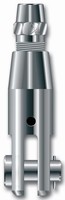
I need an odd shaped flat long shackle to go through the hole in the centre-plate with cord or wire through that shackle to use to raise it.

It will kick up if going aground and is fairly easy to lift without pulleys but as youngsters will use it, a less weighty system is preferred.

Thanks to all especially anat182 for detailed explanations, anat182 bit complicated for me!?

Any ideas where to purchase a flat, narrow shackle that will pass through the centre-plate slot in the bottom of the hull please. OR will a wire passed through do the job for a couple of years before needing renewal.
 
Two thin SS straps with cotter pins. Sized for the minimum length that allow you to put the split pin in. Top one sandwiches the loop in the strop end bottom one through the plate. You might find some dinghy chainplates long enough. 1mm would be thick enough.
DW
 
Top