Cathodic protection

mogmog2

Well-Known Member
Joined
12 Feb 2011
Messages
593
Location
Littlehampton
Visit site
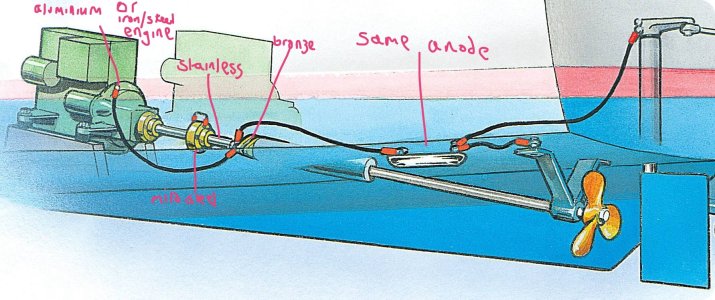
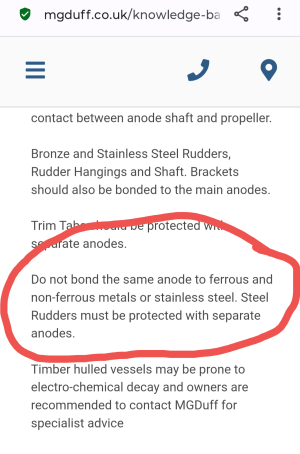
Cathodic protection. Never really given it much (enough) thought and just reading MGDUFF 's resources and saw this:

"Do not bond the same anode to ferrous and non-ferrous metals or stainless steel. ... must be protected with separate anodes."

Which is at odds with their diagram.

Do people really have multiple hull anodes to match the number if metals bonded? Or is it only the saline-bathed ones? Even so, that's still bronze and stainless.
Thanks
 

Attachments

  • Screenshot_20260429-072339.Opera.png
    Screenshot_20260429-072339.Opera.png
    260.6 KB · Views: 8
  • bonding.jpg
    bonding.jpg
    312.5 KB · Views: 9
You are right - that is a misleading diagram. No, sailing boats generally do not have multiple anodes, Normally just one to the shaft via the gearbox and coupling to protect the propeller if it is shaft drive or on the saildrive housing. Some MOBOs have rudders which are a mix of yellow metal and stainless and might have anodes as do trim tabs.
 
Countless boats have a shaft anode that protects the copper alloy propeller and the stainless steel shaft. Using an anode that by definition is more anodic than the cathodes, it corrodes preferentially, protecting the other two metals.

I think the wording may be poor, or taken out of context. It seems to be referring specifically to steel rudders. I don't know a reason why this should be so
 
Countless boats have a shaft anode that protects the copper alloy propeller and the stainless steel shaft. Using an anode that by definition is more anodic than the cathodes, it corrodes preferentially, protecting the other two metals.

I think the wording may be poor, or taken out of context. It seems to be referring specifically to steel rudders. I don't know a reason why this should be so
Thanks. It's poorly written "and Shaft. Brackets should also be bonded to the main anodes" I wasn't sure if they were only talking about rudders but the inclusion of "shaft and brackets" wobbled me. Either way, they're probably stainless or occasionally galvanised steel, and not bronze as the other bits are.
 
Where does a shaft anode at the prop fit in the scheme of things, if at all? Can it replace shaft bonding (to protect the propeller), or just augment it?
Does a strap bonding across the coupling remove any need for a shaft anode at the prop? (On a 26' boat, ie things aren't miles apart)
Neither Nigel Calder nor MGDuff resources* have answered this for me. Thanks
* who may have vested interests 🤔
 
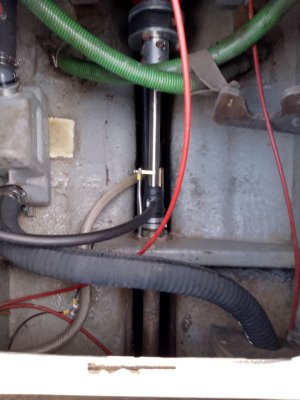
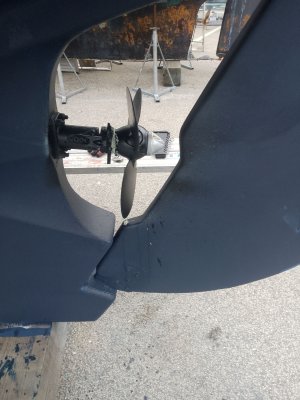
A shaft anode is often enough protection but usually only practical if tje boat has exposed shaft and a P bracket. A hull anode should be fitted close to the propeller. The wire to the gearbox housing is just to provide an electrical connection to the shaft. The wire over the coupling is ensure the electrical connection by passes the flexible part. There are other ways of providing that connection as in the photos of my boat. I have an anode on the propeller itself and a hull anode which is just out of sight on the left in the second photo.. The propeller one goes first because it is closest and the hull one is a back up. Much the same will happen with a shaft anode if a hull anode is also fitted..

Those are the principles of using anodes - close and in electrical contact with the item being protected (usually the propeller). How you achieve this depends on the boat.
 

Attachments

  • IMG_20231016_165203.jpg
    IMG_20231016_165203.jpg
    277.9 KB · Views: 4
  • IMG_20231023_134639 (1).jpg
    IMG_20231023_134639 (1).jpg
    444.4 KB · Views: 3
Sounds similar to the “cant mix alu and zinc anodes” jive, which Ive never understood/believed either
I think that in the past the voltages of the two were rather different, in which case the zinc might protect the aluminium while the boat metals were left to corrode. Nowadays the voltages of the two are very similar, so you would be correct.
 
Top